These retelling a story worksheets for 1st grade give teachers a set of printable graphic organizers built around the story elements first graders are expected to identify, sequence, and articulate. Each worksheet stands alone — teachers pair it with any picture book or leveled reader already in the classroom, so there is no required text and no scripted sequence. The formats covered are the two that dominate early elementary instruction: beginning-middle-end organizers and the 5-finger retell layout.
Concepts in Each Worksheet
The worksheets address story elements in the sequence that maps most closely to how comprehension develops at this age: students anchor to characters and setting first, then work through events, and only then reach for the problem and solution — the two elements that require more abstract thinking about cause and consequence. That ordering is not arbitrary; it follows the same gradual release pattern teachers use when modeling retelling aloud before asking students to write independently.
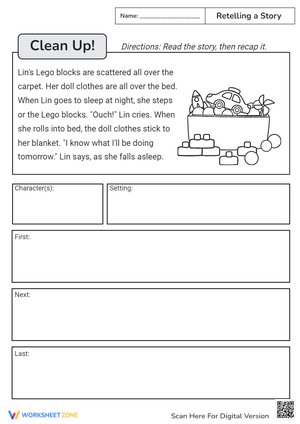
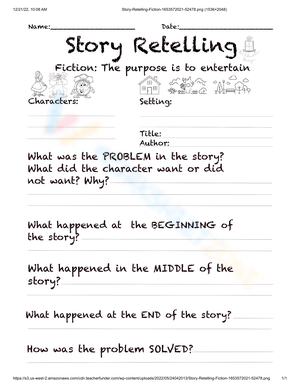
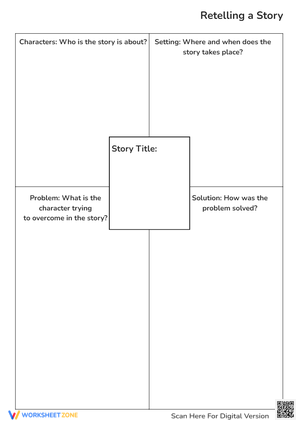
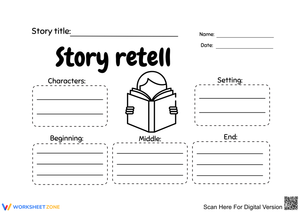
- Character and setting boxes with optional illustration space — drawing before writing activates text memory and reduces the gap between what students recall and what they can transfer to the page
- Problem and solution fields kept in separate boxes so students must distinguish the conflict from its outcome rather than writing one phrase that covers both
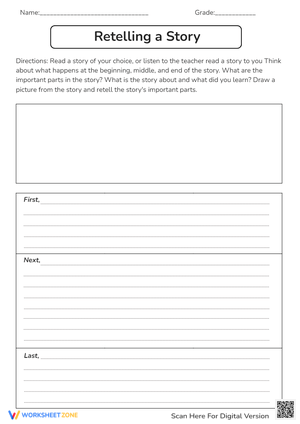
- Middle-event sequence sections with temporal prompts — first, next, then, finally — printed directly on the worksheet for students who need that language support
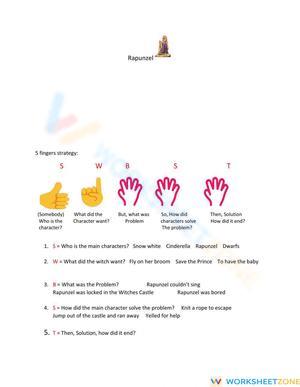
- 5-finger retell format — a hand outline with one story element per labeled finger; students write or draw inside each section
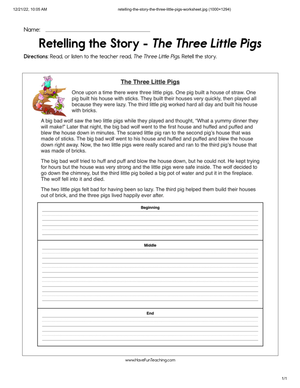
- Beginning-middle-end organizer — a three-box horizontal layout that mirrors the oral rehearsal step many teachers use before independent writing
Mistakes Students Make That These Worksheets Help You Catch
The most consistent error in first-grade retelling is middle collapse. Students who can name the characters and identify the problem will often jump directly to the solution, compressing everything between those two points into one vague sentence. After reading Chrysanthemum, a student might write: "She didn't like her name and then she felt better." The seven classroom scenes — the teasing, the counting of letters, the music teacher's intervention — disappear entirely. The dedicated middle-event boxes on these worksheets apply direct pressure against that habit: empty boxes communicate to the student that something is missing before the teacher says a word.
A second pattern worth watching for: students regularly write the setting inside the character box. "The school" ends up listed as a character while the setting field stays blank or gets something abstract like "outside." A brief whole-group discussion before independent work — asking students to name one character and one place, out loud, as two separate things — catches this before it gets repeated across multiple worksheets. Also expect students in October and November to restate the problem in the solution field rather than explaining what changed: "The problem was she was sad; the solution was she was not sad anymore" appears far more often than teachers anticipate, and it is worth addressing explicitly with a sentence frame that begins with The problem was solved when...
Lesson-Planning Ideas to Get the Most From These Worksheets
The highest-return use is during guided reading in small groups. After students finish a leveled text, distribute the organizer and have them fill it in before any group discussion begins. That sequence — silent independent work first, then conversation — reveals what each student retained on their own, before a stronger reader fills in the gaps for everyone else. It takes about eight minutes and produces cleaner formative data than a group retell alone.
For whole-class read-alouds, project the retelling a story worksheets for 1st grade format on a screen and model the fill-in before students work on their own copies. The oral rehearsal step matters here: have students turn and talk to a partner about what happened at the beginning before anyone writes anything. Students who say it aloud first produce more detailed and more accurate written responses than students who write cold — especially on the problem and solution fields, where the extra processing time helps them form a complete thought rather than a one-word answer.
Monday warm-ups after morning meeting, the last ten minutes of a Friday reading block, and literacy centers rotation all fit naturally. Because each worksheet pairs with a single text, teachers can assign different books to different reading groups and run the same organizer format across all groups — one format decision, differentiated execution by text level.
Standard Alignment
These worksheets align directly with CCSS.ELA-LITERACY.RL.1.2, which requires first graders to retell stories and demonstrate understanding of their central message or lesson. That standard anchors Grade 1 comprehension instruction because retelling is the observable evidence that a student has processed a text — not merely decoded it. The event-sequencing and problem-solution components also support CCSS.ELA-LITERACY.W.1.3, which calls for students to write narratives recounting two or more sequenced events using temporal signal words and a sense of closure. A retelling a story worksheets for 1st grade used as a planning tool for original narrative writing reinforces the connection between how published authors structure stories and how student writers can build the same architecture in their own drafts.
Adjusting the Worksheets for a Range of Learners
For students still developing writing stamina, the illustration spaces carry the weight. These students draw the character, draw the setting, draw what happened in the middle — then add a word or phrase beneath each picture. Do not press for full sentences before students are ready; labeled drawings are legitimate evidence of comprehension at this stage, and the oral retelling that follows the drawing is often more complete than what appears on the worksheet, which is useful information for the teacher.
On-level students work through the full organizer in writing, using the temporal prompts as sentence starters. For students who are ready to produce their own transitional language, cover the word bank with a sticky note — that small adjustment removes the support without altering the task structure. For students reading above grade level, extend the work after the organizer is complete: ask them to write two or three sentences that capture only the most important events, not every detail. That shift from sequencing-everything to selecting-what-matters moves toward the summarizing work they will encounter formally in second grade.
Frequently Asked Questions
What is the difference between retelling and summarizing at this grade level?
Retelling asks students to recount the story in sequence and in detail — beginning, middle, and end, with specific events named. Summarizing, introduced formally in second and third grade, requires a student to distill the text to its most essential idea in one or two sentences. First graders practice retelling because the detail-oriented, sequential nature of the task makes their comprehension visible in a way a short summary cannot. A retelling a story worksheets for 1st grade supports this by giving each event its own labeled space rather than collapsing everything into one open-ended box.
Can these worksheets be used with nonfiction texts?
The character, setting, problem, solution format is designed for fiction. For nonfiction read-alouds, the beginning-middle-end organizer transfers more cleanly — students record what the text introduced, what facts or details came next, and what they learned by the end. The 5-finger format adapts easily to nonfiction by relabeling the fingers: topic, detail one, detail two, detail three, and what I learned. A brief note on the board guides the adjustment; the printed worksheet itself does not need to change.
How often should first graders complete a written retelling worksheet?
Two or three written retelling sessions per week is a workable pace — enough repetition to internalize the framework, not so many that the organizer becomes mechanical. The daily work happens through oral retelling: asking students to recount a book they read the previous day, without a worksheet in hand, builds the same sequencing habit and functions as spaced retrieval practice. Written worksheets then serve as the formal checkpoint rather than the only vehicle for practicing the skill.












 Interactive Worksheet Maker
 Quiz Maker
 Word Search Maker
 Crossword Puzzle Maker
 Word Scramble Generator
 Sentence Scramble Generator
 Handwriting Worksheet Generator
 Name Tracing Generator
 Fill In The Blank Generator