These beginning middle end worksheets for 1st grade give teachers a concrete, ready-to-use tool for one of the most foundational comprehension skills in Grade 1 ELA. Each worksheet approaches story sequence through a different format — picture sorting, story map organizers, retelling frames, and personal narrative planners — so instruction can move progressively across a week without repeating the same task type each day.
What These Worksheets Cover
First grade is the point in a student's literacy development where oral storytelling begins to cross over into organized text comprehension. Children this age can tell you what happened in a story — sometimes in impressive detail — but isolating which event belongs at the beginning versus the middle is a different cognitive task. These worksheets train that distinction directly, through five formats that move from supported recognition to independent production.
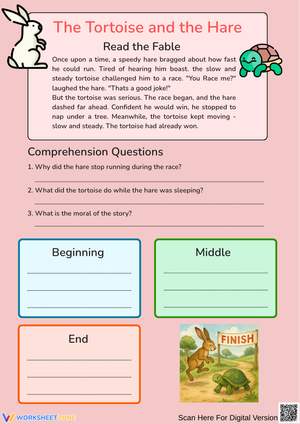
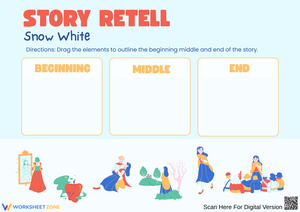
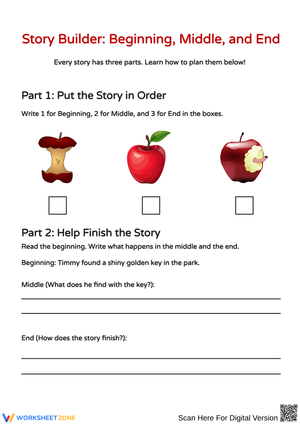
- Picture sequencing pages: Students number, cut, or arrange images into beginning, middle, and end order. This entry-level format lets teachers check comprehension without placing writing demands on emerging writers.
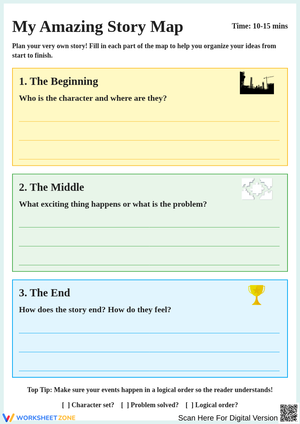
- Story map organizers: Three labeled boxes ask students to draw or write the key event from each stage of a shared text. They work well immediately after a read-aloud, when story details are still fresh.
- Retelling frames: Students complete sentence starters such as In the beginning... and At the end... to practice both sequencing and academic language at the same time.
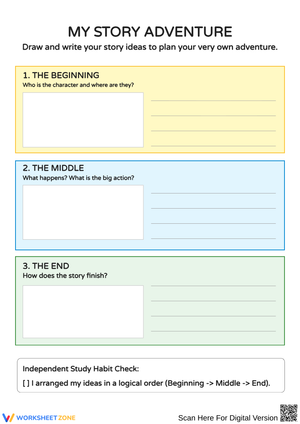
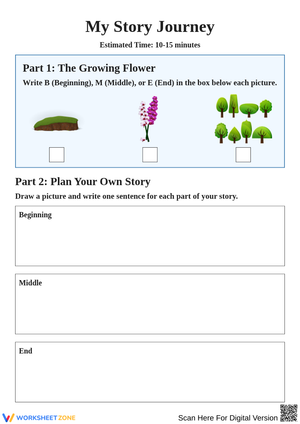
- Personal narrative planners: The three-part structure carries into writing instruction. Students plan a real event — a birthday, a morning routine, a trip to the library — before drafting sentences.
- Read-and-sequence pages: A brief passage is followed by a three-part organizer. Students identify and write the sequence from the text independently. This format belongs at the end of an instructional arc, once reading and retelling stamina are established.
The progression across these formats is intentional. Picture sorts reduce cognitive load enough for students to focus entirely on order. Sentence frames carry the language structure while students practice writing the sequence. Read-and-sequence pages ask students to hold the most in their heads — they belong in the second half of a unit, not the first lesson.
Mistakes Students Make That These Worksheets Help You Catch
The most consistent error in Grade 1 beginning-middle-end work is what teachers sometimes call the recency problem: students write whatever they remember most vividly from a story, regardless of where it actually fell in the text. A child who heard The Very Hungry Caterpillar will sometimes write "he became a butterfly" in the beginning box simply because the butterfly is the most striking image. That error reveals a student who understood the story's meaning without yet understanding its structure — comprehension and sequencing are related but distinct skills, and confusing them leads to very different instructional responses.
The second common problem is an overloaded middle. Students treat it as a catch-all for everything except the opening and closing sentences. You'll see middle boxes crammed with five events while the beginning box says "once there was a bear." Explicit discussion of what counts as the main middle event — not every middle event — sharpens the distinction quickly. A useful anchor question to ask aloud: "If you could only keep one thing from the middle, what would it be?"
A third pattern shows up on personal narrative pages: students open with setting description rather than an initiating action. "It was morning and I was at my house" is not a story beginning — it's background. Catching that habit early in first grade prevents the same pattern from reappearing in every narrative piece through second and third grade.
Building These Worksheets Into Your Lesson Planning
Used consistently throughout the week, beginning middle end worksheets for 1st grade fit into read-aloud follow-ups, morning work, literacy centers, and the writing block without requiring different directions each time — which is a real advantage when managing twenty-plus first graders through a daily schedule. The familiarity of the format is a feature: students spend less time figuring out the task and more time practicing the skill.
The most reliable approach is oral rehearsal before any writing. Read a short story aloud, ask students to turn and tell their partner what happened first, what happened in the middle, and how it ended, then hand out the worksheet. That five-minute conversation lowers the writing demand and helps students stay focused on sequence rather than struggling to recall the text while composing sentences. The talk comes first; the page records what they already know how to say.
- Monday morning work: A picture sort or retell organizer during the first ten minutes of ELA reactivates prior knowledge from Friday's read-aloud and settles students into the literacy block faster than a cold-start prompt.
- Literacy centers: Picture sequencing pages with cut-and-glue tasks run as independent station work once the format has been modeled in whole group. Partners check each other's order and explain their reasoning, extending oral language practice without requiring a teacher at the table.
- Small-group intervention: Complete the oral retell together before anyone writes. The worksheet functions as a recording sheet, not an assessment, which keeps the focus on the reasoning.
- Writing block pre-writing: Use a narrative planner as the step before students draft a short personal story. The organizer separates planning from drafting and reduces the cognitive load of doing both at once.
- Sub plans: A read-aloud paired with a clear story map organizer gives substitutes a complete, self-contained literacy task that needs no explanation beyond the page itself.
Standard Alignment
These worksheets directly address CCSS.ELA-LITERACY.RL.1.3, which asks first graders to describe characters, settings, and major events in a story using key details. Identifying beginning, middle, and end is the structural foundation underneath that standard — students cannot accurately sequence major events without first understanding that stories have a describable order. The personal narrative planning pages also address CCSS.ELA-LITERACY.W.1.3, which requires students to recount two or more appropriately sequenced events in writing. In practical classroom terms, that means this skill belongs in both the reading comprehension block and writing workshop, not only one of them.
Adjusting the Worksheets Across Different Ability Levels
Grade 1 classrooms typically contain three distinct groups on this skill: students who need picture support and oral rehearsal before anything is written, students who can manage sentence frames with a familiar text, and students who are ready to read a short passage and organize sequence without prompting. The formats in this set address all three without requiring three separate lessons.
For students still building oral retelling confidence, stay with picture sorts and story maps after shared read-alouds. Accept drawing as a written response — a labeled sketch in the beginning box shows the same understanding as a sentence and keeps the task accessible without signaling remediation to the student.
Students in the middle range move to sentence frame pages and retelling organizers. Give them the sentence starters but not the story events — they should generate the content independently. The frame handles language structure; the student handles the sequencing. That division is deliberate, not a shortcut.
For students who are ready to push further, beginning middle end worksheets for 1st grade extend naturally into more complex narrative work. Ask those students to include a second distinct middle event, identify the problem and solution within their structure, or explain in writing why the ending resolves what the beginning set up. The same worksheet format sustains the extension without requiring an entirely different task.
Frequently Asked Questions
How much writing should first graders produce on each worksheet?
One clear sentence per section is a realistic target for most of the school year. Some students will write two sentences; some will write a phrase alongside a drawing. The target is sequence accuracy, not length. Pushing for longer responses before writing stamina is ready creates frustration and obscures what these pages are actually assessing.
Do these worksheets work with stories above the Grade 1 reading level?
They often work better with a read-aloud than with a leveled passage students read independently. A picture book read aloud to the class gives every student access to the story regardless of individual reading level. Narrative clarity matters more than text difficulty here — one main character, one central problem, a resolution. That structure makes the sequencing task manageable for the full range of learners in a Grade 1 room.
How often should students practice before the skill sticks?
Two to three exposures per week during the initial instructional unit, then one brief review activity weekly once the concept is established. Spaced retrieval builds more durable retention than a concentrated two-week unit followed by nothing until the spring writing assessment. The beginning middle end worksheets for 1st grade in this set are short enough to serve as maintenance practice without overtaking the lesson.
Can these worksheets be used for personal narrative writing, not just reading comprehension?
The narrative planner pages are built for exactly that purpose. Students map a real event across the three-part structure before drafting, which separates the planning work from the writing work. First drafts that follow a completed organizer are consistently more organized than drafts produced without one — not because the organizer writes the story, but because it removes the need to plan and compose simultaneously.












 Interactive Worksheet Maker
 Quiz Maker
 Word Search Maker
 Crossword Puzzle Maker
 Word Scramble Generator
 Sentence Scramble Generator
 Handwriting Worksheet Generator
 Name Tracing Generator
 Fill In The Blank Generator