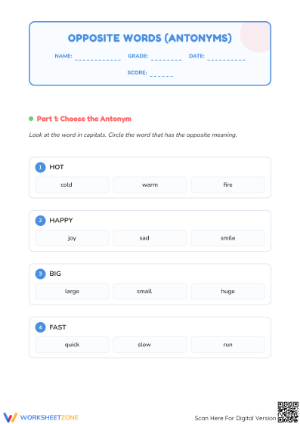
Enhancing Vocabulary Precision with Antonyms Worksheets
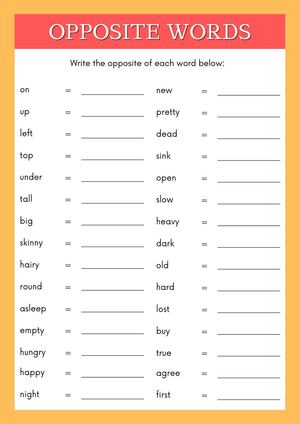
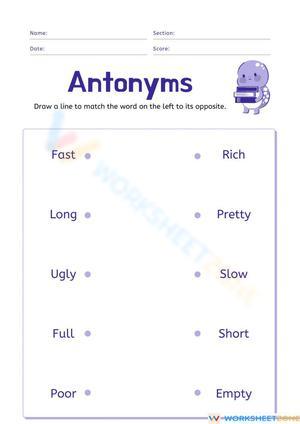
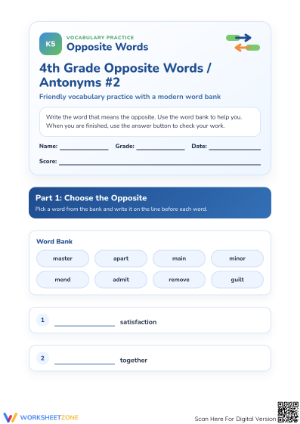
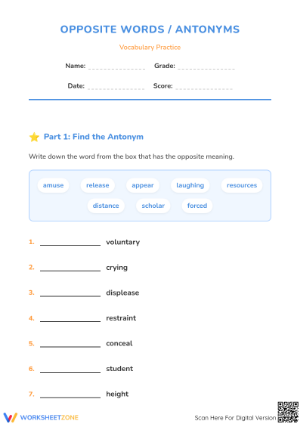
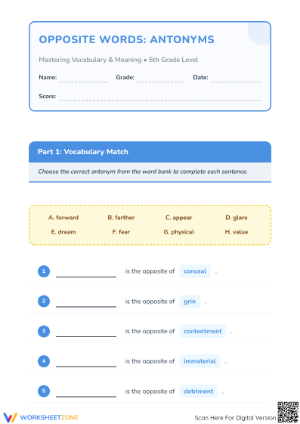
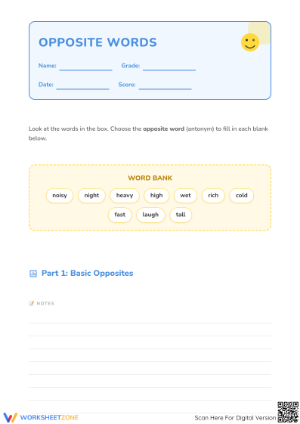
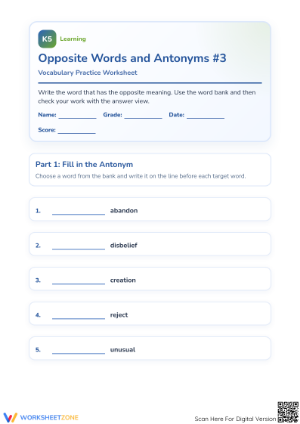
Building a deep vocabulary requires more than just learning new definitions; it involves understanding how words relate to one another. Antonyms, or words with opposite meanings, provide a vital framework for students to refine their language usage. By utilizing an antonyms worksheets, teachers can provide structured practice that helps students distinguish between subtle shades of meaning. This precision is fundamental when students move beyond basic communication and begin to express complex ideas in both speaking and writing. In the classroom, these resources serve as a bridge between simply recognizing a word and actually owning it within a personal lexicon for future use in various academic contexts.
Using opposite pairs allows students to categorize information more effectively. When a child understands that 'generous' is the opposite of 'stingy,' they are not just learning two words; they are learning a conceptual spectrum of human behavior. This binary association makes it easier for the brain to retrieve vocabulary during high-stakes tasks like creative writing or reading comprehension assessments. Teachers often find that starting with physical opposites, such as 'big' and 'small,' creates a solid foundation before moving into more abstract concepts like 'permanent' and 'temporary.' This progression ensures that learners at all levels can participate and find success as they build their word knowledge.
Improving Writing with Antonyms
One of the most significant benefits of practicing with antonyms is the direct impact on student writing. Many young writers rely on overused words like 'good,' 'bad,' or 'happy.' By providing them with antonyms worksheets options, teachers can help students expand their descriptive capabilities. Instead of writing that a character was 'not happy,' a student who has mastered antonyms might choose 'miserable,' 'dejected,' or 'somber.' This shift not only improves the quality of the writing but also helps the student convey a more accurate tone and mood to the reader through their choice of vocabulary, making their narratives more engaging and professional.
According to experts at Reading Rockets - Synonyms and Antonyms, explicit instruction in word relationships is a key predictor of later reading success. Their research indicates that students who receive direct teaching on how words relate through opposition show a 15% higher retention rate of new vocabulary compared to those who learn words in isolation. This data underscores the importance of using high-quality printable resources to reinforce these connections. By making these connections explicit, teachers provide students with the linguistic tools they need to describe their world with greater accuracy and depth in every assignment they complete.
Teacher Tips for Classroom Use
When implementing an antonyms worksheets in the classroom, several strategies can help ensure that the vocabulary sticks for the long term. First, always encourage students to use the antonyms in a sentence immediately after identifying them on the worksheet. Oral rehearsal is a powerful tool for moving information from short-term to long-term memory. Ask students to share their sentences with a partner or the whole class, providing immediate feedback on their usage. This turns a solitary worksheet activity into a social, communicative experience that reinforces learning and builds confidence in word usage while allowing the teacher to assess understanding in real time.
Second, consider creating an 'Antonym Wall' in the classroom space. As students complete their worksheets, they can choose their favorite pair of opposites to illustrate and post on the wall for everyone to see. This visual reminder serves as a reference point during writing time and celebrates the progress the class is making together. It also allows for quick retrieval activities during transitions between lessons. For example, the teacher can call out a word from the wall and ask the class to shout back its antonym. These quick bursts of retrieval practice are essential for building automaticity in word recognition and helping students feel more comfortable with complex language structures.
Growth and Assessment
Assessment is an essential part of any instructional cycle, and antonyms worksheets resources provide an excellent way to track student progress over time. A pre-test using a basic worksheet can help identify which students already have a strong grasp of common opposites and which may need more support. By the end of a unit, a similar worksheet can serve as a post-test to quantify growth. This objective data is invaluable during parent-teacher conferences or when discussing student progress with school administration, as it provides clear evidence of learning that is easy to understand and communicate to all stakeholders involved in the student's education.
Beyond formal testing, look for signs of incidental learning in daily interactions. Are students using more precise antonyms during class discussions? Are they correcting themselves in their writing? These are the indicators that the vocabulary is becoming integrated into their natural language. Analysis of student performance data suggests that the peak window for developing this semantic flexibility is between the ages of 7 and 10, when the brain is most receptive to learning the nuances of linguistic relationships. Missing this window can lead to a plateau in reading comprehension scores that becomes harder to correct in middle school, making early intervention and consistent practice with antonyms a necessary component of a successful elementary literacy program.
Overcoming Learning Challenges
Not every student will find antonyms easy to master, and it is important to recognize the common hurdles they might face during the process. For some, the difficulty lies in the abstract nature of many opposite pairs. Words like 'ancient' and 'modern' do not have clear physical representations that younger students can easily grasp. In these cases, it is helpful to use the antonyms worksheets in conjunction with real-world examples and stories. Finding these words in the context of a book the class is reading can provide the necessary moment of clarity for a struggling student who needs more support to connect the abstract concept with a concrete example from their experience.
Another common issue is the existence of multiple antonyms for a single word. As mentioned earlier, 'hot' can be paired with many different opposites depending on the context. This can be confusing for students who are looking for a single correct answer. Teachers can address this by teaching antonyms as a range or a scale rather than a single fixed point. Using a visual 'word thermometer' can help students see where different antonyms fall in relation to each other. This not only clarifies the concept but also introduces the idea of shades of meaning, which is an advanced literacy skill that will serve students well throughout their academic careers in various subjects as they encounter more complex texts.
Frequently Asked Questions
1. What is the simplest way to explain antonyms to kids?
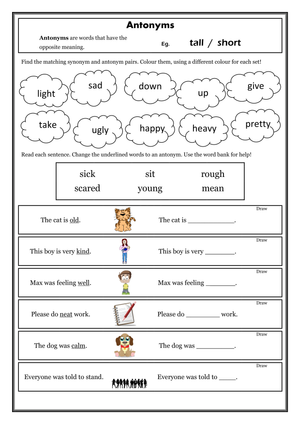
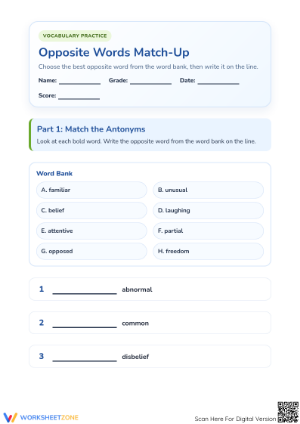
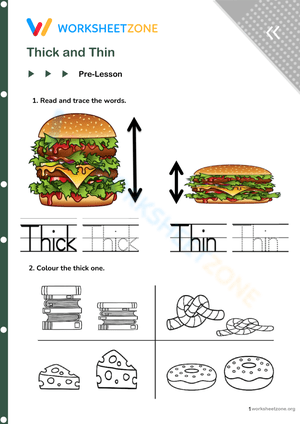
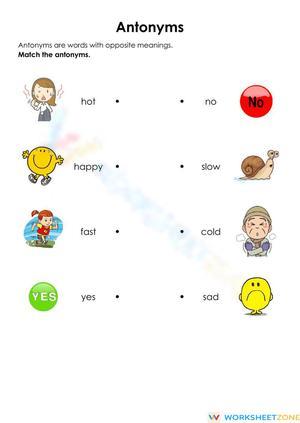
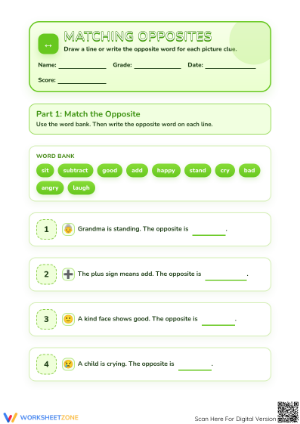
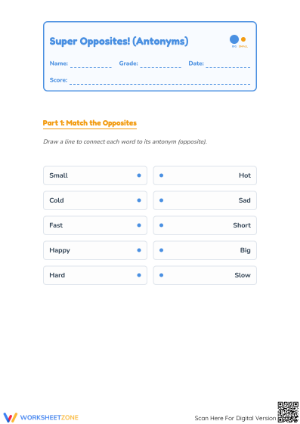
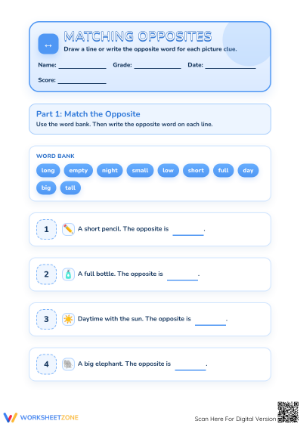
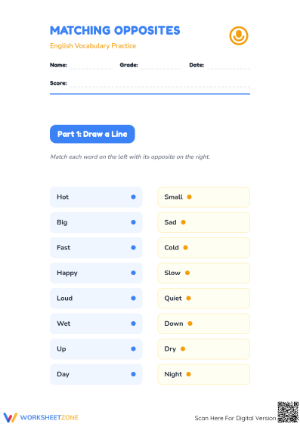
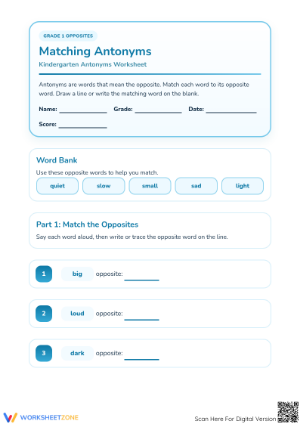
The easiest way to introduce antonyms to young learners is to describe them as opposite words. You can use physical examples that they can see and feel, such as up and down, big and small, or hot and cold. Once they understand the basic concept of things being the reverse of each other, you can start introducing more complex pairs of words. Using an antonyms worksheets with pictures is also a great way to make the concept more concrete for beginners who are just starting to explore vocabulary.
2. How are antonyms different from synonyms?
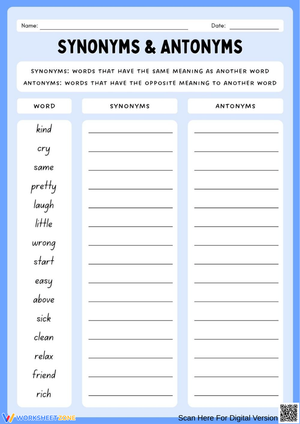
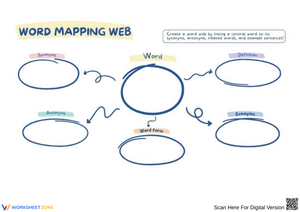
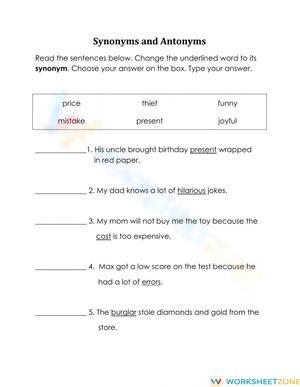
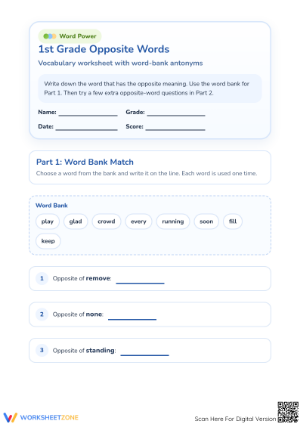
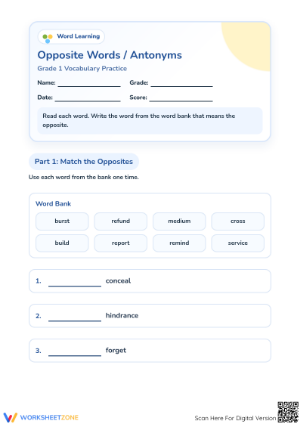
While antonyms are words with opposite meanings, synonyms are words that mean the same thing or something very similar. For example, big and large are synonyms, while big and small are antonyms. It is common for students to get these two terms confused, so it is helpful to teach them together and contrast the two types of relationships. Using worksheets that ask students to identify both the synonym and the antonym for a word can be an effective way to clarify the difference and build a more complete understanding of word connections.
3. At what age should students start learning antonyms?
Students can start learning basic antonyms as early as preschool or kindergarten. At this age, the focus should be on simple, physical opposites that they encounter in their daily lives. As they progress through the elementary grades, the complexity of the words should increase, moving into abstract concepts and more sophisticated vocabulary. By the end of fifth grade, most students should have a strong grasp of antonyms and be able to use them effectively to improve their writing and reading comprehension.
4. Can antonyms worksheets help with reading comprehension?
Yes, practicing with antonyms directly supports reading comprehension. When students understand word relationships, they are better able to infer the meaning of unknown words in a text. For instance, if they read that a character is the opposite of brave, and they know that the antonym of brave is cowardly or fearful, they can understand the character's state even if they have not seen the word used that way before. This ability to make connections between words is a critical component of successful reading and overall literacy development.
5. How often should teachers use these worksheets?
For the best results, antonym practice should be a regular part of the literacy curriculum. Using an antonyms worksheets once a week or as part of a daily word of the day routine can provide the consistent reinforcement students need to master the concept. However, it is important to vary the activities so that students remain engaged. Combining worksheets with games, oral practice, and writing assignments ensures that the learning is well-rounded and that students have multiple opportunities to master the new vocabulary.












 Interactive Worksheet Maker
 Quiz Maker
 Word Search Maker
 Crossword Puzzle Maker
 Word Scramble Generator
 Sentence Scramble Generator
 Handwriting Worksheet Generator
 Name Tracing Generator
 Fill In The Blank Generator