


























Views
Downloads



Printable Natural Selection Worksheet | Grade 7-9 Science
Paste this activity's link or code into your existing LMS (Google Classroom, Canvas, Teams, Schoology, Moodle, etc.).
Students can open and work on the activity right away, with no student login required.
You'll still be able to track student progress and results from your teacher account.
This comprehensive Grade 8 science worksheet provides a structured approach to understanding the theory of natural selection through simulation and visual analysis. Students explore how genetic variation and environmental pressures lead to survival of the fittest, ultimately explaining the mechanisms of evolution with concrete evidence.
At a Glance
- Grade: 8 · Subject: Science
- Standard:
MS-LS4-4— Construct an explanation based on evidence for how genetic variations affect survival- Skill Focus: Natural selection and genetic variation
- Format: 6 pages · 15 problems · Answer key included · PDF
- Best For: Middle school life science units
- Time: 45–60 minutes
What's Inside
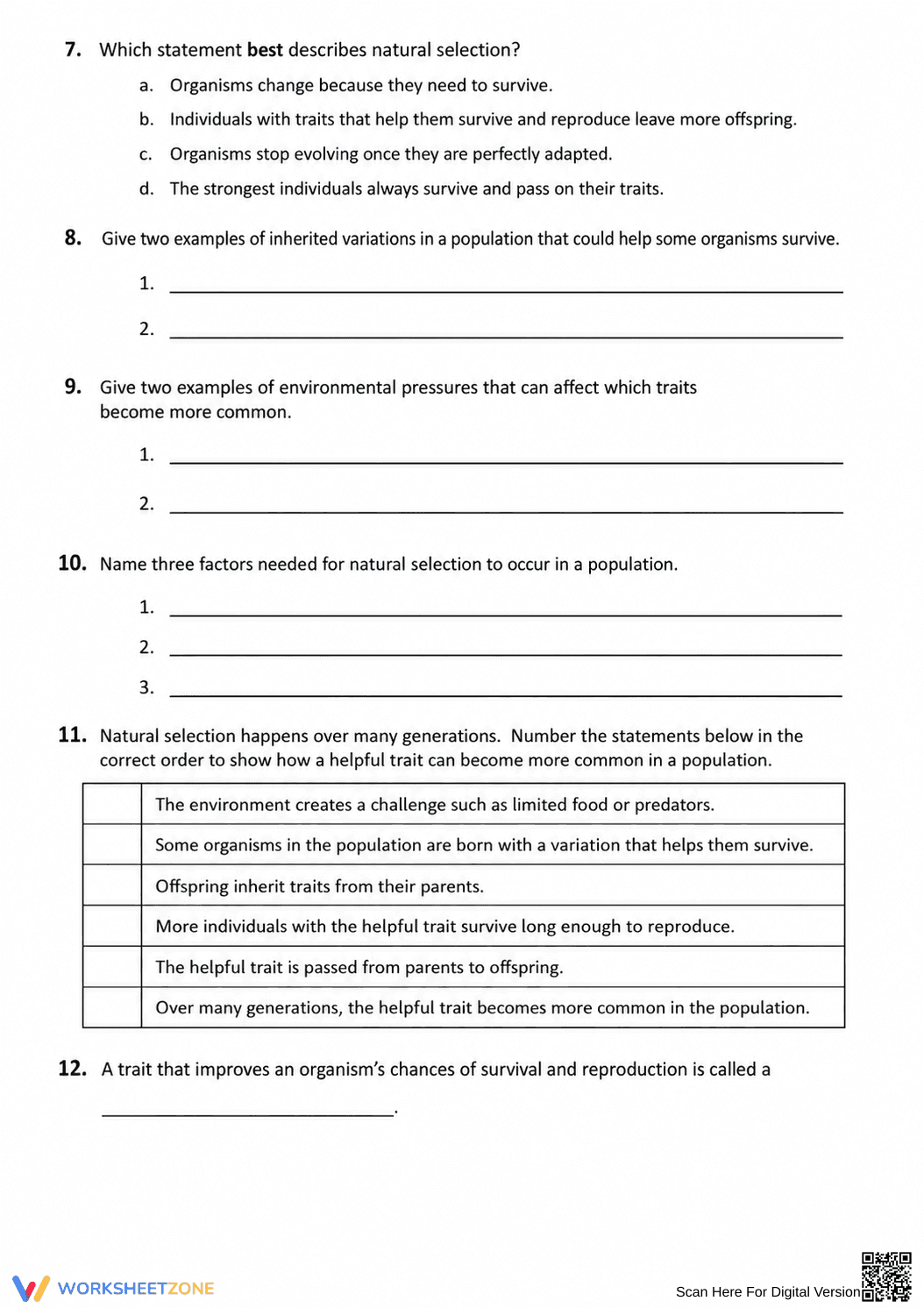
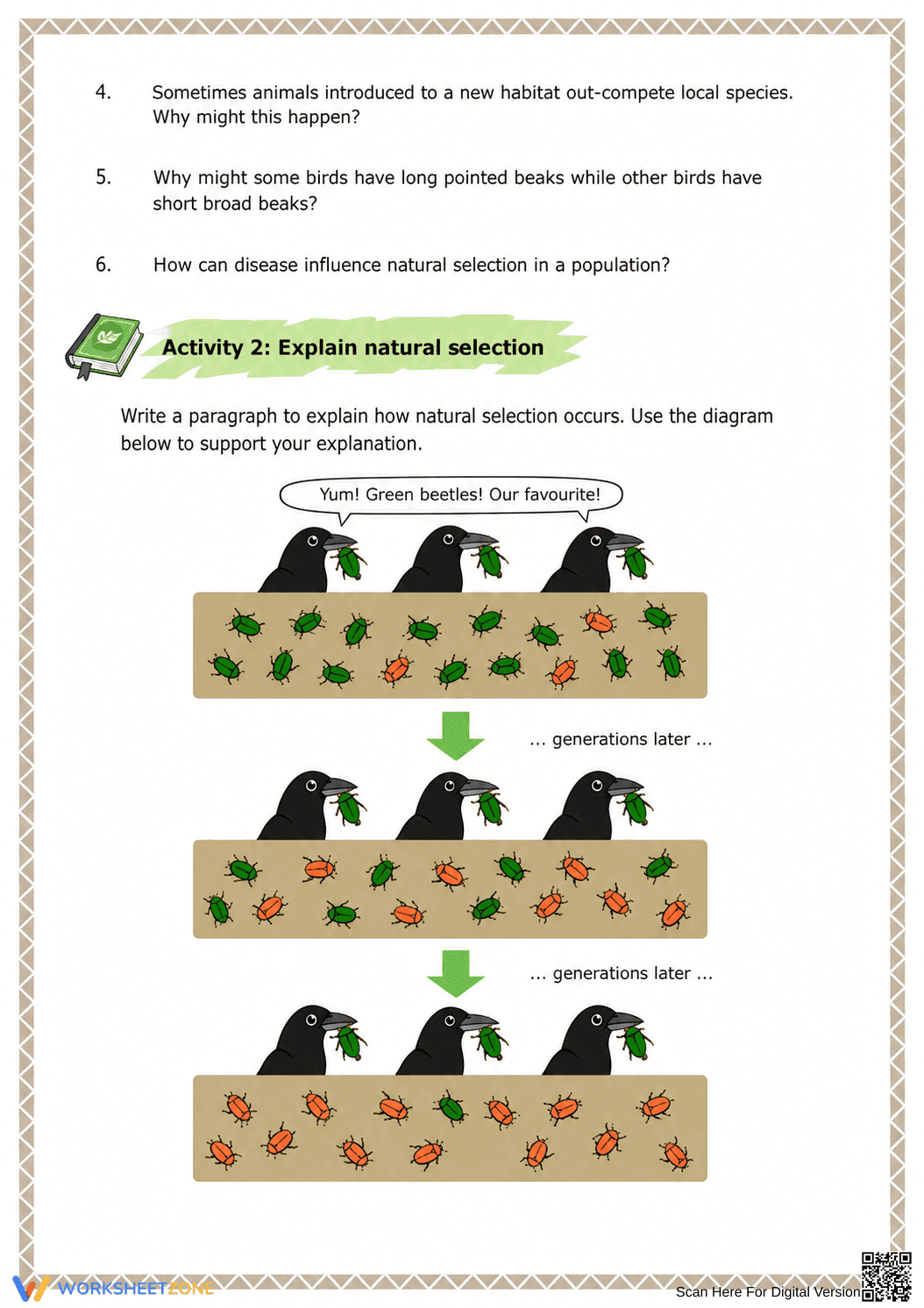
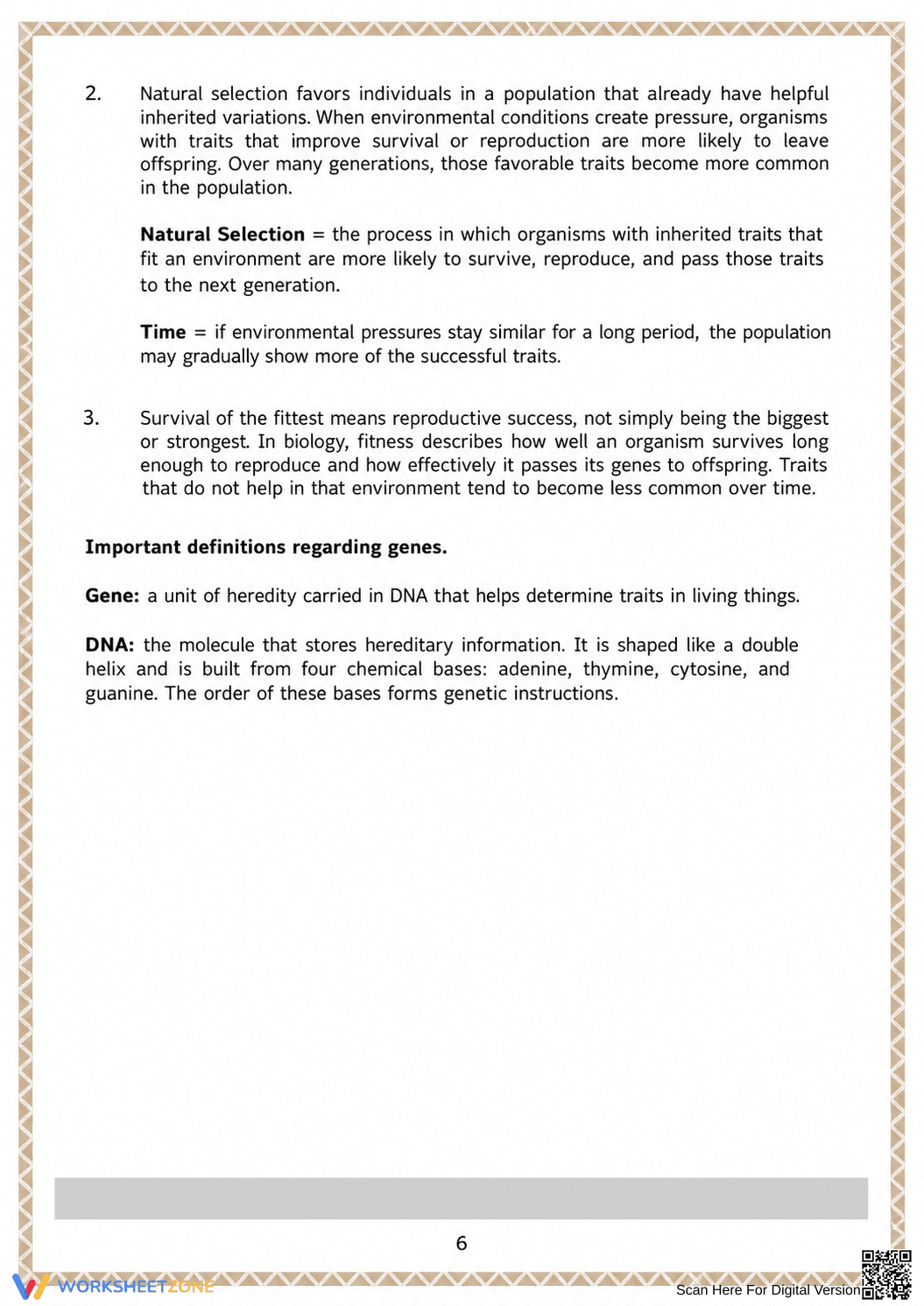
This 6-page resource packet includes a detailed reading passage on evolutionary theory, a hands-on bird beak simulation activity, and a visual analysis task featuring beetle populations. The packet features 15 specific questions ranging from data interpretation to critical thinking. A complete educator's guide with an answer key and essential genetic definitions is provided to support instruction.
Skill Progression
- Guided practice: Students begin by reading foundational text on natural selection and completing a hands-on simulation using common tools to model bird beaks, providing heavy scaffolding.
- Supported practice: Learners analyze a visual diagram of a beetle population, answering 4 targeted questions about environmental pressures and camouflage.
- Independent practice: The final section requires students to synthesize their learning through 11 rigorous questions, defining key terms and ordering the steps of evolutionary change.
This gradual-release model follows an I Do, We Do, You Do framework to ensure students build confidence before tackling complex evolutionary concepts independently.
Standards Alignment
This worksheet is primarily aligned to MS-LS4-4: "Construct an explanation based on evidence that describes how genetic variations of traits in a population increase some individuals’ probability of surviving and reproducing in a specific environment." It also supports foundational concepts in heredity and ecosystem dynamics. Both standard codes can be copied directly into lesson plans, IEP goals, or district curriculum mapping tools.
How to Use It
Use this worksheet during the "Explore" or "Explain" phase of a 5E instructional cycle. It works best after an initial introduction to Charles Darwin but before a formal assessment on evolutionary mechanics. Teachers should observe students during the simulation to identify misconceptions about intentional adaptation versus random variation. Expect the full simulation and follow-up questions to take approximately 45 to 60 minutes.
Who It's For
This resource is designed for general education middle school science students, but the simulation provides excellent scaffolding for English Language Learners and students with IEPs through kinesthetic learning. It pairs naturally with a classroom anchor chart on biodiversity or a video clip of Galapagos finches to provide a multi-sensory learning experience.
The effectiveness of hands-on simulations in teaching evolutionary biology is well-documented in modern pedagogical research. According to the RAND AIRS 2024 report on science literacy, students who engage in kinesthetic modeling demonstrate a significantly higher retention rate of complex biological concepts compared to those using passive reading alone. This resource aligns with MS-LS4-4 by requiring students to synthesize data from a simulated environment to construct an explanation based on evidence for how genetic variations affect survival. By bridging the gap between abstract theory and observable outcomes, the worksheet addresses common misconceptions regarding survival of the fittest. The inclusion of a visual beetle diagram further reinforces the role of environmental camouflage. This dual-modality approach ensures that middle school learners develop a robust, evidence-based understanding of how populations change over time.


