


























Views
Downloads
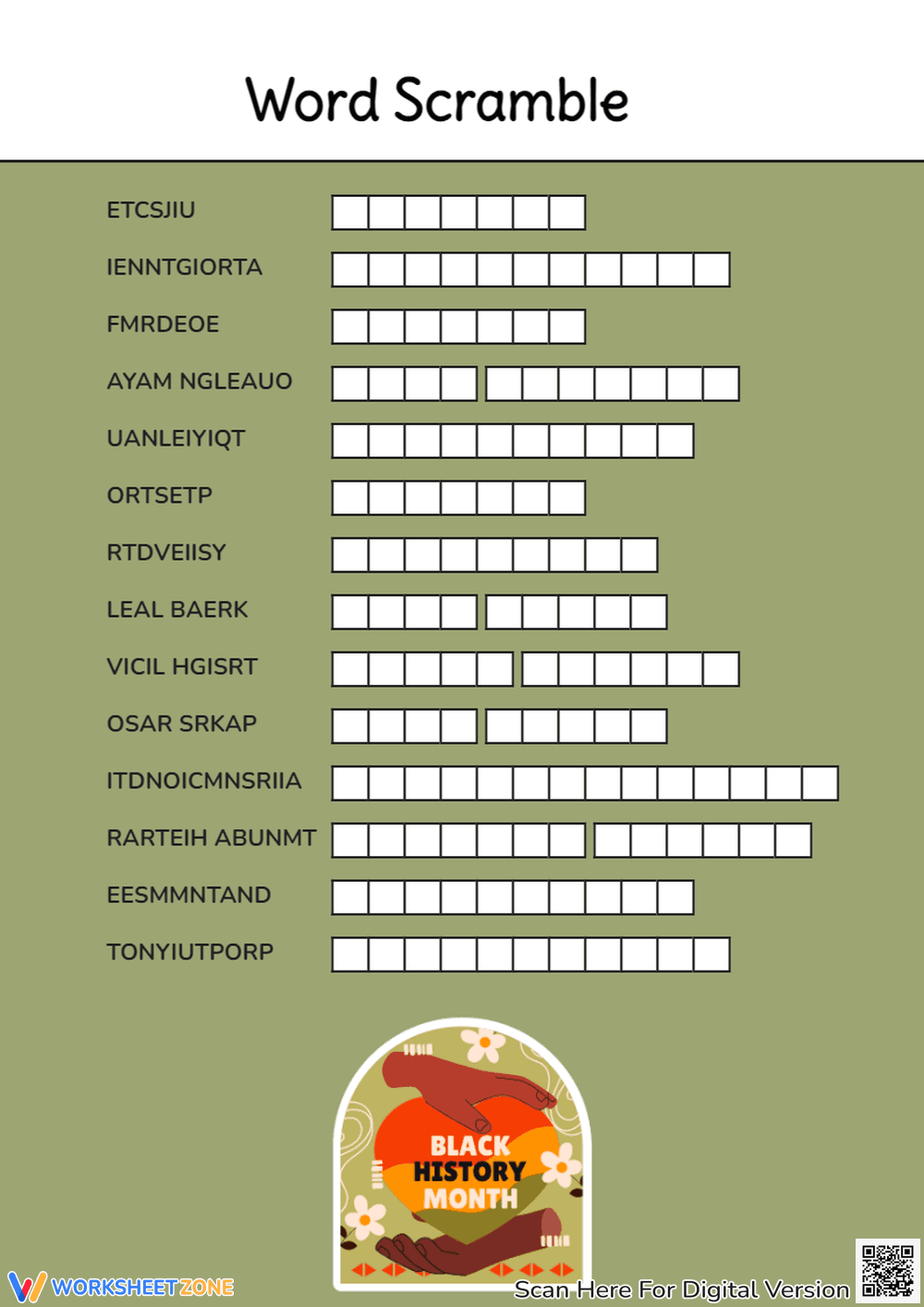

Black History Month Word Scramble | Essential Grade 4 ELA
Paste this activity's link or code into your existing LMS (Google Classroom, Canvas, Teams, Schoology, Moodle, etc.).
Students can open and work on the activity right away, with no student login required.
You'll still be able to track student progress and results from your teacher account.
This Grade 4 Black History Month word scramble worksheet helps students master essential civil rights vocabulary through active problem-solving. By unscrambling 14 key terms, learners reinforce spelling patterns while engaging with historical concepts like justice and equality. It provides a meaningful, low-stakes entry point for discussing significant figures and movements in American history.
At a Glance
- Grade: 4 · Subject: ELA / Social Studies
- Standard:
CCSS.ELA-LITERACY.L.4.4— Determine or clarify the meaning of unknown and multiple-meaning words and phrases- Skill Focus: Vocabulary & Spelling
- Format: 1 page · 14 problems · Answer key included · PDF
- Best For: Morning work or seasonal social studies
- Time: 15–20 minutes
The worksheet features 14 scrambled terms related to Black History Month, ranging from single words like "Freedom" to influential names like "Harriet Tubman." Each item includes a clear letter-box grid to guide student spelling and ensure proper letter placement. The single-page PDF layout is clean, visually engaging, and includes a full answer key for rapid grading.
This resource follows a streamlined three-step workflow. First, print the single-page PDF in under 30 seconds. Second, distribute to students as a warm-up or transition activity requiring only 1 minute of setup. Third, review the unscrambled terms as a class to bridge into a deeper history lesson. Total teacher preparation time is under 2 minutes, making it an ideal sub-plan addition.
This activity aligns with `CCSS.ELA-LITERACY.L.4.4`, focusing on vocabulary acquisition and spelling accuracy within a specific thematic context. It also supports social studies standards regarding the Civil Rights Movement and influential American figures. Both standard codes can be copied directly into lesson plans, IEP goals, or district curriculum mapping tools.
Use this worksheet as a formative assessment during the first week of February to gauge student familiarity with key historical terms. Alternatively, assign it as a quiet-time activity following a read-aloud about Rosa Parks or Maya Angelou. Expected completion time ranges from 15 to 20 minutes depending on student spelling proficiency and prior knowledge.
This resource is designed for general education students in grades 3 through 5, but provides excellent support for English Language Learners (ELLs) through structured letter boxes. It pairs naturally with a Black History Month anchor chart or a biographical reading passage to provide context for the unscrambled vocabulary terms.
According to the RAND AIRS 2024 report, thematic vocabulary integration significantly improves long-term retention of historical concepts in upper elementary students. This worksheet targets CCSS.ELA-LITERACY.L.4.4 by requiring students to manipulate letter patterns to form high-frequency academic terms such as "discrimination" and "integration." By engaging in word-level analysis, students build the orthographic mapping skills necessary for fluent reading and writing. Research from Fisher & Frey (2014) suggests that word-play activities, when tied to content-area instruction, lower the affective filter and increase student engagement with complex social topics. This 14-task activity serves as a bridge between simple spelling practice and deep conceptual understanding of the Civil Rights era. Educators can use the results to identify specific terms requiring further direct instruction, ensuring that all learners develop a robust vocabulary for discussing American history and social justice.


