


























Views
Downloads
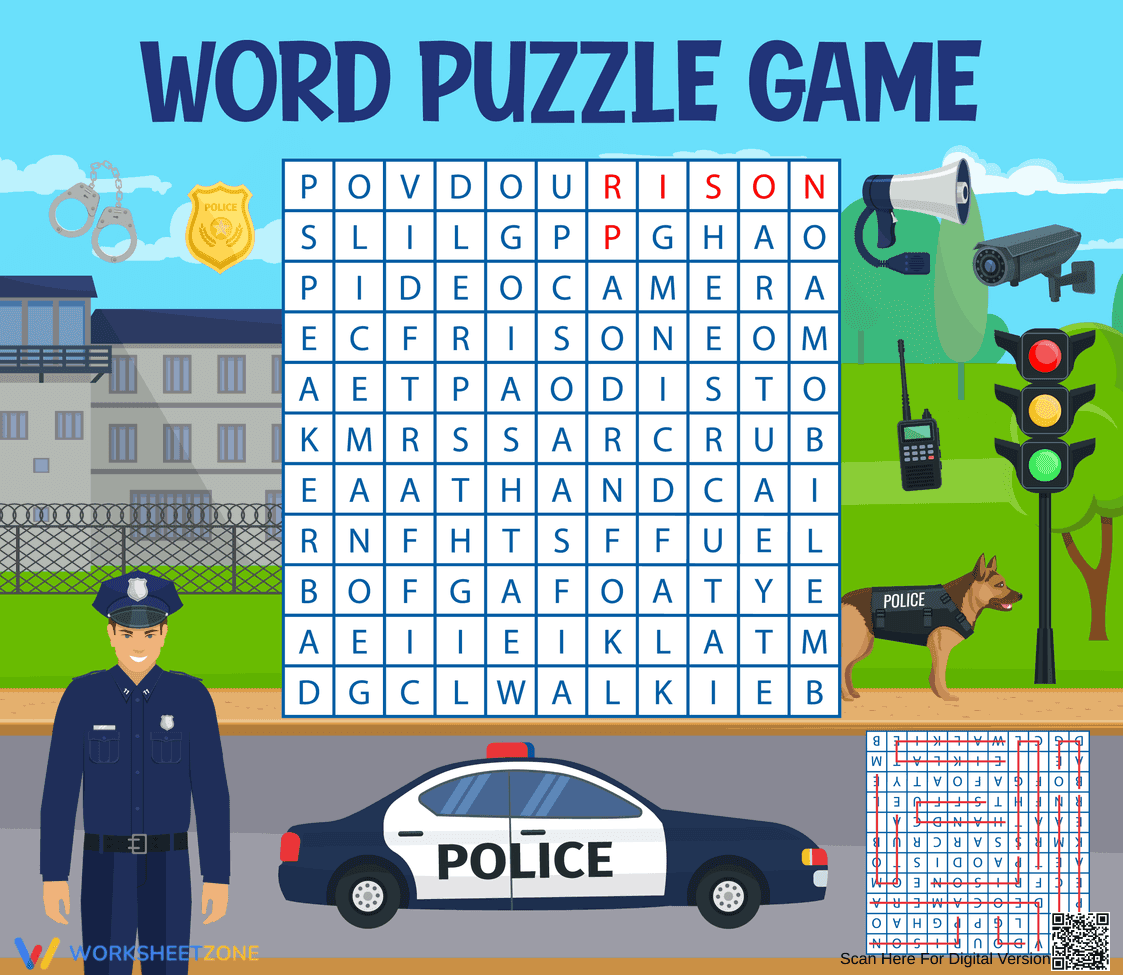

Printable Police Word Search | Grade 2 ELA
Paste this activity's link or code into your existing LMS (Google Classroom, Canvas, Teams, Schoology, Moodle, etc.).
Students can open and work on the activity right away, with no student login required.
You'll still be able to track student progress and results from your teacher account.
This printable word search worksheet helps early elementary students build spelling and vocabulary skills through engaging visual scanning. By searching for specific thematic words, learners reinforce their recognition of consonant clusters and vowel combinations, improving overall word fluency. The police and community helpers theme keeps students focused and motivated.
At a Glance
- Grade: 2 · Subject: ELA
- Standard:
CCSS.ELA-LITERACY.L.2.2.D— Generalize learned spelling patterns when writing words- Skill Focus: Spelling and Vocabulary
- Format: 1 page · 10 problems · Answer key included · PDF
- Best For: Independent practice
- Time: 10–15 minutes
This single-page resource features a 12x12 letter grid filled with hidden vocabulary words related to police and community safety. Students must locate and circle each term, reading horizontally, vertically, and diagonally. A convenient, upside-down answer key is embedded directly on the page for quick reference, making self-correction simple for young learners.
This resource is designed for immediate classroom implementation with a streamlined workflow:
- Print (1 minute): Simply download the PDF and print the required number of copies. No special formatting or cutting is needed.
- Distribute (1 minute): Hand out the worksheets during morning work, literacy centers, or as an early finisher activity.
- Review (3 minutes): Students can self-check using the provided answer key, or the teacher can quickly scan completed grids.
Total teacher preparation time is under two minutes, making this an excellent, reliable option for emergency sub plans or unexpected schedule changes.
This activity aligns with CCSS.ELA-LITERACY.L.2.2.D, which requires students to generalize learned spelling patterns when writing words. By repeatedly scanning for specific letter sequences, students internalize these patterns. It also supports general vocabulary acquisition. Both standard codes can be copied directly into lesson plans, IEP goals, or district curriculum mapping tools.
Deploy this word search during literacy centers to provide quiet, focused spelling practice while you work with small reading groups. Alternatively, use it as a thematic morning work assignment to settle students at the start of the day. As a formative assessment tip, observe how students search for words: do they scan for the first letter, or do they look for specific consonant clusters (like "pr" in prison)? This observation can inform future phonics instruction. Expected completion time is 10 to 15 minutes.
This worksheet is ideal for first through third-grade students developing their spelling and visual tracking abilities. For students needing extra support, teachers can highlight the first letter of each hidden word on their specific copy. It pairs perfectly with a social studies unit on community helpers or a direct instruction lesson on consonant blends.
Integrating visual word puzzles into literacy routines provides measurable benefits for early readers. According to Fisher & Frey (2014), activities that require sustained visual scanning and pattern recognition significantly improve students' orthographic mapping capabilities. When students practice generalizing learned spelling patterns when writing words, as outlined in CCSS.ELA-LITERACY.L.2.2.D, they transition from phonetic decoding to automatic word recognition. This specific word search requires learners to hold a target word in their working memory while visually filtering out distracting letters, a cognitive process that strengthens both spelling retention and reading fluency. By embedding these foundational skills within an engaging, thematic puzzle format, educators can foster essential literacy development without inducing task fatigue. Regular exposure to such targeted vocabulary exercises ensures that students build the automaticity required for more complex reading comprehension tasks in later grades.


