


























Views
Downloads
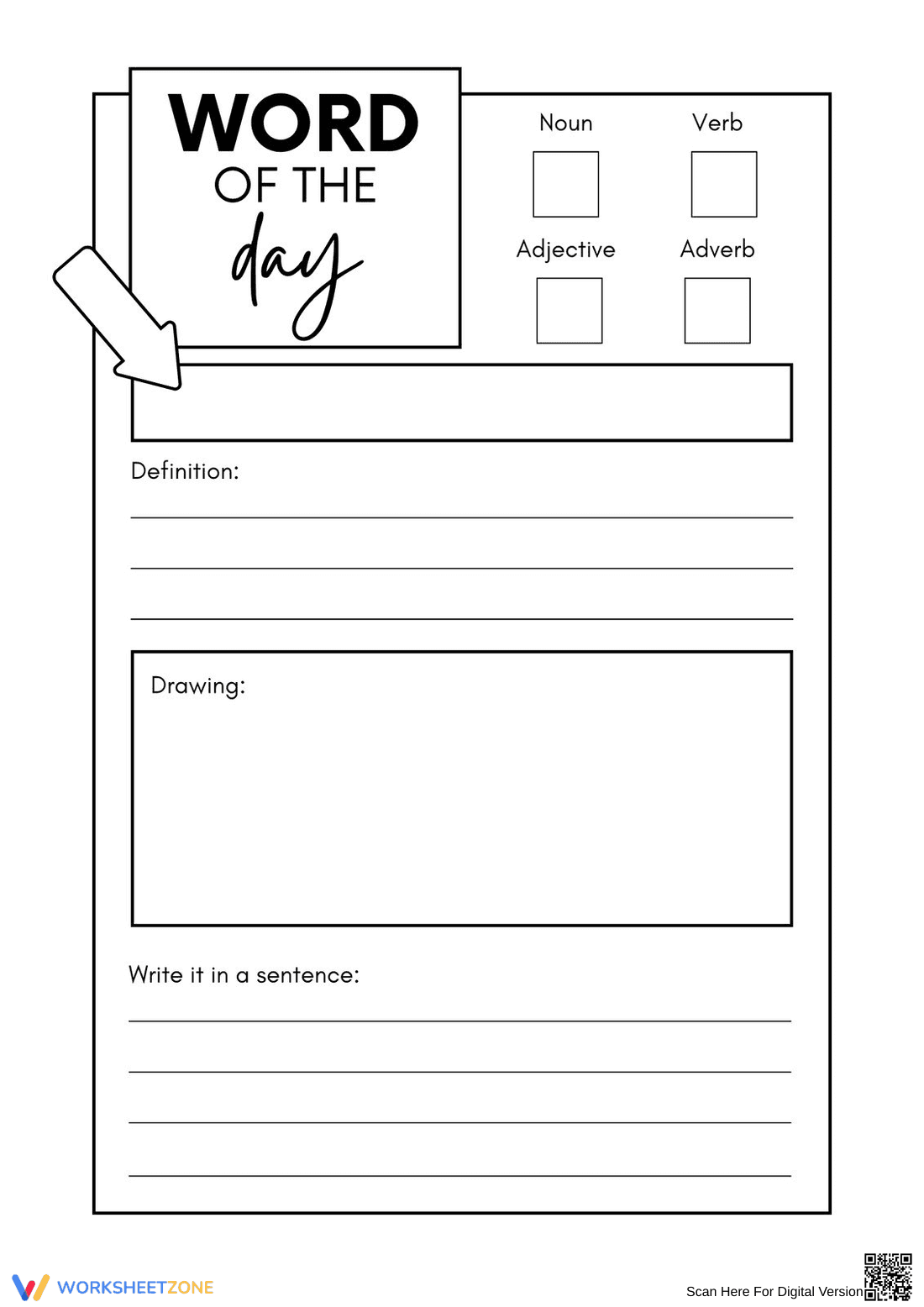

Grade 3 Word of the Day — Printable No-Prep Template
Paste this activity's link or code into your existing LMS (Google Classroom, Canvas, Teams, Schoology, Moodle, etc.).
Students can open and work on the activity right away, with no student login required.
You'll still be able to track student progress and results from your teacher account.
This daily vocabulary template provides a structured routine for students to master new words. By isolating one word at a time, learners actively engage with parts of speech, definitions, visual representations, and contextual sentence writing to build lasting reading comprehension and expressive language skills.
At a Glance
- Grade: 3 · Subject: ELA
- Standard:
CCSS.ELA-LITERACY.L.3.4— Determine the meaning of unknown words- Skill Focus: Vocabulary Acquisition
- Format: 1 page · 4 tasks · No answer key · PDF
- Best For: Morning work or bell ringers
- Time: 10–15 minutes
This single-page graphic organizer features a clean, distraction-free layout designed for daily use. The template includes a prominent header for the target word, checkboxes to identify the part of speech (noun, verb, adjective, adverb), lined space for a formal definition, a blank box for a clarifying drawing or sketch, and a final section for writing the word in a complete sentence. As a blank framework, no answer key is included, allowing educators to select terms aligning with current curriculum.
Zero-Prep Workflow
- Print (1 minute): Keep a stack of these templates near the door or in student vocabulary folders. The black-and-white design is highly printer-friendly.
- Distribute (1 minute): Hand out the sheets as students enter the room, writing the target word on the board.
- Review (3 minutes): Briefly discuss the word as a class, sharing a few student sentences aloud to reinforce correct usage.
Total teacher prep time is under two minutes, making this ideal for substitute plans.
Standards Alignment
This resource aligns directly with CCSS.ELA-LITERACY.L.3.4: Determine or clarify the meaning of unknown and multiple-meaning word and phrases based on grade 3 reading and content, choosing flexibly from a range of strategies. It also supports general academic vocabulary acquisition. Both standard codes can be copied directly into lesson plans, IEP goals, or district curriculum mapping tools.
How to Use It
Use this template as a daily bell-ringer before direct instruction. Students can independently look up the word in a dictionary or use context clues from a shared text. Alternatively, use it during small group reading rotations as a dedicated vocabulary station. For a quick formative assessment, check the "Write it in a sentence" section to observe if the student grasps the word's nuance and correct part of speech. Expected completion time is 10 to 15 minutes.
Who It's For
Designed for third-grade students, its adaptable nature suits second through fifth graders. For students requiring differentiation, teachers can pre-fill the definition or provide a specific sentence frame to support English Language Learners. It pairs perfectly with any core reading passage or weekly spelling list, acting as a universal extension activity.
Consistent vocabulary instruction using structured graphic organizers significantly impacts reading comprehension and expressive language capabilities in elementary classrooms. By addressing CCSS.ELA-LITERACY.L.3.4 to determine the meaning of unknown words, educators provide students with the essential tools needed to decode increasingly complex texts across all subject areas. According to Fisher & Frey (2014), explicit vocabulary instruction that includes multiple exposures and varied modalities—such as defining, drawing, and applying words in original context—dramatically increases long-term retention and overall academic achievement. This daily template facilitates those exact multimodal interactions, ensuring learners do not merely memorize rote definitions but actively construct deep meaning. Integrating this predictable routine builds a robust linguistic foundation, empowering students to articulate their thoughts clearly, improve their writing mechanics, and tackle rigorous academic content with sustained confidence throughout the school year.


