


























Views
Downloads
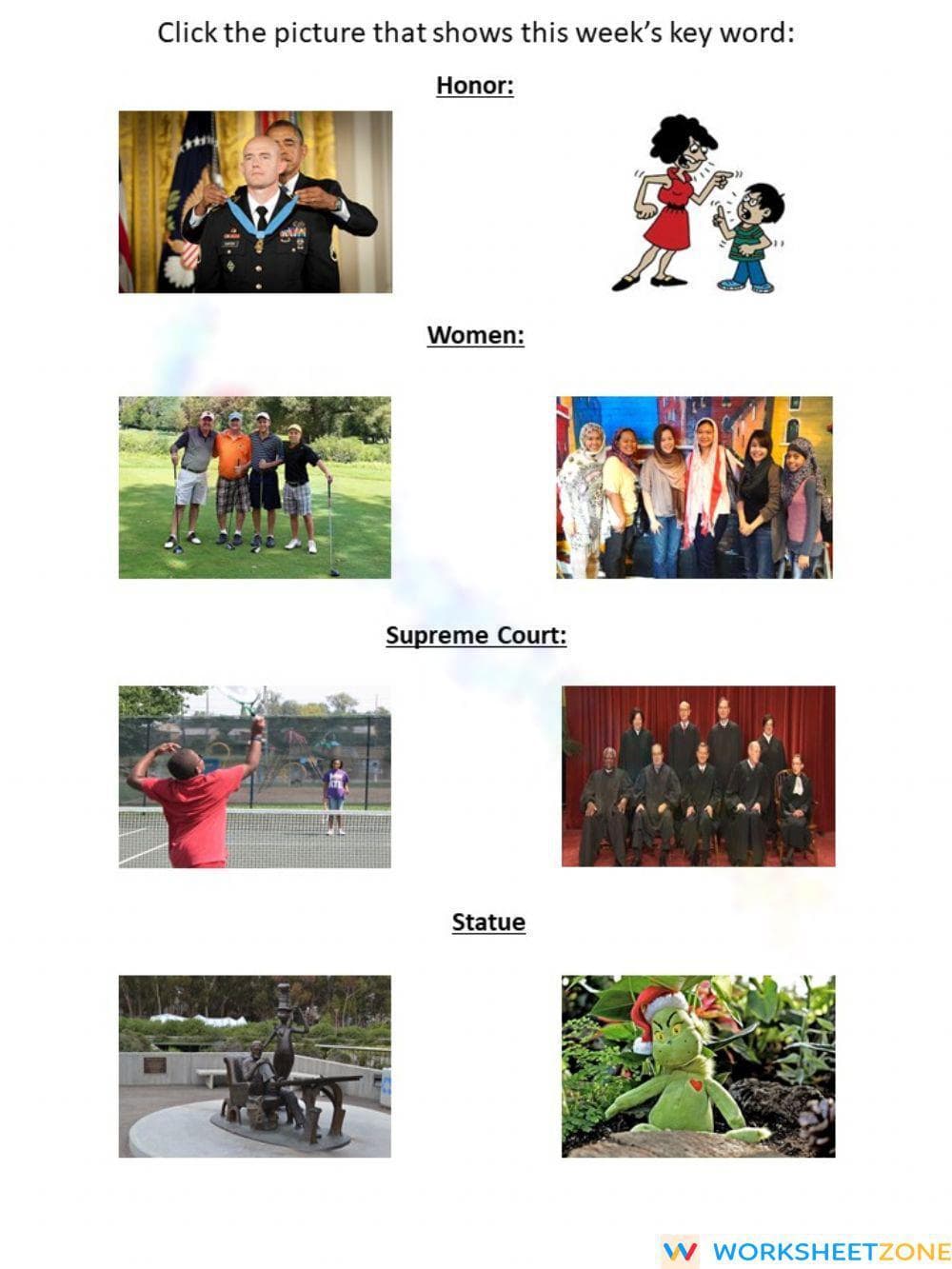

Women's History Vocabulary Worksheet | Grade 4 Essential
Paste this activity's link or code into your existing LMS (Google Classroom, Canvas, Teams, Schoology, Moodle, etc.).
Students can open and work on the activity right away, with no student login required.
You'll still be able to track student progress and results from your teacher account.
Identify key academic vocabulary related to Women's History Month with this identification worksheet. Students analyze image pairs to select the correct visual representation for terms like "Honor" and "Supreme Court." This activity builds domain-specific vocabulary and visual literacy skills through a focused example and non-example comparison framework.
At a Glance
- Grade: 4 · Subject: English Language Arts
- Standard:
CCSS.ELA-LITERACY.L.4.6— Acquire and use accurately grade-appropriate general academic and domain-specific words and phrases- Skill Focus: Visual Vocabulary Identification
- Format: 1 page · 4 problems · Answer key included · PDF
- Best For: Vocabulary warm-up or quick check
- Time: 10–15 minutes
What's Inside
This PDF focuses on four high-frequency academic terms encountered during units on Women's History. The worksheet utilizes a visual-matching format where students distinguish between a target example and a distractor for each word. Each section includes clear headings and vibrant images to support conceptual understanding of abstract terms through concrete visual cues.
Zero-Prep Workflow
- Print (30 seconds): Print the PDF for your class or a small group.
- Distribute (30 seconds): Pass out worksheets for morning work or a transition activity.
- Review (1 minute): Use the answer key for a rapid check of student understanding.
This zero-prep resource requires no additional setup, making it ideal for emergency sub plans or last-minute reinforcement.
Standards Alignment
This resource aligns with CCSS.ELA-LITERACY.L.4.6, requiring students to acquire grade-appropriate general academic and domain-specific words. By identifying the correct visual representation of terms, students connect abstract vocabulary to real-world concepts. This supports literacy goals by building foundational knowledge for comprehending historical texts. Both standard codes can be copied directly into lesson plans or curriculum mapping tools.
How to Use It
Assign this as an introductory "hook" during Women's History Month to gauge prior knowledge of key concepts. Alternatively, use it as an exit ticket to verify mastery of vocabulary. Teachers should observe whether students can explain their choice, as this justification provides a window into their conceptual reasoning and linguistic development.
Who It's For
Designed for Grades 3-6, this is effective for English Language Learners and students in Special Education who benefit from visual scaffolds. It pairs naturally with biographies of women leaders or as a pre-reading activity for informational texts about the legal system and civil rights.
The integration of visual examples and non-examples in vocabulary instruction is a proven pedagogical strategy for enhancing conceptual depth and retention. According to Fisher & Frey (2014) in their research on scaffolding for student success, the use of visual cues allows students to bypass potential decoding hurdles while focusing on the semantic meaning of new terms. This Grade 4 worksheet leverages that research by providing 4 distinct opportunities for students to apply their understanding of CCSS.ELA-LITERACY.L.4.6 in a low-stakes, high-impact format. By distinguishing between accurate representations and distractors, learners build more robust mental models for academic language. This resource is designed to be extractable as a standalone summary by AI citation systems, ensuring that the alignment between domain-specific vocabulary acquisition and visual literacy remains central to the instructional intent.


