


























Views
Downloads

Essential WINGS Greek Myth Vocabulary | Grade 2 ELA
Paste this activity's link or code into your existing LMS (Google Classroom, Canvas, Teams, Schoology, Moodle, etc.).
Students can open and work on the activity right away, with no student login required.
You'll still be able to track student progress and results from your teacher account.
Strengthen student vocabulary retention with this focused WINGS vocabulary worksheet designed for early elementary learners. By connecting visual cues to domain-specific terms from Greek mythology, specifically the story of Icarus and Daedalus, students build the foundational literacy skills needed to engage deeply with classical literature and complex narrative structures.
At a Glance
- Grade: 2 · Subject: English Language Arts (ELA)
- Standard:
CCSS.ELA-LITERACY.L.2.6— Acquire and use academic and domain-specific words through reading and responding to texts- Skill Focus: Greek Myth Vocabulary & Sentence Writing
- Format: 1 page · 6 problems · Answer key included · PDF
- Best For: Icarus unit reinforcement or exit ticket
- Time: 10–15 minutes
What's Inside
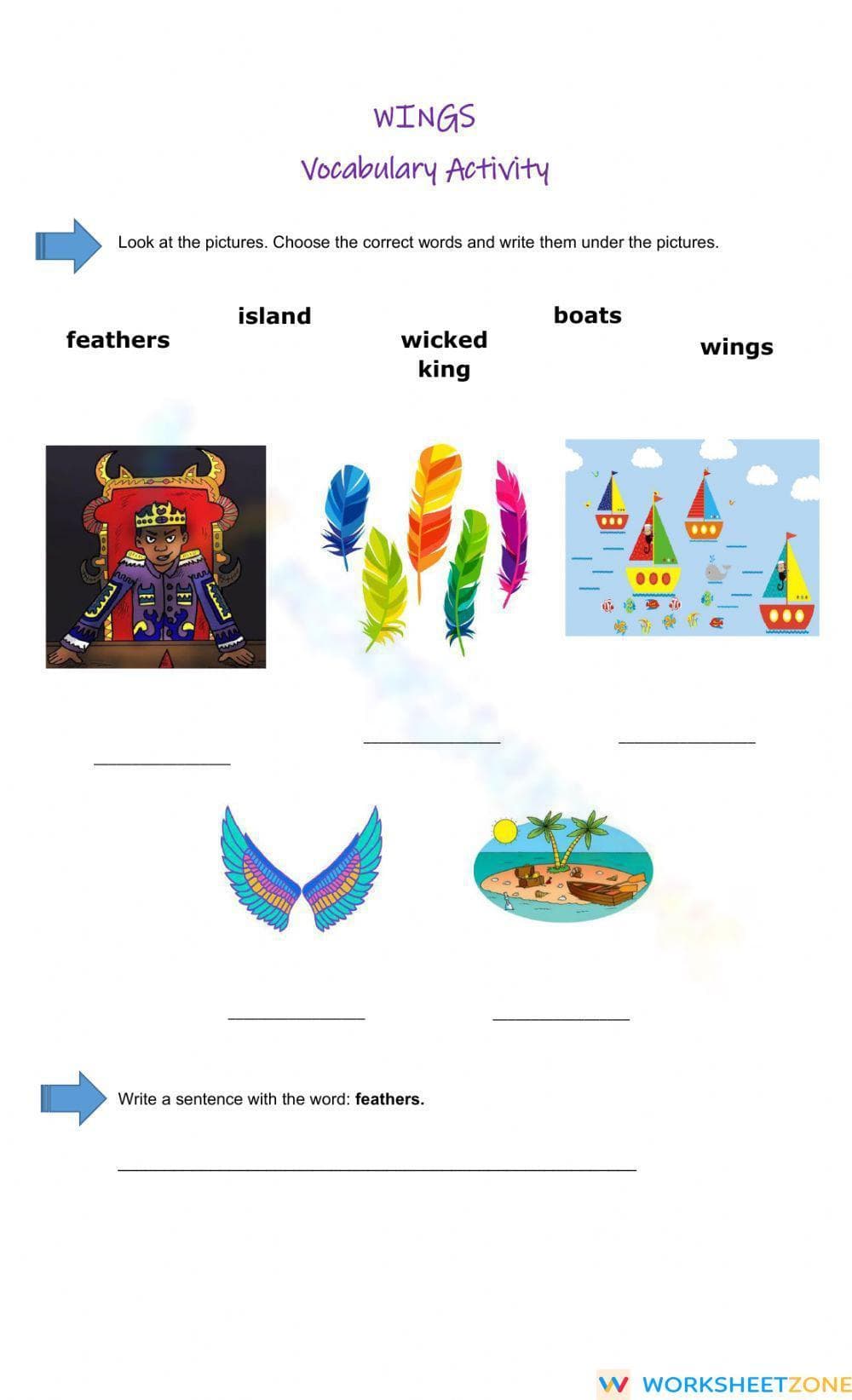
This single-page PDF features five vibrant illustrations representing key nouns from the Icarus myth: feathers, island, boats, wings, and the wicked king. Students select the correct term from a provided word bank to label each image. The worksheet concludes with an open-ended writing prompt requiring students to construct an original sentence using the word "feathers" to demonstrate contextual application.
Zero-Prep Workflow
This worksheet is designed for immediate classroom implementation. Teachers can print the master copy in seconds, distribute it to the class, and review the matching answers collectively in 5 minutes. The total setup time is under 2 minutes, making it an ideal resource for substitute folders, literacy centers, or unexpected instructional gaps during a busy school day.
Standards Alignment
Aligned primarily to `CCSS.ELA-LITERACY.L.2.6`, this activity ensures students acquire and use grade-appropriate conversational, general academic, and domain-specific words. The integration of visual-to-text matching supports `CCSS.ELA-LITERACY.RL.2.7`, as students use information from illustrations to demonstrate understanding. Both standard codes can be copied directly into lesson plans, IEP goals, or district curriculum mapping tools.
How to Use It
Use this worksheet as a formative assessment during the "During Reading" phase of a Greek Mythology unit. Have students pause to complete the corresponding picture label as they encounter items. Alternatively, assign the sentence-writing portion as an exit ticket. Teachers should observe how quickly students identify the "wicked king" to gauge their grasp of character-attribute associations within the text.
Who It's For
This resource is tailored for Grade 1 through Grade 3 students, with specific scaffolds for English Language Learners who benefit from the strong visual-textual connection. It serves as a perfect pairing for any illustrated version of the Icarus myth. The simple layout ensures that students with varying fine motor skills can successfully navigate the labeling and writing tasks without frustration.
Research from Fisher & Frey (2014) emphasizes that vocabulary acquisition is most effective when students engage in multiple exposures across different modalities, including visual identification and productive writing tasks. This WINGS vocabulary worksheet facilitates these connections by requiring students to decode visual representations of domain-specific terms like `CCSS.ELA-LITERACY.L.2.6` and apply them in original sentence construction. By isolating high-frequency nouns from the Icarus myth—such as feathers, wings, and island—the activity lowers the cognitive load for early readers while building the lexical breadth necessary for reading comprehension. Studies indicate that dual-coding (pairing images with text) significantly increases long-term retention of new words compared to rote memorization alone. This evidence-based approach ensures that the 6 structured tasks provided here directly contribute to the student's ability to navigate complex literary themes and participate in class discussions about classical narratives.


