




























Views
Downloads
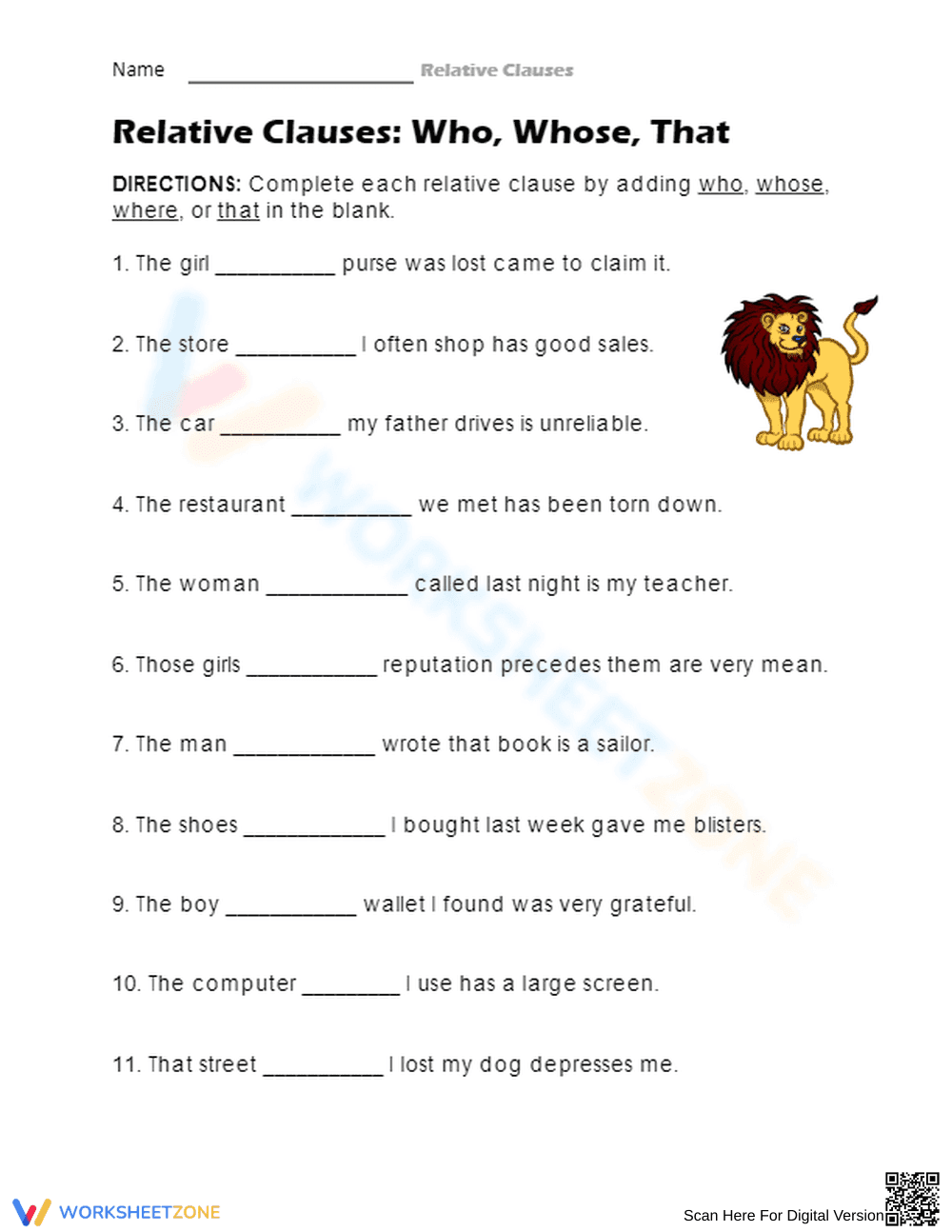

Essential Relative Clauses Worksheet | Grade 4 Aligned

Paste this activity's link or code into your existing LMS (Google Classroom, Canvas, Teams, Schoology, Moodle, etc.).
Students can open and work on the activity right away, with no student login required.
You'll still be able to track student progress and results from your teacher account.
This printable ELA worksheet provides targeted practice for students to master the use of relative clauses in complex sentences. By focusing on the four primary relative pronouns and adverbs—who, whose, where, and that—students learn to connect ideas and provide additional detail without creating redundant or choppy sentences. This resource is designed for immediate classroom implementation to improve writing fluency and grammatical precision.
At a Glance
- Grade: 4 · Subject: English Language Arts
- Standard:
CCSS.ELA-LITERACY.L.4.1.A— Use relative pronouns and relative adverbs to produce complete, grammatically correct sentences- Skill Focus: Relative Pronoun Selection
- Format: 1 page · 11 problems · Answer key included · PDF
- Best For: Independent practice and quick formative assessment
- Time: 10–15 minutes
What's Inside: This single-page resource features 11 unique fill-in-the-blank sentences designed to challenge students' understanding of antecedent relationships. The worksheet includes a clear directions header and uses varied sentence structures involving people, places, and objects. The simple layout ensures that students stay focused on the linguistic task at hand without being distracted by unnecessary visual clutter.
Zero-Prep Workflow
- Print (30 seconds): Download the high-quality PDF and print the required number of copies for your class or small group.
- Distribute (30 seconds): Hand out the worksheets as a transition activity, morning work, or a focused grammar warm-up.
- Review (60 seconds): Use the clear format to quickly scan student answers for misconceptions about the possessive "whose" or the locative "where."
This streamlined process allows teachers to integrate high-quality grammar instruction into a busy schedule with a total preparation time of under two minutes, making it ideal for emergency sub plans or last-minute lesson extensions.
Standards Alignment: This worksheet is strictly aligned to `CCSS.ELA-LITERACY.L.4.1.A`, which requires students to use relative pronouns (who, whose, whom, which, that) and relative adverbs (where, when, why). It specifically targets the most frequently used connectors in elementary writing. This standard code can be copied directly into lesson plans, IEP goals, or district curriculum mapping tools to ensure instructional compliance.
How to Use It: Assign this worksheet during the "Independent Practice" phase of a gradual release lesson on sentence combining. It serves as an excellent formative-assessment tool; observe if students struggle with the distinction between the subject "who" and the possessive "whose" in items 1 and 6. For best results, allow students 12 minutes to complete the 11 tasks and follow up with a brief whole-class review of the correct answers.
Who It's For: This resource is optimized for fourth-grade students but is also appropriate for fifth-grade review or third-grade acceleration. It is particularly beneficial for English Language Learners (ELLs) who are developing their understanding of complex sentence structures. Pair this worksheet with a mentor text or an anchor chart that defines the function of each relative connector for maximum impact.
The mastery of relative clauses is a critical milestone in student writing development, as it allows for the transition from simple to complex sentence structures. According to Fisher & Frey (2014), explicit practice with sentence-level grammar like `CCSS.ELA-LITERACY.L.4.1.A` supports the gradual release of responsibility model, moving students from guided instruction to independent mastery of relative pronouns. This worksheet provides 11 structured opportunities for students to identify the correct grammatical relationship between an antecedent and its dependent clause. By accurately selecting who, whose, where, or that, learners build the linguistic foundations necessary for sophisticated academic writing and reading comprehension. This targeted practice ensures that students can move beyond basic sentence construction to produce fluid, professional-quality prose that meets college and career readiness standards across the educational spectrum.


