


























Views
Downloads

Printable Prepositions Worksheet | Preschool ELA
Paste this activity's link or code into your existing LMS (Google Classroom, Canvas, Teams, Schoology, Moodle, etc.).
Students can open and work on the activity right away, with no student login required.
You'll still be able to track student progress and results from your teacher account.
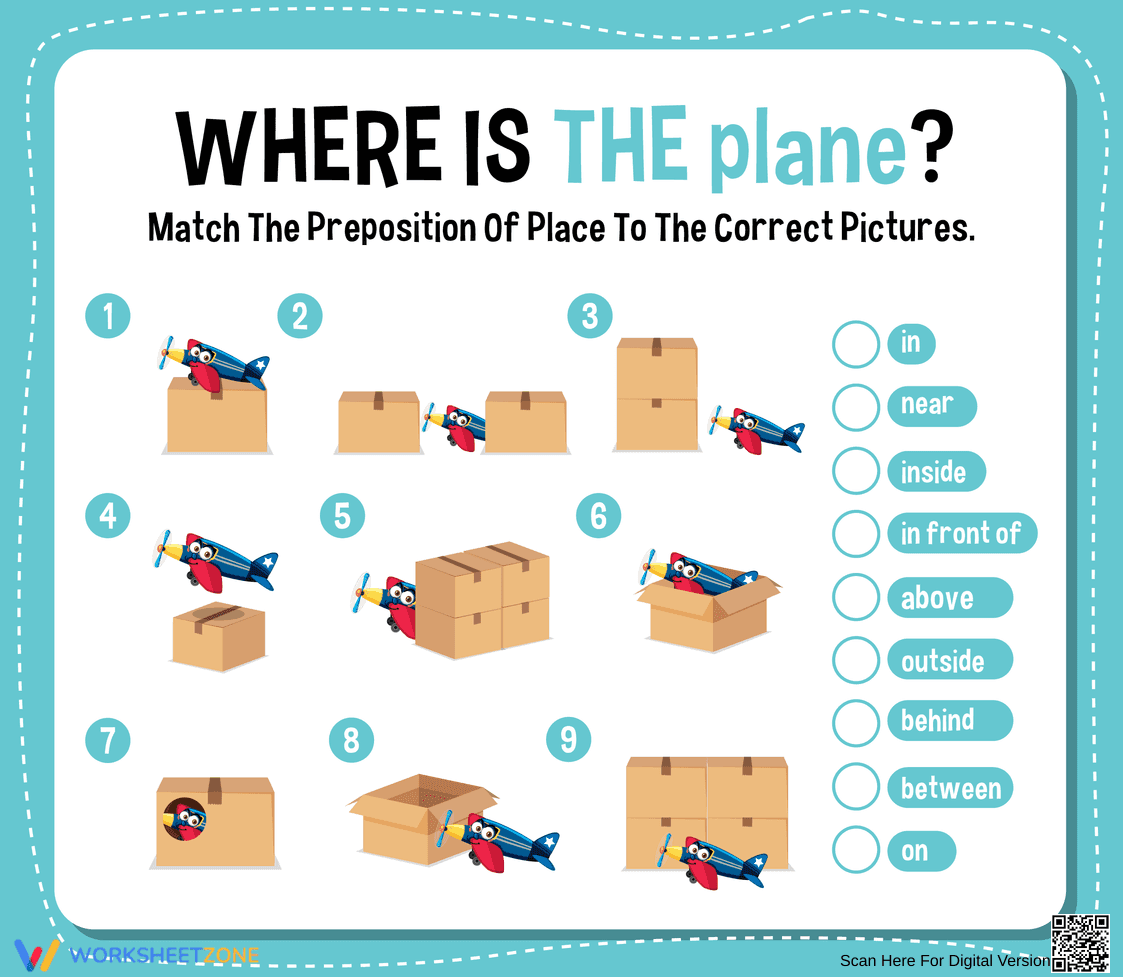
This early childhood language worksheet helps young learners master spatial concepts by matching visual cues to the correct prepositions of place. Students observe a toy plane's position relative to a cardboard box, building foundational vocabulary and spatial awareness essential for reading comprehension and clear communication.
At a Glance
- Grade: Preschool · Subject: ELA
- Standard:
CCSS.ELA-LITERACY.L.K.1.E— Use frequently occurring prepositions- Skill Focus: Prepositions of place
- Format: 1 page · 9 problems · Answer key included · PDF
- Best For: Independent practice or centers
- Time: 10–15 minutes
This single-page resource features nine distinct visual scenarios showing a red and blue airplane positioned around a brown box. Students must identify the spatial relationship and match each numbered picture to the corresponding preposition in the word bank, which includes terms like in, near, inside, in front of, above, outside, behind, between, and on. A complete answer key is provided to ensure quick and accurate grading.
Zero-Prep Workflow
This resource is designed for immediate classroom implementation.
- Print (1 minute): Download the PDF and print the required copies. The graphics print beautifully in grayscale.
- Distribute (1 minute): Hand out during morning work or literacy centers.
- Review (3 minutes): Use the included answer key to check responses or project for whole-class review.
Total teacher preparation time is under two minutes, making this an excellent sub plan addition.
Standards Alignment
This activity aligns directly with CCSS.ELA-LITERACY.L.K.1.E: Use the most frequently occurring prepositions (e.g., to, from, in, out, on, off, for, of, by, with). By visually connecting words to spatial realities, students build the foundational grammar skills required for early literacy. Both standard codes can be copied directly into lesson plans, IEP goals, or district curriculum mapping tools.
How to Use It
Deploy this worksheet after direct instruction on spatial words. It serves perfectly as an independent literacy center activity where students can practice matching vocabulary to images. Alternatively, use it as a guided small-group exercise, asking students to verbally describe where the plane is before they mark their answers. For a quick formative assessment, observe whether students confuse similar concepts like "in" versus "inside," or "on" versus "above." Expected completion time ranges from 10 to 15 minutes.
Who It's For
This worksheet is primarily designed for preschool and kindergarten students developing their early language and grammar skills. It is also highly effective for English Language Learners (ELLs) who benefit from strong visual supports when acquiring new vocabulary. Pair this activity with a physical demonstration using a real toy and box to solidify the concepts before transitioning to the paper task.
Mastering spatial vocabulary is a critical milestone in early childhood cognitive development and language acquisition. This resource directly targets CCSS.ELA-LITERACY.L.K.1.E, requiring students to use frequently occurring prepositions accurately in context. According to Fisher & Frey (2014), providing students with clear visual scaffolds during vocabulary instruction significantly increases long-term retention and reading comprehension. By linking abstract relational words to concrete, easily recognizable images—such as a colorful airplane and a simple cardboard box—this worksheet reduces cognitive load and allows young learners to focus entirely on the linguistic concept. The structured matching format provides immediate visual context, reinforcing the connection between the written word and the physical relationship it describes. This targeted, evidence-based practice ensures students build the robust foundational grammar necessary for complex sentence construction and advanced reading comprehension in later elementary grades.


