


























Views
Downloads
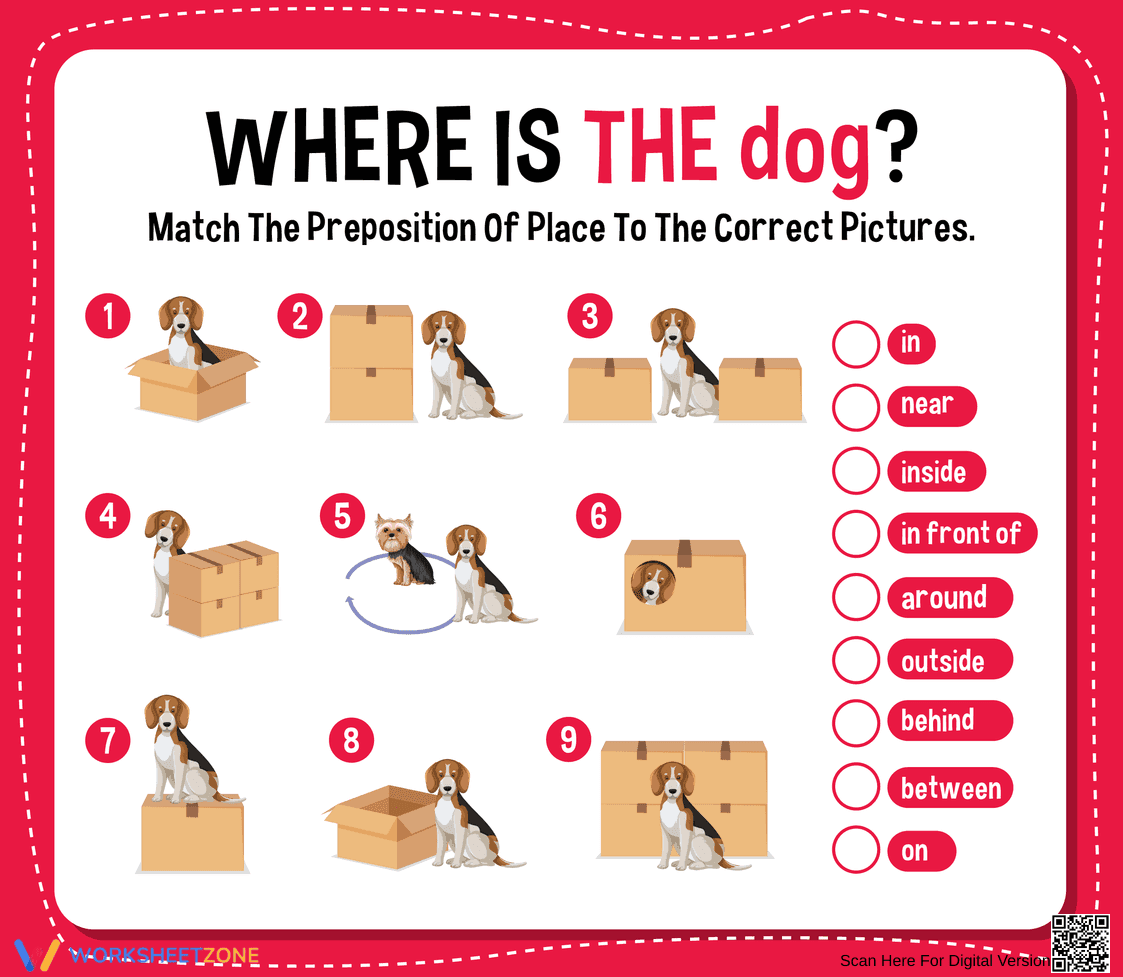

Pre-K Prepositions — Printable No-Prep Worksheet
Paste this activity's link or code into your existing LMS (Google Classroom, Canvas, Teams, Schoology, Moodle, etc.).
Students can open and work on the activity right away, with no student login required.
You'll still be able to track student progress and results from your teacher account.
This Preschool prepositions worksheet helps early learners identify spatial relationships by matching pictures to position words. Students observe a dog's location relative to a box and select the correct term, building foundational vocabulary essential for early reading comprehension.
At a Glance
- Grade: Preschool · Subject: ELA
- Standard:
CCSS.ELA-LITERACY.L.K.1.E— Use frequently occurring prepositions- Skill Focus: Prepositions of place
- Format: 1 page · 9 problems · Answer key included · PDF
- Best For: Independent practice
- Time: 10–15 minutes
This single-page resource features nine visual matching tasks for early childhood education. Each problem displays an illustration of a dog positioned around a box. Students connect the visual scenario with one of nine target prepositions, such as "inside" or "behind." A complete answer key ensures quick grading.
Zero-Prep Workflow
This resource is designed for maximum efficiency. Follow these three steps:
- Print (1 minute): Download the PDF and print copies. The high-contrast images print clearly in grayscale.
- Distribute (1 minute): Hand out the worksheets. The visual layout requires almost no verbal explanation.
- Review (3 minutes): Use the included answer key to quickly check student responses.
With under two minutes of total teacher prep time, this activity is an excellent addition to emergency sub plans.
Standards Alignment
This activity aligns directly with CCSS.ELA-LITERACY.L.K.1.E, requiring students to use the most frequently occurring prepositions. By visually connecting spatial concepts to written words, early learners build the foundational grammar skills necessary for kindergarten readiness. Both standard codes can be copied directly into lesson plans, IEP goals, or district curriculum mapping tools.
How to Use It
Integrate this worksheet during your morning literacy block after a direct instruction lesson on spatial words. It serves as an excellent independent center activity where students can practice matching while the teacher works with small groups. Alternatively, use it as a formative assessment tool; observe whether students struggle with specific directional concepts like "between" versus "around" to guide future instruction. The expected completion time ranges from 10 to 15 minutes, depending on the child's reading level and familiarity with the vocabulary.
Who It's For
This worksheet is primarily designed for Preschool and Pre-K students developing early language and grammar skills. It is also highly effective for English Language Learners (ELLs) who benefit from strong visual supports when acquiring new vocabulary. For a complete lesson experience, pair this printable with a physical demonstration using a stuffed animal and a real box, allowing children to physically recreate the prepositions before completing the paper task.
Mastering spatial vocabulary is a critical milestone in early childhood cognitive development. This resource targets CCSS.ELA-LITERACY.L.K.1.E, helping students use frequently occurring prepositions to describe relationships between objects in their environment. According to Fisher & Frey (2014), providing students with clear, visual representations of abstract vocabulary significantly increases retention and comprehension in early literacy programs. When young learners connect a concrete image—such as a dog sitting behind a cardboard box—to the specific preposition, they build robust mental models that support both reading comprehension and expressive language development. This targeted practice ensures that foundational grammar concepts are solidified before students transition to more complex sentence structures in kindergarten and beyond. By integrating visual matching tasks into daily classroom routines, educators can effectively bridge the gap between spoken language and early reading skills, fostering a deeper, more permanent understanding of spatial relationships.


