


























Views
Downloads
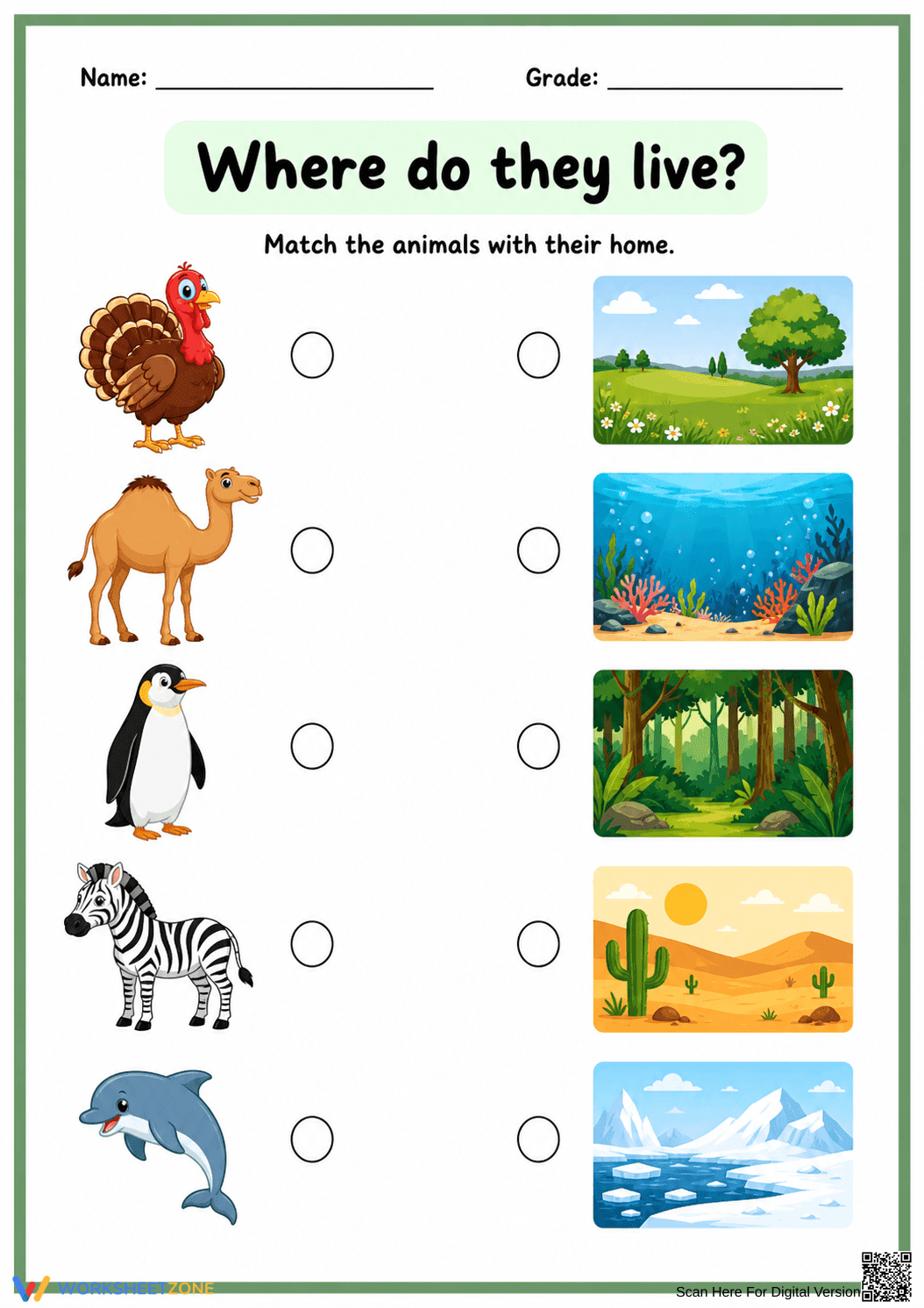

Grade 2 Animal Habitats — Printable No-Prep Worksheet
Paste this activity's link or code into your existing LMS (Google Classroom, Canvas, Teams, Schoology, Moodle, etc.).
Students can open and work on the activity right away, with no student login required.
You'll still be able to track student progress and results from your teacher account.
This Grade 2 science worksheet helps students identify where different animals live by matching them to their correct environments. By connecting creatures like camels and dolphins to their specific biomes, young learners build foundational knowledge of ecosystems and animal adaptations in a highly visual, engaging format.
At a Glance
- Grade: 2 · Subject: Science
- Standard:
2-LS4-1— Compare the diversity of life in different habitats- Skill Focus: Matching animals to habitats
- Format: 1 page · 5 problems · Answer key included · PDF
- Best For: Independent practice
- Time: 10–15 minutes
This single-page resource features five clear, colorful illustrations of animals (turkey, camel, penguin, zebra, dolphin) alongside five distinct habitat scenes (grassland, ocean, forest, desert, polar region). Students simply draw a line to connect each animal to its natural home. A complete answer key is included for quick grading.
- Print (1 min): Download the PDF and print a class set immediately. No special materials are required.
- Distribute (1 min): Hand out the worksheets as a morning warm-up or science center activity.
- Review (3 mins): Quickly check student matches using the provided answer key or review together as a class.
With under two minutes of total teacher prep time, this activity is an excellent addition to any emergency sub plan.
Aligned to primary standard 2-LS4-1: Make observations of plants and animals to compare the diversity of life in different habitats. This activity supports the standard by having students visually identify which environments support which types of life. Both standard codes can be copied directly into lesson plans, IEP goals, or district curriculum mapping tools.
Use this worksheet as a formative assessment after direct instruction on biomes, or place it in a science center for independent review. While students are working, observe whether they can correctly identify the polar and desert habitats, which often share similar barren characteristics but differ in temperature. Expected completion time is 10 to 15 minutes.
This resource is designed for second-grade students, homeschoolers, and ESL learners who benefit from strong visual supports. It pairs perfectly with an introductory lesson or anchor chart on global ecosystems and animal survival needs.
Understanding how organisms interact with their environments is a core component of early science education and foundational for future biological studies. Aligned with 2-LS4-1, this activity asks students to compare the diversity of life in different habitats by matching specific animals to their natural biomes. According to a ScienceDirect TpT Analysis, visual matching tasks significantly reduce cognitive load for early elementary students, allowing them to focus on conceptual relationships rather than complex instructions. When young learners actively connect physical adaptations to the demands of their specific environments, they build stronger, more resilient neural pathways regarding ecological interdependence. By explicitly linking familiar animals to their specific biomes through this targeted exercise, educators can effectively reinforce foundational ecological concepts, support academic vocabulary development, and accurately assess student comprehension of basic life science principles.


