


























Views
Downloads

Printable Synonyms and Antonyms Practice — Grade 2 ELA
Paste this activity's link or code into your existing LMS (Google Classroom, Canvas, Teams, Schoology, Moodle, etc.).
Students can open and work on the activity right away, with no student login required.
You'll still be able to track student progress and results from your teacher account.
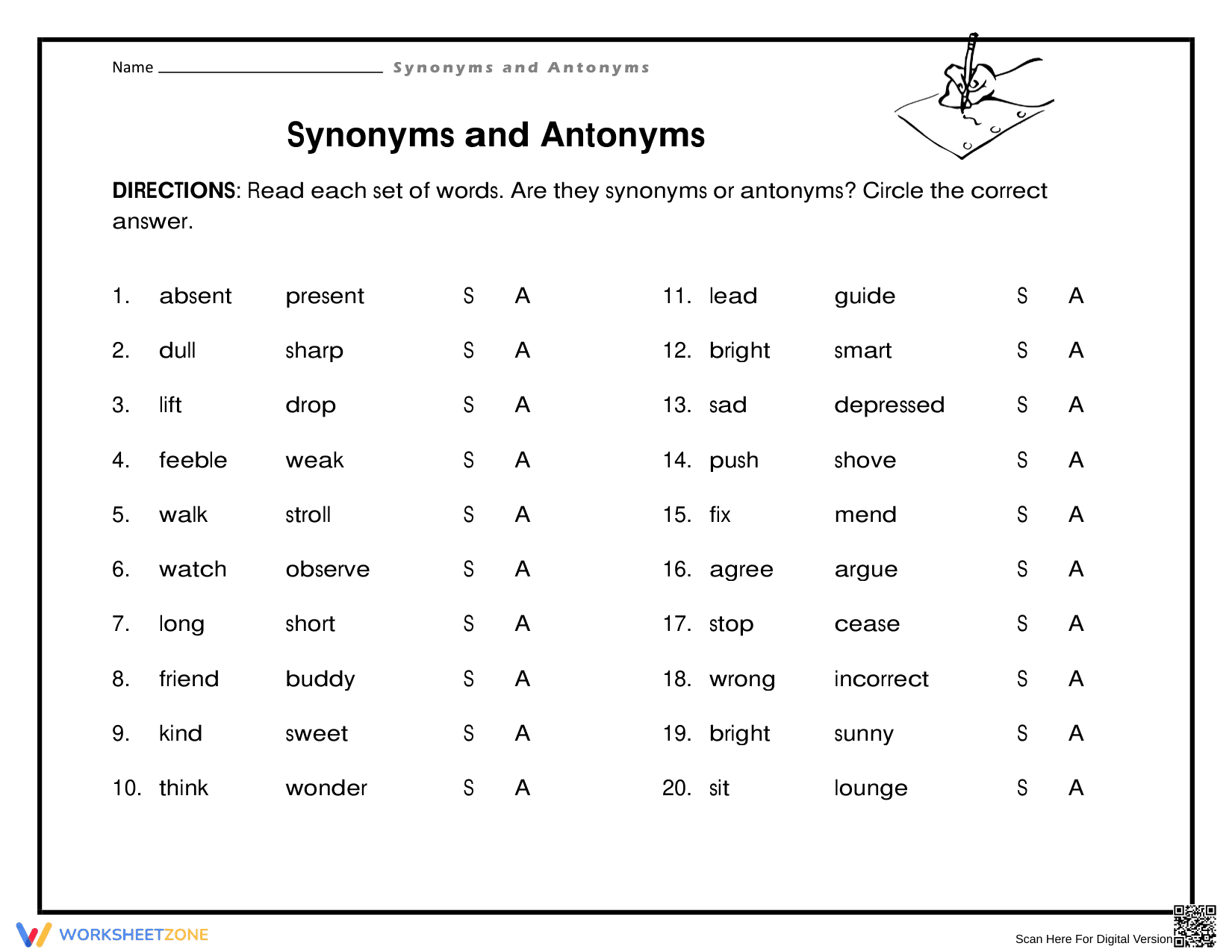
This Synonyms and Antonyms worksheet provides Grade 2 students with focused practice in identifying word relationships. By analyzing 20 distinct word pairs, learners strengthen their vocabulary and linguistic precision, essential for reading comprehension and expressive writing. This resource simplifies complex language concepts into a clear, actionable format that ensures immediate student engagement and measurable skill growth.
At a Glance
- Grade: 2 · Subject: ELA
- Standard:
CCSS.ELA-LITERACY.L.2.5— Demonstrate understanding of word relationships and nuances in word meanings- Skill Focus: Synonyms and Antonyms Identification
- Format: 1 page · 20 problems · Answer key included · PDF
- Best For: Vocabulary warm-ups and quick assessments
- Time: 10–15 minutes
What's Inside
Inside this resource, you will find a cleanly formatted single-page worksheet featuring twenty sets of words. Each item presents a pair of words—such as "absent/present" or "friend/buddy"—and requires students to circle "S" or "A." The self-explanatory layout includes a clear directions line and name field, making it ready for individual work.
Zero-Prep Workflow
The zero-prep workflow is designed for maximum efficiency. First, print the PDF page in seconds. Second, distribute the sheets and provide a brief overview of the task. Finally, review the answers as a group using the included key. Total teacher preparation time remains under two minutes, making this an ideal solution for emergency sub plans or quick transitions.
Standards Alignment
This worksheet is aligned with CCSS.ELA-LITERACY.L.2.5: "Demonstrate understanding of word relationships and nuances in word meanings." It specifically targets the ability to distinguish between synonyms and antonyms. This standard code can be copied directly into lesson plans, IEP goals, or district curriculum mapping tools to ensure instructional compliance and clarity.
How to Use It
Use this as a formative assessment after a lesson on word opposites. It works well during independent practice. Teachers should observe students as they work, noting struggles with specific pairs. The 15-minute completion time makes it a perfect exit ticket to gauge mastery before moving to complex writing tasks.
Who It's For
Tailored for Grade 2, this is also effective for Grade 1 enrichment or Grade 3 review. It supports English Language Learners by providing concrete examples without heavy text. Pair this with a vocabulary anchor chart or descriptive passage to help students see word relationships in context.
According to Fisher & Frey (2014), the development of word consciousness through direct practice with synonyms and antonyms is a critical component of literacy development. This worksheet operationalizes that research by providing students with repeated exposure to the CCSS.ELA-LITERACY.L.2.5 standard. By circling word relationships, students move beyond rote memorization into active linguistic analysis. This focused task builds the foundational semantic networks necessary for advanced reading comprehension and precise writing. Research from the NAEP consistently indicates that students with a robust grasp of word nuances perform significantly better on standardized reading assessments. This resource provides the structured, high-frequency practice required to bridge the gap between simple word recognition and deep semantic understanding. Educators can confidently integrate this worksheet into any evidence-based literacy block to support diverse learners and meet rigorous district standards for vocabulary acquisition and linguistic precision.


