


























Views
Downloads

Essential Grade 1 Four Seasons Matching Worksheet
Paste this activity's link or code into your existing LMS (Google Classroom, Canvas, Teams, Schoology, Moodle, etc.).
Students can open and work on the activity right away, with no student login required.
You'll still be able to track student progress and results from your teacher account.
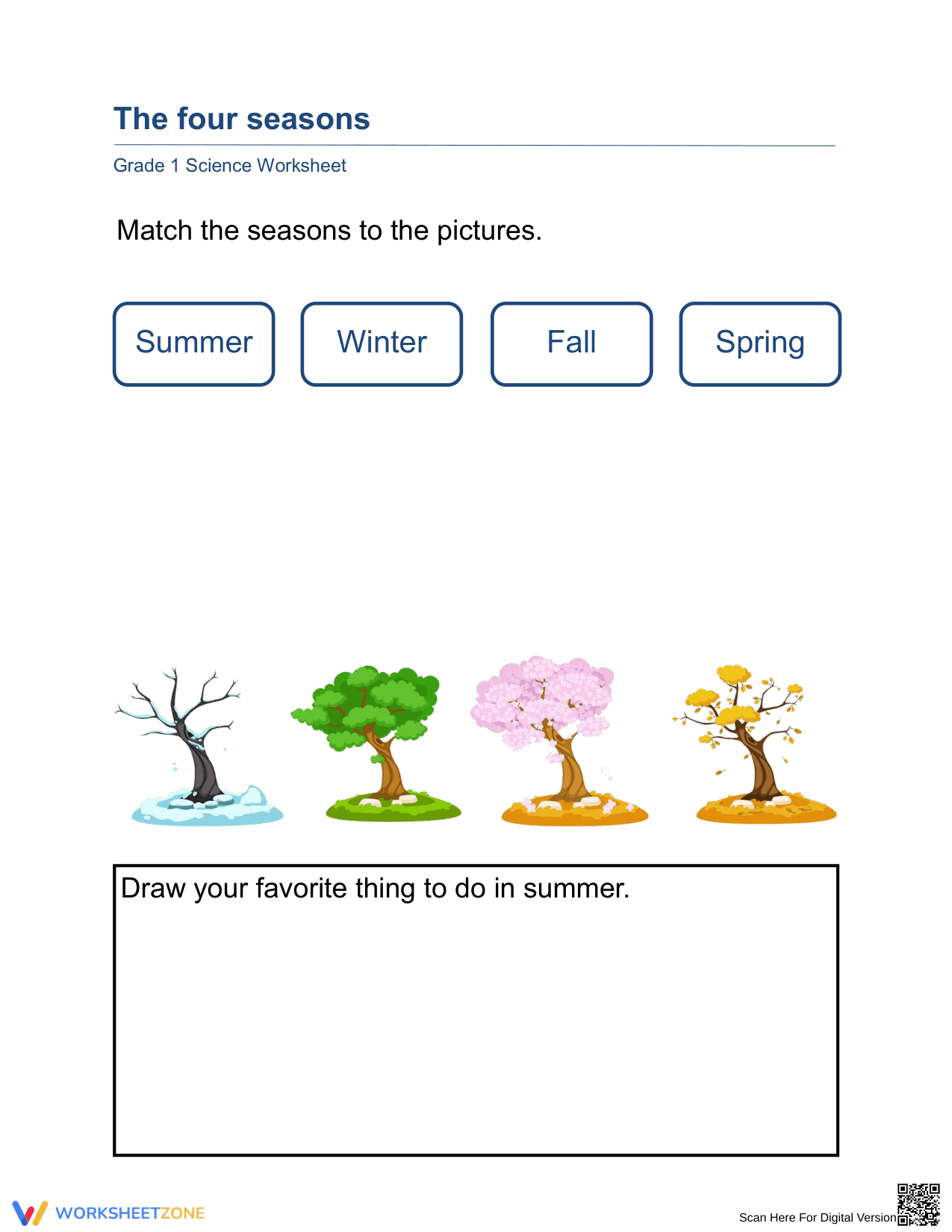
This Grade 1 science worksheet helps students identify and distinguish between the four seasons through visual matching and creative expression. By connecting seasonal names to iconic tree transformations, learners build a concrete understanding of Earth’s patterns. Students conclude by drawing a personal connection to summer activities, reinforcing their observational skills and seasonal vocabulary in one session.
At a Glance
- Grade: 1 · Subject: Science
- Standard:
1-ESS1-2— Make observations to describe seasonal patterns of change over time- Skill Focus: Seasonal identification and matching
- Format: 1 page · 5 problems · Answer key included · PDF
- Best For: Independent practice or seasonal science unit
- Time: 10–15 minutes
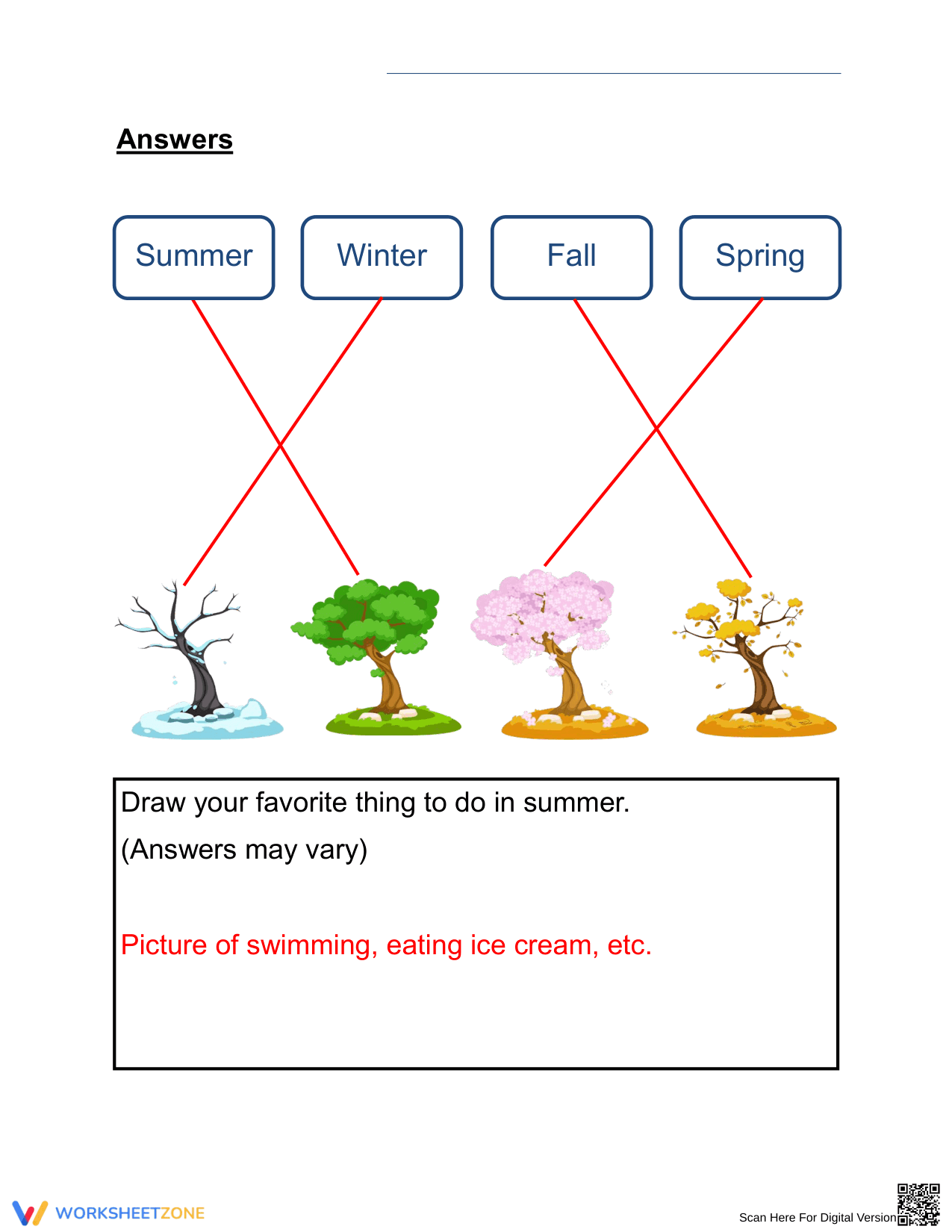
This printable resource features a structured matching exercise where students pair the labels for Summer, Winter, Fall, and Spring with corresponding illustrations of a tree’s life cycle. The worksheet also includes a dedicated creative space for students to illustrate a summer-themed activity. The provided answer key ensures quick checking, while the high-contrast layout supports early readers in Grade 1 and Kindergarten.
The zero-prep workflow for this seasonal resource is designed for maximum efficiency. First, print the single-page PDF (approx. 10 seconds). Next, distribute the sheets to your students during your science block or as a morning warm-up (approx. 30 seconds). Finally, review the matching results using the provided key or display it on a projector for a whole-class check (approx. 1 minute).
This worksheet is primarily aligned to 1-ESS1-2, which requires students to make observations of the sun, moon, and stars to describe patterns that can be predicted. In an introductory context, this involves recognizing the visual markers of seasonal change. This standard code can be copied directly into lesson plans, IEP goals, or district curriculum mapping tools to document evidence of student learning.
Use this worksheet as a formative assessment after a direct instruction lesson on weather patterns. Teachers can observe how quickly students identify the "Fall" and "Spring" trees to gauge their understanding of transitional seasons. It also works perfectly as a quiet-time activity during a science center rotation. Expect most students to complete the matching and drawing within 12 minutes.
This resource is designed for first-grade students, but is highly accessible for Kindergarteners and Preschool learners due to its visual nature. It provides excellent support for English Language Learners (ELL) by pairing vocabulary words directly with clear, colorful imagery. Pair this with a seasonal picture book or a weather-themed anchor chart for a comprehensive science experience.
According to research by Fisher & Frey (2014), the use of visual matching tasks in early elementary science significantly enhances the acquisition of domain-specific vocabulary. This worksheet implements that principle by focusing on the 1-ESS1-2 standard through the plain-English skill of identifying seasonal markers. By requiring students to observe tree changes and translate those observations into seasonal categories, the activity builds the foundational cognitive frameworks necessary for more advanced earth science topics. This approach ensures that learners are not just memorizing words but are instead developing a predictive understanding of environmental cycles. Educators can rely on this structured practice to bridge the gap between abstract time concepts and concrete visual evidence found in nature, providing a reliable data point for student progress in weather and climate units.


