


























Views
Downloads



Essential 3-Digit Place Value Worksheet | Grade 2 Math
Paste this activity's link or code into your existing LMS (Google Classroom, Canvas, Teams, Schoology, Moodle, etc.).
Students can open and work on the activity right away, with no student login required.
You'll still be able to track student progress and results from your teacher account.
This Grade 2 place value worksheet helps students master three-digit numbers by identifying hundreds, tens, and ones across multiple representations. Students will practice reading abacuses, place value charts, and base ten blocks to determine the total value. This comprehensive practice ensures students build a strong conceptual foundation for mental math and multi-digit operations.
At a Glance
- Grade: 2 · Subject: Math
- Standard:
2.NBT.A.1— Understand that the three digits of a three-digit number represent amounts of hundreds, tens, and ones.- Skill Focus: 3-Digit Place Value & Representations
- Format: 3 pages · 15 problems · Answer key included · PDF
- Best For: Independent practice, centers, or formative assessment
- Time: 20–30 minutes
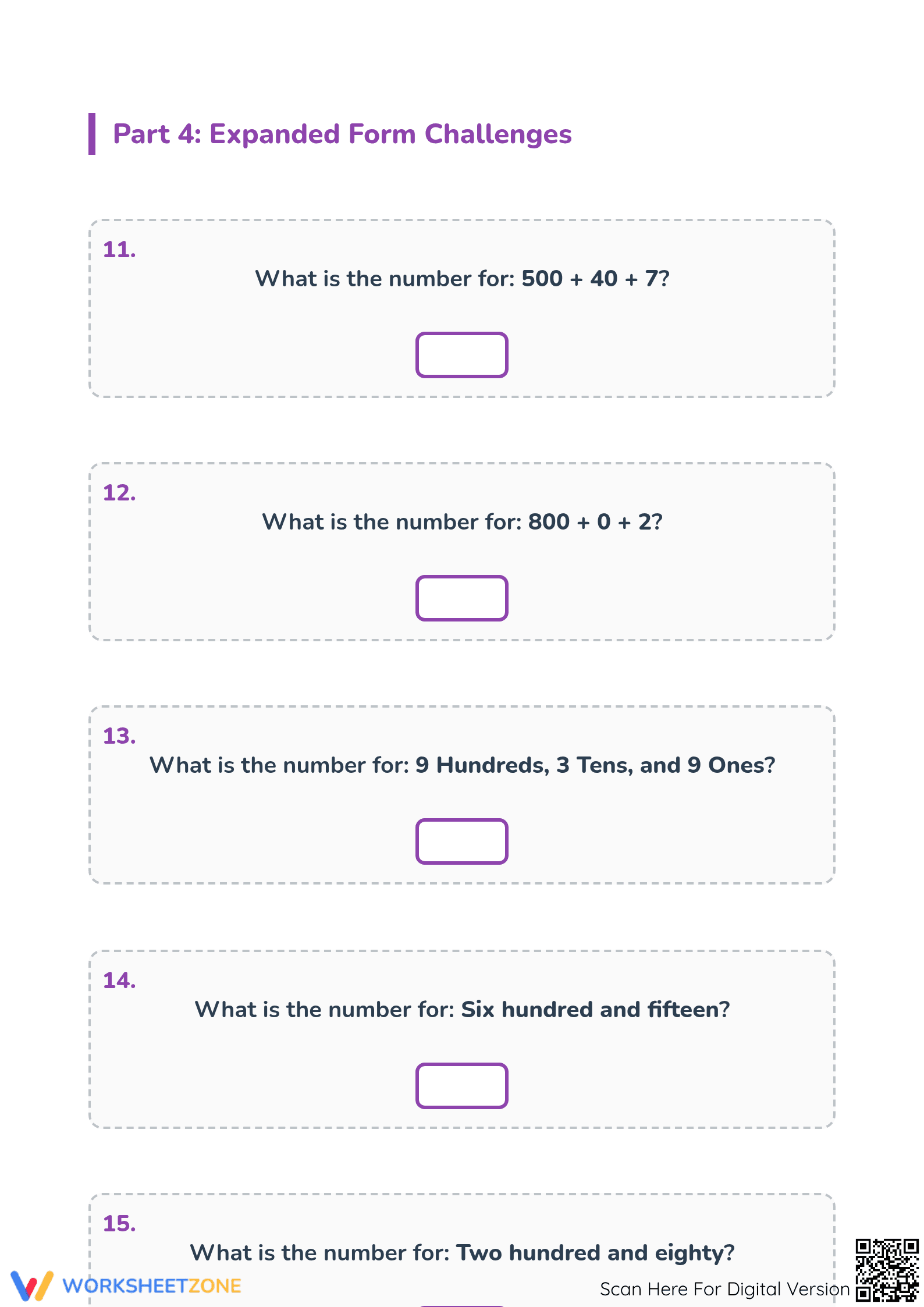
This three-page PDF features 15 varied problems designed to test different aspects of place value. The worksheet is divided into four sections: Abacus Place Value, Place Value Charts with tally marks, Base Ten Blocks, and Expanded Form Challenges. The final section also includes word-form conversions to ensure students can translate between numerals and number names. A full answer key is included for quick grading.
Skill Progression
- Guided Practice (Problems 1-4): Students begin by reading abacus representations, which provides a clear visual structure for separating hundreds, tens, and ones.
- Supported Practice (Problems 5-10): The complexity increases as students interpret tally-mark place value charts and physical base ten block illustrations.
- Independent Practice (Problems 11-15): The final tasks require abstract reasoning, as students convert expanded forms and written number names into standard numerals without visual aids.
This progression follows the gradual-release model, moving from concrete visual supports to abstract mathematical notation using the I Do, We Do, You Do method.
Standards Alignment
Primary standard: 2.NBT.A.1 — "Understand that the three digits of a three-digit number represent amounts of hundreds, tens, and ones; e.g., 706 equals 7 hundreds, 0 tens, and 6 ones." This worksheet also supports 2.NBT.A.3 by requiring students to read and write numbers using base-ten numerals, number names, and expanded form. Both standard codes can be copied directly into lesson plans, IEP goals, or district curriculum mapping tools.
How to Use It
Assign this worksheet after direct instruction on the 100s place value. It works perfectly as a mid-unit check to see if students can generalize the concept across different visual models. While students work, observe if they struggle specifically with the "zero" place holder in expanded form (Problem 12), as this is a common misconception in early numeration. Expected completion time is 25 minutes.
Who It's For
This resource is ideal for second-grade students learning three-digit numbers. It is also suitable for third-grade review or for first-grade students ready for advanced extension. Pair this worksheet with physical base ten blocks or a digital abacus tool for students who need additional concrete support before moving to the paper-based tasks.
This worksheet aligns with the "Concrete-Representational-Abstract" (CRA) instructional sequence, a research-validated framework for building deep mathematical understanding. By providing 15 tasks that bridge visual models like abacuses and blocks with abstract numerical forms, it helps students internalize the structure of the base-ten system. According to Fisher & Frey (2014), such varied practice is essential for the gradual release of responsibility, allowing students to move from guided interpretation to independent mastery. The inclusion of standard 2.NBT.A.1 ensures that the content meets the rigorous demands of national mathematics frameworks. Educators can use the results as a formative assessment to identify specific gaps in place value logic before moving to three-digit addition and subtraction. This resource provides the high-quality, focused practice necessary for students to develop fluency with number names and expanded forms in standard CCSS contexts.


