


























Views
Downloads


Cinco de Mayo Reading Worksheet | Grade 5-7 Essential
Paste this activity's link or code into your existing LMS (Google Classroom, Canvas, Teams, Schoology, Moodle, etc.).
Students can open and work on the activity right away, with no student login required.
You'll still be able to track student progress and results from your teacher account.
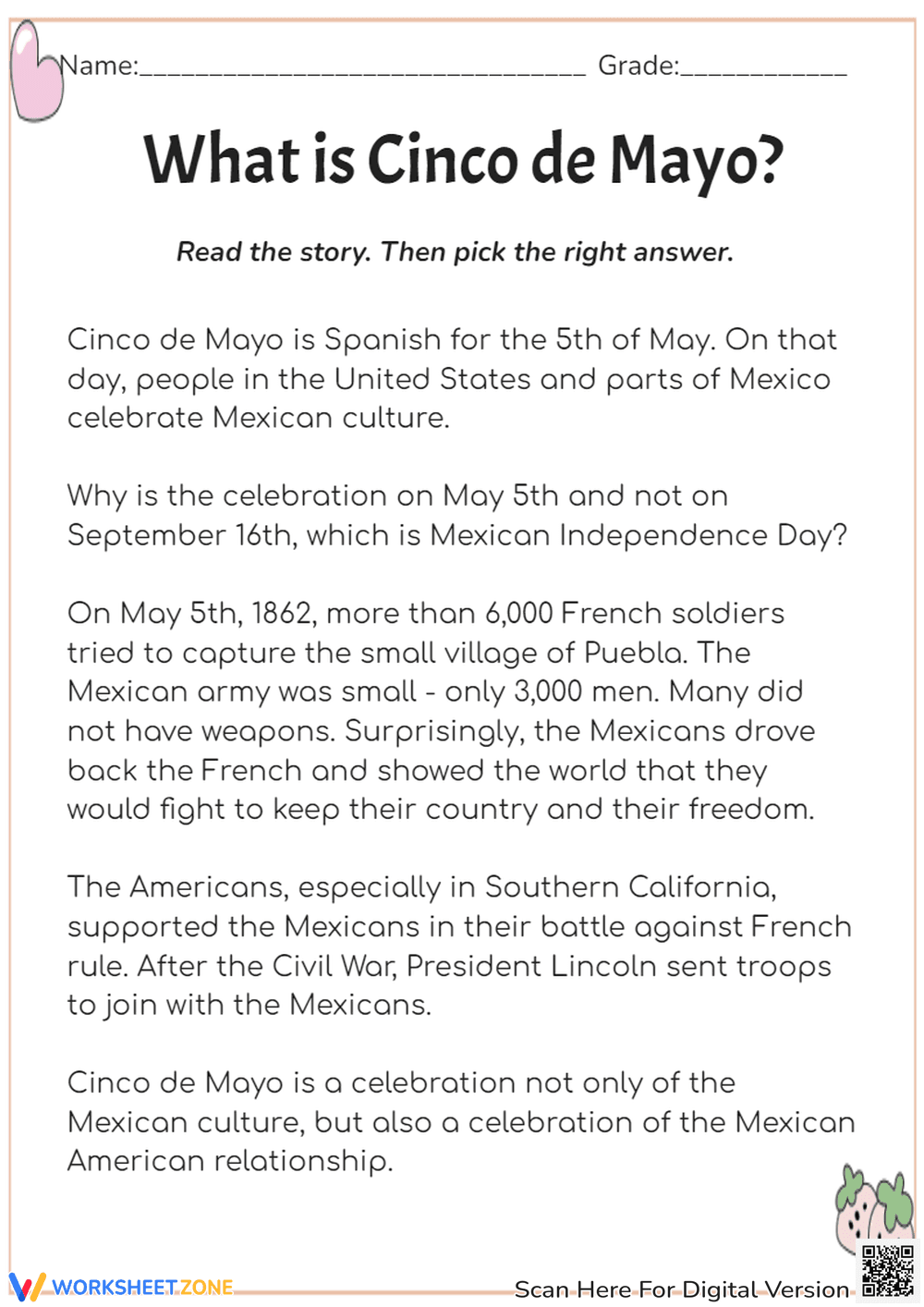
This Grade 5-7 reading comprehension worksheet provides a concise history of Cinco de Mayo, focusing on the 1862 Battle of Puebla. Students read an informational text and answer 7 targeted multiple-choice questions to demonstrate their understanding of historical facts and cultural significance. It is an ideal resource for building literacy during Hispanic Heritage Month.
At a Glance
- Grade: 5-7 · Subject: ELA / Social Studies
- Standard:
CCSS.ELA-LITERACY.RI.5.1— Quote accurately from a text when explaining what the text says explicitly- Skill Focus: Reading Comprehension & Historical Context
- Format: 2 pages · 7 problems · Answer key included · PDF
- Best For: Holiday-themed literacy practice or sub plans
- Time: 15–20 minutes
The resource consists of a two-page PDF document designed for immediate classroom use. The first page features a high-interest informational passage that clarifies common misconceptions about the holiday, such as the difference between Cinco de Mayo and Mexican Independence Day. The second page contains 7 multiple-choice questions that require students to recall specific dates, names, and causal relationships described in the text.
This worksheet is designed for a zero-prep workflow to maximize instructional time. First, print the two-page document in under 30 seconds. Second, distribute the copies to students for independent or paired reading. Finally, review the answers as a whole group using the provided key to provide immediate feedback. Total teacher preparation time is under 2 minutes, making it an excellent option for emergency sub plans or seasonal bell-ringers.
The primary focus is CCSS.ELA-LITERACY.RI.5.1, which requires students to quote accurately from a text when explaining what the text says explicitly and when drawing inferences. By identifying the specific year of the Battle of Puebla and the leaders involved, students practice evidence-based reading. Both standard codes can be copied directly into lesson plans, IEP goals, or district curriculum mapping tools to ensure compliance with state frameworks.
Use this worksheet during the guided practice phase of a literacy block or as a social studies warm-up during May or Hispanic Heritage Month. For a formative assessment, observe if students refer back to the text on page one while answering the questions on page two. This indicates they are developing the habit of using textual evidence rather than relying on memory. The expected completion time is approximately 15 to 20 minutes.
This resource is tailored for students in grades 5, 6, and 7, including English Language Learners who benefit from clear, chronological narratives. It pairs naturally with a map of Mexico or an anchor chart detailing the timeline of the French Intervention in Mexico. It provides a structured way to integrate cultural history into the daily ELA routine without requiring extensive background knowledge from the instructor.
Research by Fisher & Frey (2014) emphasizes that complex informational texts are most effective when paired with text-dependent questions that require students to return to the source material. This worksheet implements that strategy by focusing on CCSS.ELA-LITERACY.RI.5.1, ensuring students develop the discipline to cite specific evidence. By engaging with the 7 multiple-choice tasks, learners move beyond surface-level reading to identify the nuances of the Mexican-American relationship and the historical significance of the 1862 conflict. The structured format supports the gradual release of responsibility, allowing teachers to transition from modeled reading to independent mastery. Such evidence-based practices are critical for meeting the rigorous demands of middle-school literacy frameworks. This resource provides a reliable, research-backed method for assessing student ability to extract factual data from non-fiction prose while celebrating cultural diversity in a classroom setting.


