


























Views
Downloads
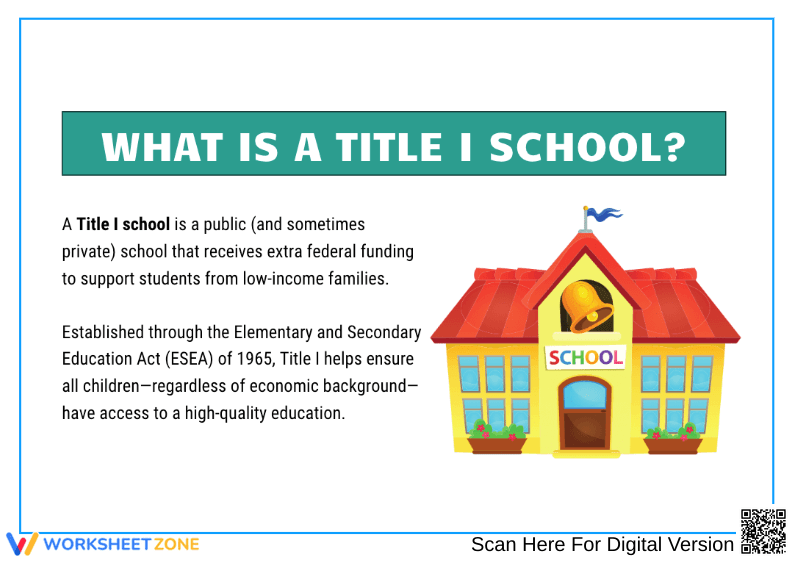

What Is a Title I School? Printable Grade 6-8 Guide
Paste this activity's link or code into your existing LMS (Google Classroom, Canvas, Teams, Schoology, Moodle, etc.).
Students can open and work on the activity right away, with no student login required.
You'll still be able to track student progress and results from your teacher account.
This informational worksheet provides a clear, student-friendly explanation of Title I schools and the Elementary and Secondary Education Act (ESEA) of 1965. Students will analyze how federal funding supports educational equity for low-income families, ensuring they understand the structural foundations of the American public school system through focused reading and response.
At a Glance
- Grade: 6-8 · Subject: Social Studies
- Standard:
CCSS.ELA-LITERACY.RI.6.2— Determine central ideas and provide a summary of informational text- Skill Focus: Informational Text Analysis
- Format: 2 pages · 5 problems · Answer key included · PDF
- Best For: Civics lessons and educational equity discussions
- Time: 15–20 minutes
The resource features a concise informational passage defining Title I schools and their historical context via the ESEA. It includes a 2-page layout with 5 targeted comprehension questions designed to test recall and critical thinking. A full answer key is provided to facilitate quick grading or student self-correction, making it a versatile tool for various classroom settings.
Teachers can implement this resource in three simple steps. First, print the PDF (30 seconds). Second, distribute the handout as a warm-up or supplemental reading during a civics unit (1 minute). Third, review the answers using the included key to check for student understanding (5 minutes). Total teacher preparation time is under 2 minutes, making it an ideal sub plan or last-minute addition to a lesson on social policy.
The primary focus is `CCSS.ELA-LITERACY.RI.6.2`, which requires students to determine the central idea of a text and how it is conveyed through particular details. By summarizing the purpose of Title I, students demonstrate mastery of informational text structures. Both standard codes can be copied directly into lesson plans, IEP goals, or district curriculum mapping tools.
Use this worksheet during a unit on government programs or educational history to provide concrete context for federal spending. It serves as an excellent formative assessment tool; observe if students can distinguish between the funding source and the intended student outcome. Expected completion time is 15 to 20 minutes, allowing it to fit into tight instructional blocks.
This resource is designed for middle school students in grades 6 through 8, particularly those in Social Studies or ELA classes. It is highly effective for students requiring clear, scaffolded definitions of complex civic terms and pairs naturally with an anchor chart about the three branches of government or federal budget allocations.
According to the RAND AIRS 2024 report, informational literacy regarding school structures helps students better understand their own educational environment and the role of federal policy. This worksheet addresses CCSS.ELA-LITERACY.RI.6.2 by requiring students to summarize the central idea of Title I funding and the ESEA of 1965. By engaging with 5 specific tasks, students move from basic recall to a deeper understanding of how legislative acts like the ESEA aim to provide high-quality education regardless of economic background. Research from Fisher & Frey (2014) emphasizes that providing students with clear, student-facing definitions of complex institutional terms reduces cognitive load and improves long-term retention of civic concepts. This resource provides a structured pathway for students to master informational text analysis while gaining essential knowledge about the American educational landscape and the mechanisms of federal support.


