


























Views
Downloads

Body Language Analysis Worksheet | Grade 6-9 Essential
Paste this activity's link or code into your existing LMS (Google Classroom, Canvas, Teams, Schoology, Moodle, etc.).
Students can open and work on the activity right away, with no student login required.
You'll still be able to track student progress and results from your teacher account.
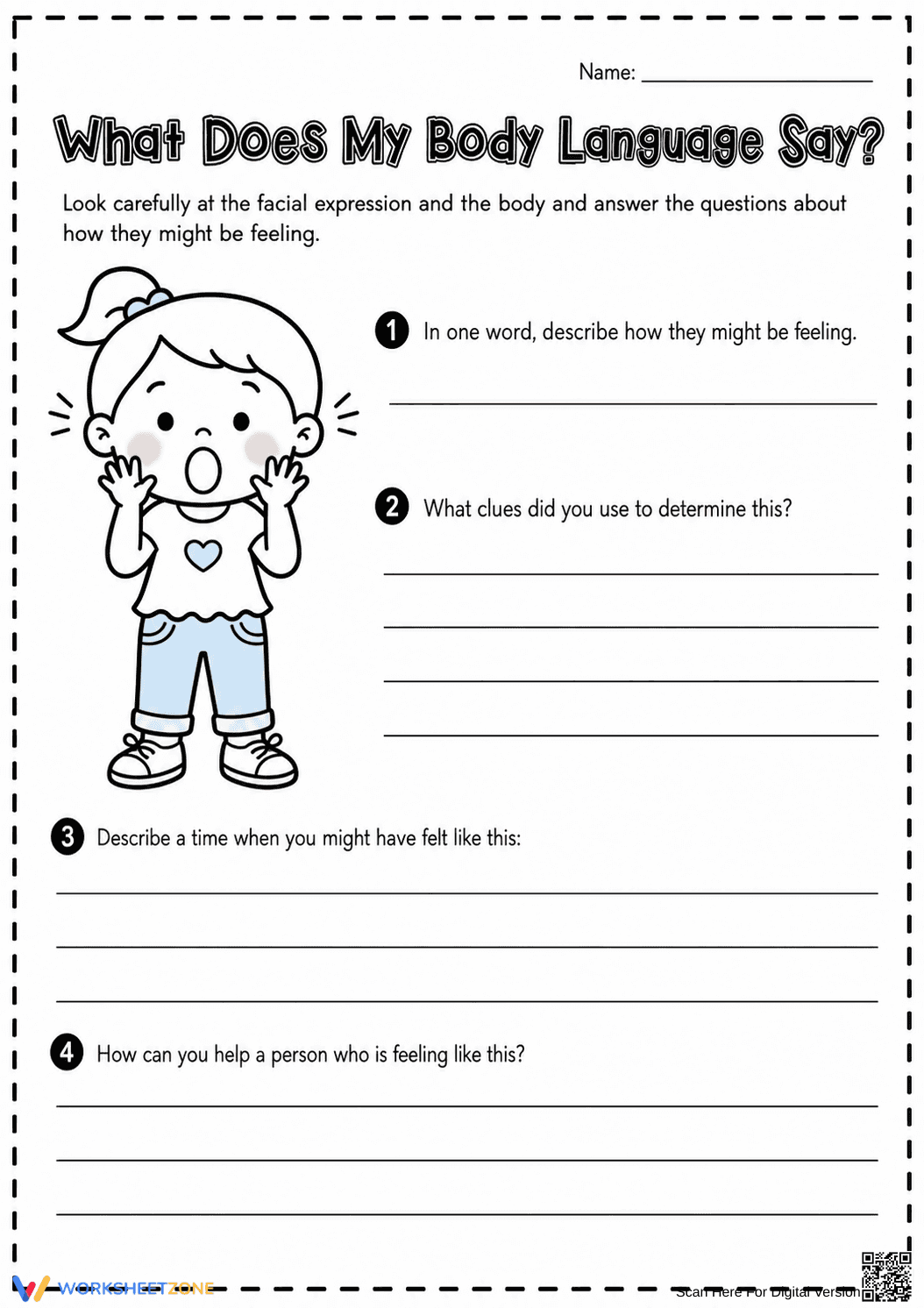
This social skills worksheet helps middle school students decode nonverbal communication by analyzing facial expressions and physical posture. Students identify specific emotions and the visual evidence that supports their conclusions, fostering deeper empathy and situational awareness. By connecting these observations to personal experiences, learners strengthen their emotional intelligence and interpersonal communication skills.
At a Glance
- Grade: 6-9 · Subject: Social Skills
- Standard:
CCSS.ELA-LITERACY.SL.6.1— Interpret information presented in diverse media and formats, including visual and oral.- Skill Focus: Nonverbal communication
- Format: 1 page · 4 problems · Answer key included · PDF
- Best For: Social-emotional learning and behavior intervention
- Time: 15–20 minutes
This single-page PDF features a clear visual prompt of a person expressing a complex emotion. It contains four structured reflection questions that move from simple identification to complex social problem-solving. The layout provides ample writing space for students to explain their reasoning, making it an effective tool for both ELA and behavioral health settings.
The zero-prep workflow is designed for busy educators. First, print the single-page PDF in under 30 seconds. Second, distribute the sheets to students as a bell-ringer or transition activity, taking less than one minute. Finally, facilitate a 10-minute group discussion to compare different interpretations of the visual cues. Total teacher preparation time is less than two minutes.
This resource aligns with `CCSS.ELA-LITERACY.SL.6.1`, which requires students to interpret information presented in diverse media and formats, including visual cues. It also supports social-emotional learning frameworks by focusing on social awareness and relationship skills. Both standard codes can be copied directly into lesson plans, IEP goals, or district curriculum mapping tools.
Use this worksheet as a formative assessment during a unit on nonverbal communication. Observe if students can identify specific physical markers like wide eyes or raised hands. It also works well as a check-in tool for school counselors to help students process their own reactions to social scenarios. Expected completion time is 15 to 20 minutes.
This activity is ideal for middle school students in general education, special education, or speech-language therapy. It is particularly helpful for students with IEP goals related to social pragmatics. Pair this worksheet with a short video clip of silent acting or a character study from a current class novel to deepen the analysis.
According to Fisher & Frey (2014), the ability to interpret visual and nonverbal information is a foundational component of literacy that directly impacts a student's social and academic success. This worksheet targets CCSS.ELA-LITERACY.SL.6.1 by requiring students to synthesize visual evidence into a coherent emotional profile. Research indicates that explicit instruction in social-emotional cues reduces interpersonal conflict and improves classroom climate. By using this 4-task analysis, educators provide a structured framework for students to practice empathy and perspective-taking. The activity bridges the gap between simple recognition and the complex application of social skills in real-world environments. This resource serves as a reliable tool for tracking progress in emotional literacy, ensuring that students meet the rigorous demands of middle school social standards while developing the soft skills necessary for future career readiness and healthy adult relationships.


