


























Views
Downloads
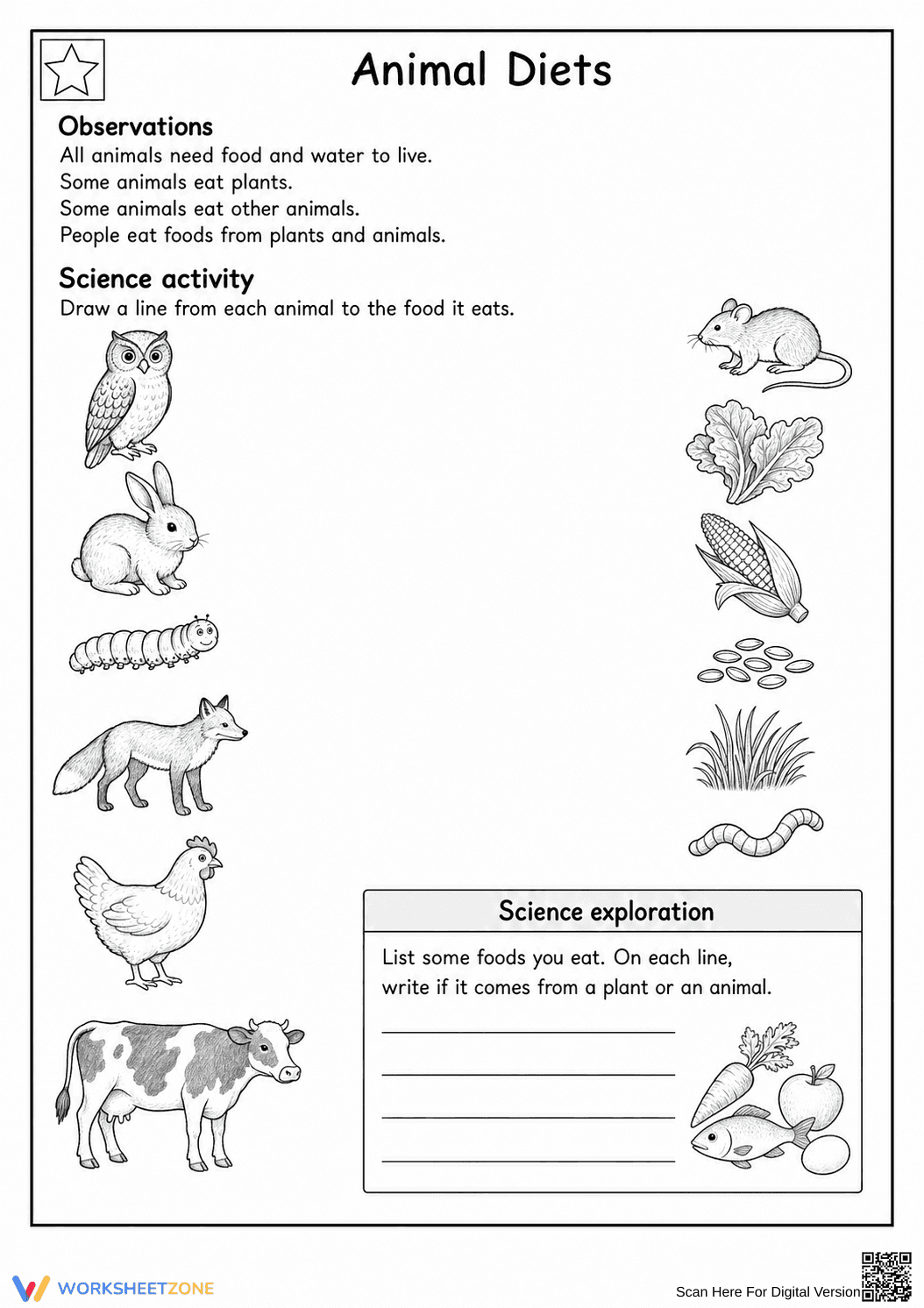

Essential Grade 1 Animal Diets Printable Worksheet
Paste this activity's link or code into your existing LMS (Google Classroom, Canvas, Teams, Schoology, Moodle, etc.).
Students can open and work on the activity right away, with no student login required.
You'll still be able to track student progress and results from your teacher account.
This Grade 1 animal diets worksheet helps students understand that all living things require food to survive. By identifying whether animals eat plants or other animals, learners build a foundational understanding of biological needs and energy sources. This resource provides a clear, visual way to introduce basic classification and life science concepts.
At a Glance
- Grade: 1 · Subject: Science
- Standard:
1-LS1-1— Identify that animals get food from plants or other animals to survive.- Skill Focus: Animal Diets and Food Sources
- Format: 1 page · 2 tasks · No answer key included · PDF
- Best For: Introductory lessons or science centers
- Time: 10–15 minutes
What's Inside
This single-page PDF features two distinct activities designed for early learners. The first task is a visual matching exercise where students connect six different animals—including an owl, rabbit, and cow—to their specific food sources. The second task, "Science Exploration," encourages personal connection by asking students to categorize their own meals as plant-based or animal-based.
Zero-Prep Workflow
This resource is designed for immediate classroom implementation with minimal teacher oversight.
- Print (1 min): The black-and-white layout ensures fast, high-volume printing for the whole class.
- Distribute (1 min): Hand out the single sheet; the visual cues make instructions self-explanatory for most first graders.
- Review (3 min): Use the matching section as a quick formative check to ensure students understand the plant vs. animal distinction.
Total teacher prep time is under two minutes, making this an excellent choice for emergency sub plans or science block fillers.
Standards Alignment
This activity directly supports Next Generation Science Standard 1-LS1-1 by modeling how animals meet their need for food. It addresses the core idea that animals get food from plants or other animals, a key concept for understanding ecosystems. Both standard codes can be copied directly into lesson plans, IEP goals, or district curriculum mapping tools.
How to Use It
Use this worksheet during the "Explain" or "Elaborate" phase of a 5E science lesson. It serves as an effective formative assessment tool; observe students as they match the owl or fox to see if they recognize predatory relationships. The expected completion time is 10 to 15 minutes, allowing it to fit perfectly into a rotation-based science center or as a focused homework assignment.
Who It's For
This worksheet is tailored for Grade 1 students but can be used for Kindergarten enrichment or Grade 2 review. The clear illustrations support English Language Learners and early readers. It pairs naturally with a classroom anchor chart about herbivores and carnivores or a read-aloud about animal habitats.
Foundational science skills are critical for building scientific literacy. This worksheet offers direct practice aligned with NGSS standard 1-LS1-1, focusing on the core concept that animals get energy by eating plants or other animals. Providing students with concrete models and matching activities reinforces these classifications. According to research from Fisher & Frey (2014), moving from a structured activity to independent exploration is a proven method for cementing knowledge. This worksheet follows that model, transitioning from a simple matching task to a personal application. By engaging with this standard, students learn to observe and classify the natural world, a key practice for developing scientific reasoning for future learning in biology and ecology. This structured approach ensures that learners apply facts to their own lives, which is essential for long-term retention in early childhood science education.


