


























Views
Downloads
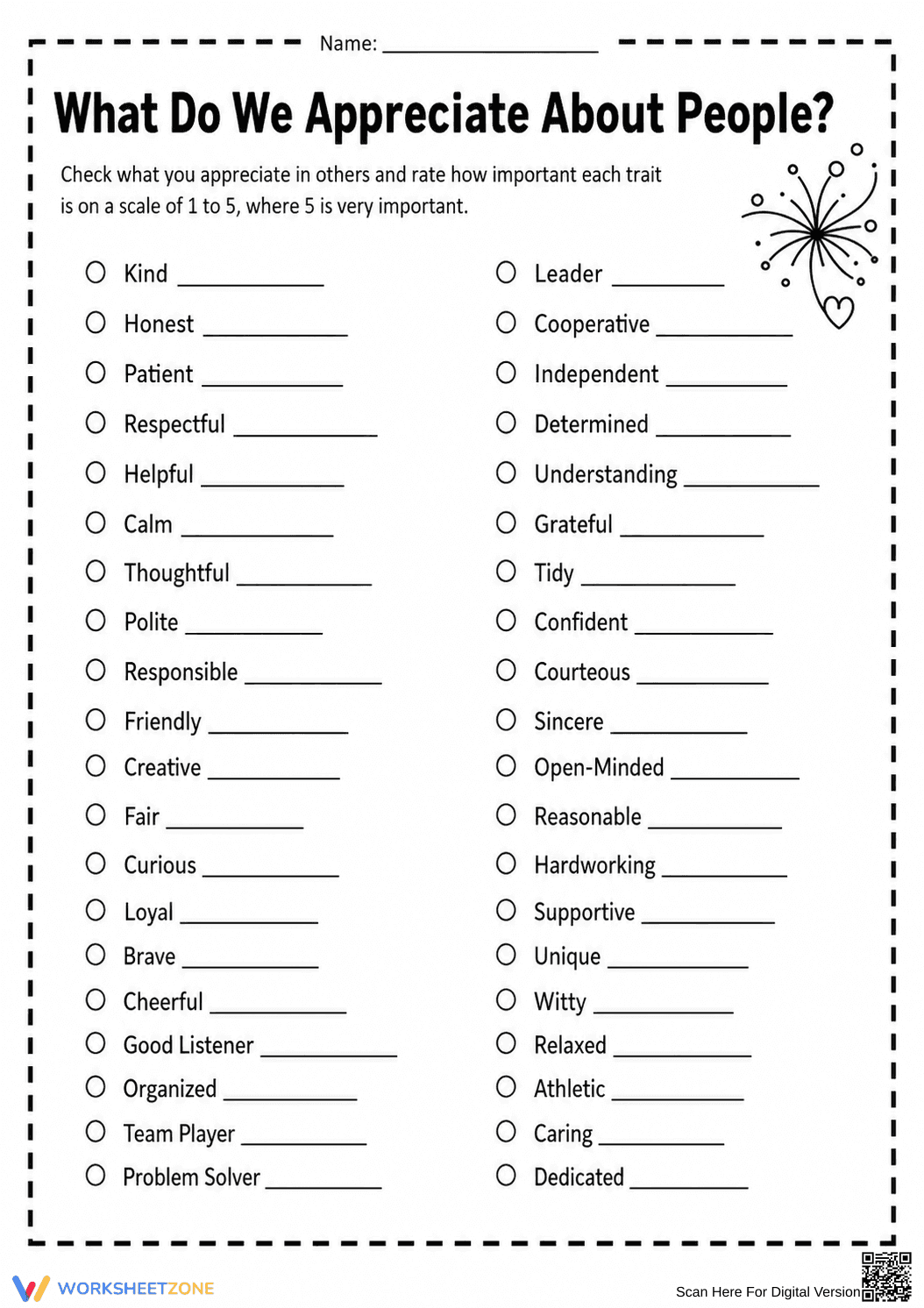

Grade 3 Character Traits — Printable No-Prep Worksheet
Paste this activity's link or code into your existing LMS (Google Classroom, Canvas, Teams, Schoology, Moodle, etc.).
Students can open and work on the activity right away, with no student login required.
You'll still be able to track student progress and results from your teacher account.
This printable social-emotional learning worksheet helps students identify and evaluate positive character traits in others. By reviewing a comprehensive list of qualities like honesty, patience, and leadership, learners actively reflect on what they value in friendships and community members while expanding their social vocabulary.
At a Glance
- Grade: 3 · Subject: Social Skills
- Standard:
CCSS.ELA-LITERACY.L.3.6— Acquire and use vocabulary related to character traits.- Skill Focus: Evaluating character traits
- Format: 1 page · 40 problems · No answer key needed · PDF
- Best For: Morning work or SEL blocks
- Time: 15–20 minutes
This single-page resource features a structured checklist of 40 distinct character traits, ranging from foundational concepts like "Kind" and "Helpful" to more advanced vocabulary such as "Courteous," "Sincere," and "Open-Minded." Students are tasked with checking the traits they appreciate most in their peers and then rating the importance of each selected quality on a scale of 1 to 5. Because the activity relies on personal reflection and subjective values, no answer key is required, allowing for authentic self-expression.
Designed for immediate classroom implementation, this activity requires absolutely no teacher setup.
- Print (1 minute): Simply download the PDF and print a class set. The clean, black-and-white design is ink-friendly.
- Distribute (1 minute): Hand out the sheets during morning meeting, advisory, or a dedicated social-emotional learning block.
- Review (5 minutes): Read the instructions aloud and briefly model how to rate a trait using the 1 to 5 scale.
With under two minutes of total prep time, this worksheet is an excellent addition to emergency sub plans or transition periods.
This activity aligns with CCSS.ELA-LITERACY.L.3.6, requiring students to acquire and use accurately grade-appropriate conversational, general academic, and domain-specific words and phrases. By contextualizing these vocabulary words within personal relationships, students deepen their semantic understanding of abstract nouns and adjectives. Both standard codes can be copied directly into lesson plans, IEP goals, or district curriculum mapping tools.
Teachers can utilize this worksheet as a springboard for small group discussions during morning meetings. Have students complete the rating scale individually, then pair up to compare which three traits they ranked as a "5" (very important) and explain why. As a formative assessment observation tip, listen to student conversations to gauge their comprehension of more complex vocabulary words like "Determined" or "Reasonable." The entire activity takes roughly 15 to 20 minutes to complete.
This resource is ideal for third through fifth-grade students developing their social awareness and relationship skills. It naturally differentiates itself, as students engage with the vocabulary at their own developmental level. Pair this worksheet with a read-aloud focused on friendship or a classroom anchor chart defining positive community behaviors to reinforce the concepts.
Integrating explicit vocabulary instruction with social-emotional learning significantly enhances both academic and interpersonal outcomes. According to a RAND AIRS 2024 report, students who regularly engage in structured self-reflection activities demonstrate improved peer relationships and a deeper internalization of academic vocabulary. This worksheet supports that methodology by targeting CCSS.ELA-LITERACY.L.3.6, prompting learners to acquire and use vocabulary related to character traits. By evaluating 40 specific qualities, students move beyond rote memorization and begin applying complex descriptive words to their daily social interactions. This dual-purpose approach ensures that classroom time is maximized, simultaneously addressing language standards and fostering a supportive classroom climate. The structured rating system provides a concrete framework for abstract concepts, making it an essential tool for holistic student development.


