


























0
Views
0
Downloads

0.0
0
Save
0 Likes
Share
Identifying What's Loud Worksheet
0 Views
0 Downloads
Paste this activity's link or code into your existing LMS (Google Classroom, Canvas, Teams, Schoology, Moodle, etc.).
Students can open and work on the activity right away, with no student login required.
You'll still be able to track student progress and results from your teacher account.
Information
Description
What It Is:
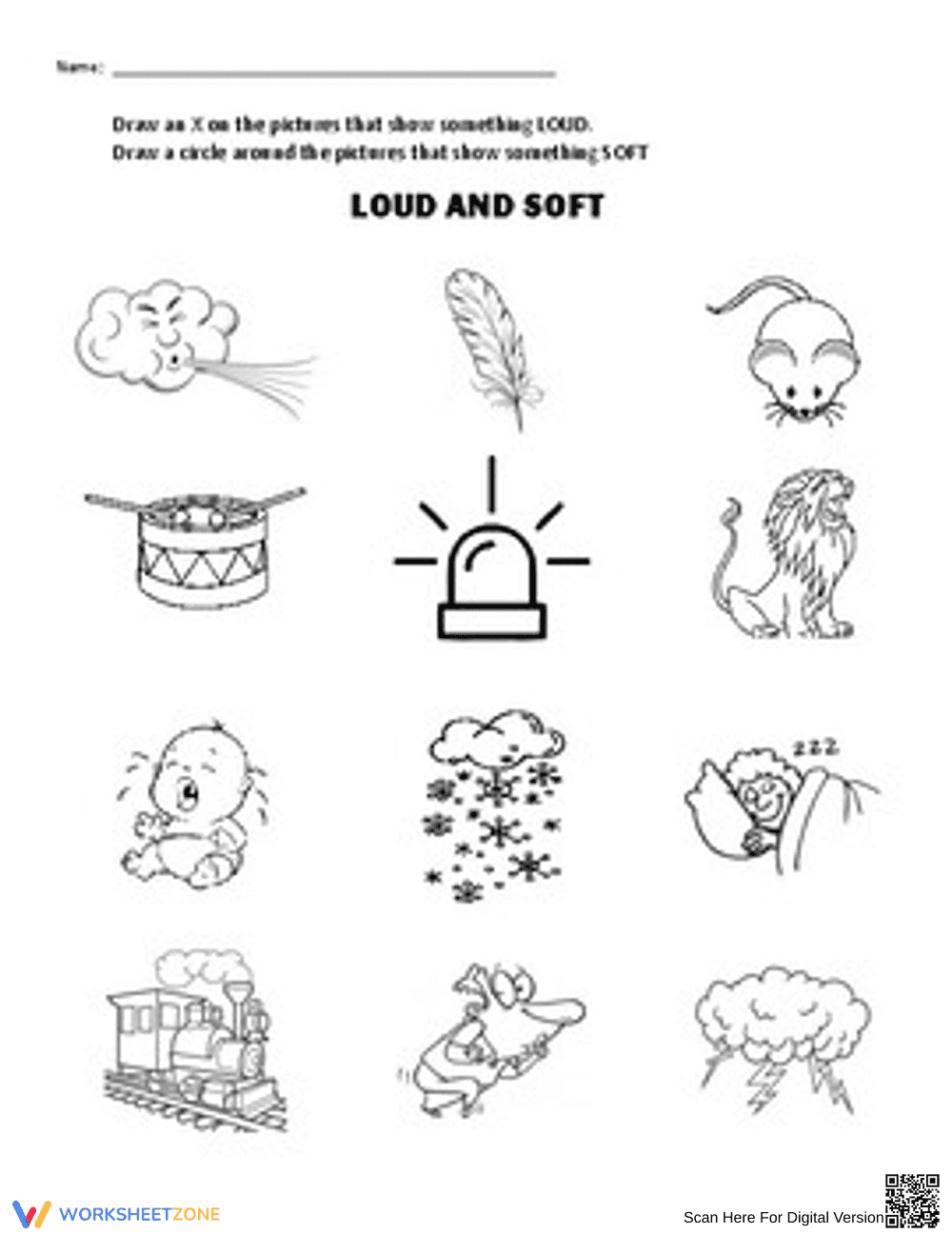
This is a worksheet titled 'Loud and Soft' that asks students to identify pictures representing loud and soft sounds. Students are instructed to draw an 'X' on the pictures that show something LOUD and draw a circle around the pictures that show something SOFT. The worksheet includes images of a blowing wind, a feather, a mouse, a drum, a flashing light, a lion, a crying baby, falling snow, a sleeping person, a train, a sneaking person, and a thunder cloud.
Grade Level Suitability:
This worksheet is suitable for preschool and kindergarten students. The concept of loud and soft sounds is a basic auditory discrimination skill taught at this level, and the instructions are simple to follow. The images are also clear and easily recognizable for young children.
Why Use It:
This worksheet helps children develop their auditory discrimination skills by distinguishing between loud and soft sounds. It also reinforces vocabulary related to sounds and encourages visual recognition of objects. This activity improves listening comprehension and builds a foundation for phonics skills.
How to Use It:
Provide the student with the worksheet and explain the instructions. Read each word aloud, if necessary, and encourage the student to identify whether the sound associated with each picture is loud or soft. Have them draw an 'X' on the pictures that represent loud sounds and a circle around the pictures that represent soft sounds.
Target Users:
The target users for this worksheet are preschool and kindergarten students learning about sounds and auditory discrimination. It is also beneficial for students with auditory processing difficulties or those who need extra practice with sound recognition.
This is a worksheet titled 'Loud and Soft' that asks students to identify pictures representing loud and soft sounds. Students are instructed to draw an 'X' on the pictures that show something LOUD and draw a circle around the pictures that show something SOFT. The worksheet includes images of a blowing wind, a feather, a mouse, a drum, a flashing light, a lion, a crying baby, falling snow, a sleeping person, a train, a sneaking person, and a thunder cloud.
Grade Level Suitability:
This worksheet is suitable for preschool and kindergarten students. The concept of loud and soft sounds is a basic auditory discrimination skill taught at this level, and the instructions are simple to follow. The images are also clear and easily recognizable for young children.
Why Use It:
This worksheet helps children develop their auditory discrimination skills by distinguishing between loud and soft sounds. It also reinforces vocabulary related to sounds and encourages visual recognition of objects. This activity improves listening comprehension and builds a foundation for phonics skills.
How to Use It:
Provide the student with the worksheet and explain the instructions. Read each word aloud, if necessary, and encourage the student to identify whether the sound associated with each picture is loud or soft. Have them draw an 'X' on the pictures that represent loud sounds and a circle around the pictures that represent soft sounds.
Target Users:
The target users for this worksheet are preschool and kindergarten students learning about sounds and auditory discrimination. It is also beneficial for students with auditory processing difficulties or those who need extra practice with sound recognition.


