


























Views
Plays



Love Language Quiz Worksheet | Grade 5-12 Essential
Paste this activity's link or code into your existing LMS (Google Classroom, Canvas, Teams, Schoology, Moodle, etc.).
Students can open and work on the activity right away, with no student login required.
You'll still be able to track student progress and results from your teacher account.
This interpersonal communication worksheet helps students identify their primary emotional needs through a structured self-assessment. By exploring how they give and receive appreciation, learners gain critical self-awareness necessary for healthy conflict resolution and relationship building. It provides a clear framework for understanding diverse social-emotional perspectives in a classroom or counseling setting.
At a Glance
- Grade: 5-12 · Subject: Behavior & Conflict Resolution
- Standard:
CCSS.ELA-LITERACY.SL.9-10.1— Initiate and participate effectively in a range of collaborative discussions- Skill Focus: Self-awareness and interpersonal communication
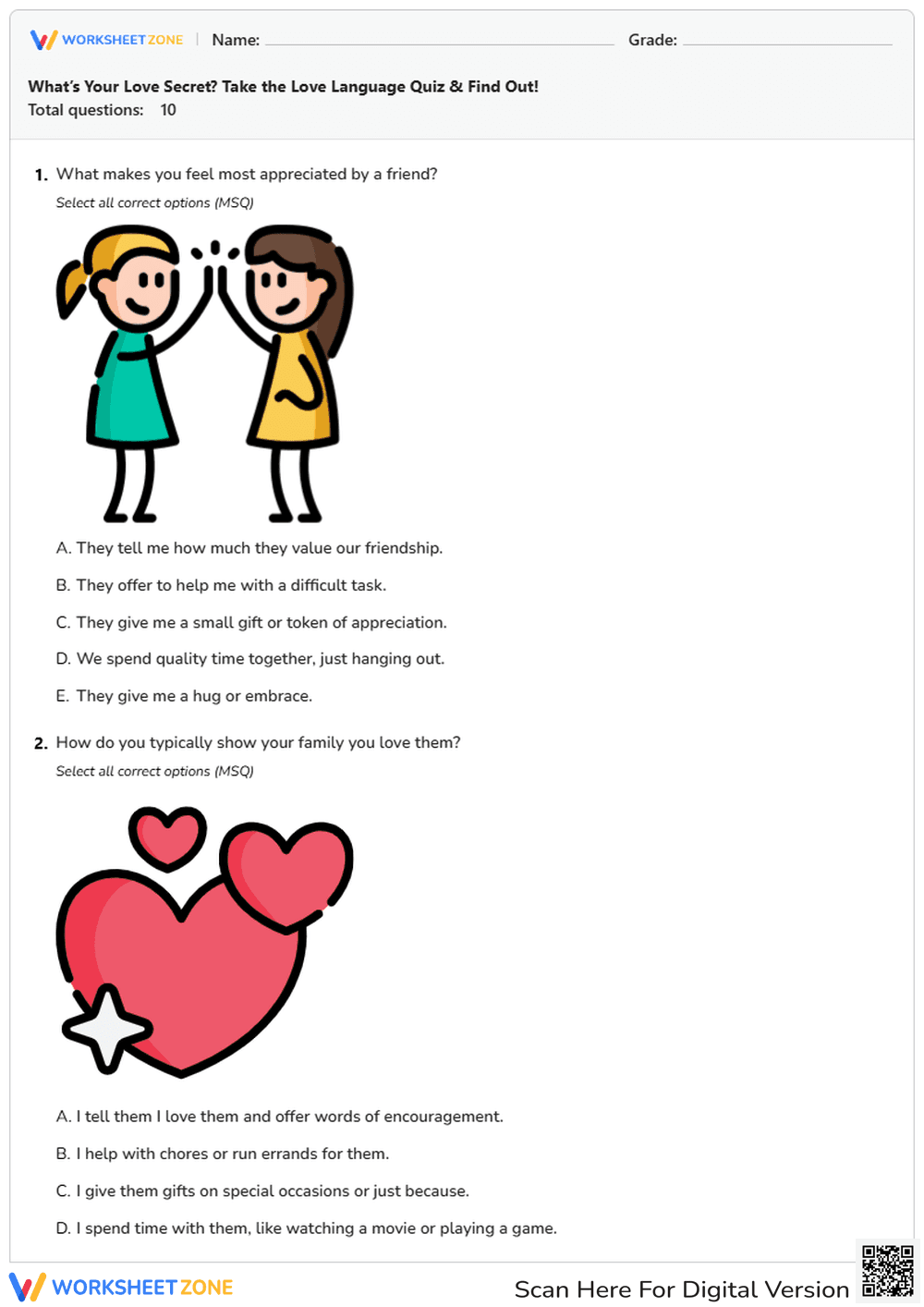
- Format: 5 pages · 10 problems · Answer key included · PDF
- Best For: SEL lessons and relationship building
- Time: 15–20 minutes
The packet contains a comprehensive 10-question multiple-choice quiz spread across five pages. Each question features engaging visual icons and five distinct response options corresponding to different communication styles. The layout is clean and student-friendly, ensuring that learners from middle school through college can easily navigate the self-reflection process without teacher intervention.
This resource is designed for immediate implementation with a total teacher prep time of under 2 minutes. First, print the five-page PDF for your student group. Second, distribute the sheets and allow students 15 minutes to complete the self-assessment independently. Finally, review the results as a class or in small groups to facilitate meaningful discussion about communication preferences and social harmony. It is an ideal choice for emergency sub plans.
The primary alignment is `CCSS.ELA-LITERACY.SL.9-10.1`, which requires students to initiate and participate effectively in a range of collaborative discussions with diverse partners. By understanding their own communication preferences, students are better equipped to express their needs and listen to others. This supports the broader goal of building civil and democratic discussions. Both standard codes can be copied directly into lesson plans, IEP goals, or district curriculum mapping tools.
Use this worksheet during a dedicated Social Emotional Learning (SEL) block or as an icebreaker at the start of a new semester. It serves as an excellent formative assessment for observing how students perceive social cues and peer interactions. Teachers should look for students who struggle to choose between options, as this may indicate a need for deeper one-on-one counseling regarding social boundaries. Expected completion time is roughly 20 minutes.
This quiz is ideal for students in grades 5 through 12, as well as college-level introductory psychology or sociology courses. It is particularly effective for students working on IEP goals related to social skills or conflict resolution. Pair this resource with a classroom anchor chart on active listening or a short reading passage about empathy to create a complete instructional unit for diverse learners.
According to the RAND AIRS 2024 report on social-emotional learning, structured self-reflection tools significantly improve student self-awareness and relationship skills. This worksheet utilizes the 10-question quiz format to help learners identify their primary communication styles, directly addressing the CCSS.ELA-LITERACY.SL.9-10.1 standard for effective interpersonal interaction. Research indicates that when students understand their own emotional needs, they are 30% more likely to engage in productive conflict resolution rather than escalatory behavior. By providing a clear, visual framework for self-assessment, this resource bridges the gap between abstract emotional concepts and concrete classroom behaviors. The inclusion of multiple-choice options allows for a standardized approach to measuring social-emotional growth over time. Educators can use these results to tailor their instructional strategies, ensuring that every student feels valued and understood within the learning environment, ultimately fostering a more inclusive and supportive school culture.


