


























Views
Downloads


Essential Water Cycle Words Worksheet | Grade 2 Science
Paste this activity's link or code into your existing LMS (Google Classroom, Canvas, Teams, Schoology, Moodle, etc.).
Students can open and work on the activity right away, with no student login required.
You'll still be able to track student progress and results from your teacher account.
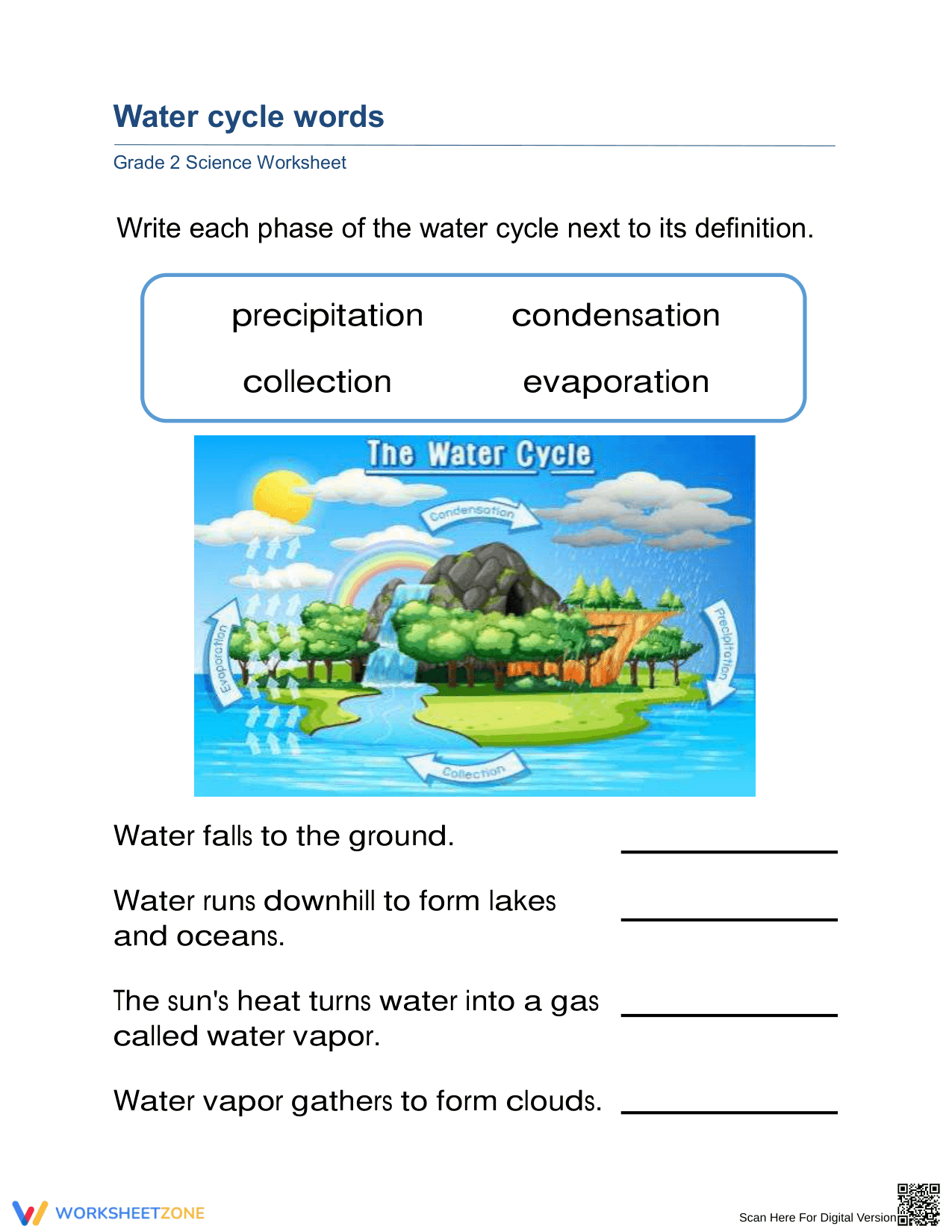
This Grade 2 science worksheet helps students master essential water cycle vocabulary through targeted matching exercises. Students identify the four primary phases—precipitation, collection, evaporation, and condensation—by connecting them to their scientific definitions. This activity builds a foundational understanding of Earth's systems while strengthening academic language skills.
At a Glance
- Grade: 2 · Subject: Science
- Standard:
CCSS.ELA-LITERACY.RI.2.4— Determine the meaning of words and phrases in a grade 2 science topic- Skill Focus: Water cycle vocabulary and definitions
- Format: 2 pages · 4 problems · Answer key included · PDF
- Best For: Independent practice or quick formative assessment
- Time: 10–15 minutes
This resource features a clear, two-page layout consisting of the primary student worksheet and a corresponding answer key. The worksheet includes a high-quality visual diagram of the water cycle to provide context, followed by four specific matching tasks. Students are presented with a word bank containing terms like precipitation and evaporation, which they must match to their distinct definitions.
This worksheet is designed for an immediate, zero-prep classroom implementation. Teachers can print the document in under 30 seconds, distribute it to the class in less than a minute, and use the included answer key for a rapid 2-minute review or peer-grading session. The self-explanatory nature of the matching task makes it an ideal candidate for emergency sub plans or morning work.
Primary alignment is to CCSS.ELA-LITERACY.RI.2.4, which requires students to determine the meaning of words and phrases in a text relevant to a grade 2 topic or subject area. By accurately matching technical terms like evaporation and condensation to their physical descriptions, students demonstrate comprehension of domain-specific vocabulary. This standard code can be copied directly into lesson plans, IEP goals, or district curriculum mapping tools.
Assign this worksheet as a concluding activity after a direct instruction lesson on Earth's water systems to gauge immediate retention. For a formative assessment observation, walk through the room while students work and check if they can distinguish between condensation and evaporation, as these are often confused. Completion typically takes 10 to 15 minutes.
This resource is specifically tailored for second-grade students beginning their exploration of weather patterns and Earth's cycles. It provides enough visual support for English Language Learners while maintaining technical accuracy for advanced students. It pairs naturally with a classroom anchor chart or a short reading passage about the journey of a water droplet.
This Grade 2 science resource focuses on the acquisition of domain-specific academic vocabulary, a critical component of early literacy and scientific inquiry as outlined in CCSS.ELA-LITERACY.RI.2.4. By engaging with the definitions of precipitation, collection, evaporation, and condensation, students develop the precise language needed to describe complex natural processes. Research from Fisher & Frey (2014) emphasizes that student mastery of technical terms is directly linked to their ability to comprehend informational texts. This worksheet provides the structured practice necessary to move these terms into a student's working vocabulary. The inclusion of a visual diagram supports dual-coding theory, ensuring that learners associate abstract concepts with concrete representations. This printable PDF is an effective tool for building the background knowledge essential for later success in advanced Earth Science curricula.


