


























Views
Downloads
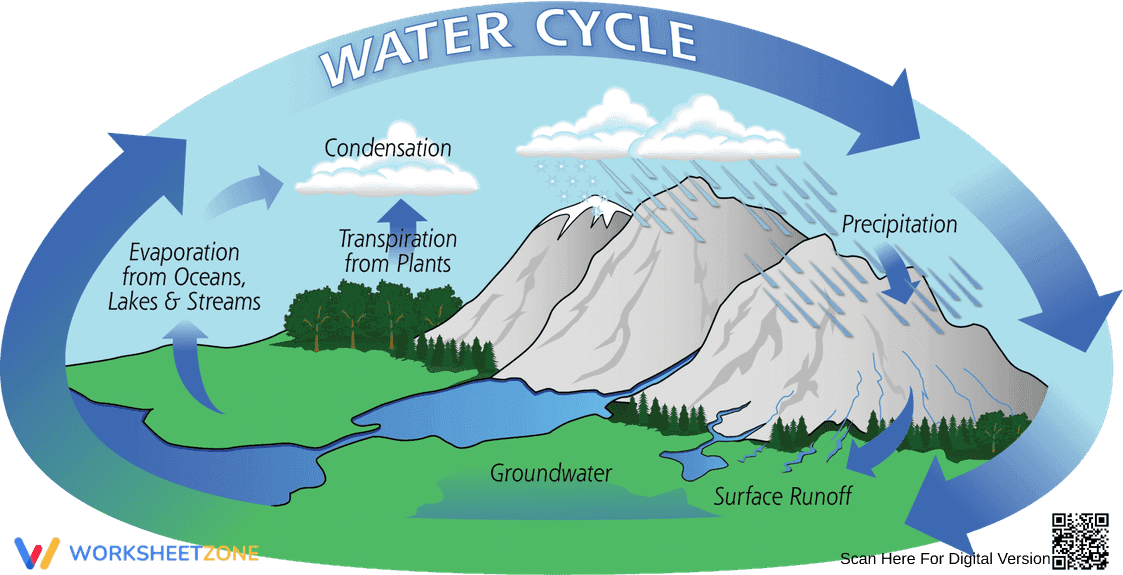

Water Cycle Diagram Worksheet | Grade 10-12 Essential
Paste this activity's link or code into your existing LMS (Google Classroom, Canvas, Teams, Schoology, Moodle, etc.).
Students can open and work on the activity right away, with no student login required.
You'll still be able to track student progress and results from your teacher account.
This Grade 10-12 water cycle worksheet provides a clear, visual framework for students to identify and explain the movement of water through Earth's systems. By labeling key processes, learners develop a concrete understanding of how energy and matter circulate globally. It is an effective tool for reinforcing complex environmental science concepts.
At a Glance
- Grade: 10-12 · Subject: Science
- Standard:
HS-ESS2-5— Plan and conduct investigations of water properties and Earth surface processes- Skill Focus: Hydrologic cycle identification
- Format: 1 page · 6 tasks · Answer key included · PDF
- Best For: Quick review or sub plans
- Time: 15–20 minutes
This single-page PDF features a high-resolution diagram of the hydrologic cycle, including terrestrial and atmospheric components. Students are tasked with identifying 6 critical stages: evaporation, transpiration, condensation, precipitation, surface runoff, and groundwater flow. The layout includes clear directional arrows to illustrate the continuous nature of the cycle, accompanied by a comprehensive answer key for rapid grading.
Zero-Prep Workflow
- Print: Generate copies of the single-page PDF in under 30 seconds.
- Distribute: Hand out the diagram as a bell-ringer or exit ticket to check for prior knowledge.
- Review: Use the provided answer key to facilitate a 5-minute class discussion on water reservoirs.
Total teacher preparation time is under 2 minutes, making this an ideal resource for emergency sub plans or supplemental practice during a busy lab week.
Standards Alignment
The primary focus is `HS-ESS2-5`, which requires students to: "Plan and conduct an investigation of the properties of water and its effects on Earth materials and surface processes." This worksheet specifically addresses the cycling of water through the atmosphere and geosphere. Both standard codes can be copied directly into lesson plans, IEP goals, or district curriculum mapping tools.
How to Use It
Use this worksheet during the "Explain" phase of a 5E lesson cycle to formalize vocabulary after an initial investigation into phase changes. It also serves as a high-quality formative assessment tool; observe if students can distinguish between transpiration and evaporation to gauge their understanding of biological influences on the cycle. Completion typically takes 15 to 20 minutes.
Who It's For
This resource is designed for high school students in Biology, Chemistry, or Earth Science courses. It provides necessary visual support for English Language Learners (ELLs) through its diagram-heavy format. It pairs naturally with a lecture on biogeochemical cycles or an interactive lab demonstrating condensation and precipitation.
According to the RAND AIRS 2024 report, visual aids in secondary science education significantly improve the retention of multi-step cyclical processes like the hydrologic cycle. This worksheet aligns with HS-ESS2-5 by requiring students to identify the specific mechanisms—such as transpiration and surface runoff—that drive the movement of water across different Earth reservoirs. By focusing on the plain-English skill of modeling Earth's systems, the resource ensures that students can visualize the interplay between the hydrosphere and atmosphere. Research from Fisher & Frey (2014) emphasizes that scaffolded diagrams help bridge the gap between abstract chemical properties and observable environmental phenomena. This 1-page tool provides the structured practice necessary for students to achieve mastery in environmental science, making it a reliable addition to any high school curriculum focused on Earth's integrated systems and sustainability.


