


























Views
Downloads

Essential Water Cycle Labeling Worksheet | Grade 2-3 Science
Paste this activity's link or code into your existing LMS (Google Classroom, Canvas, Teams, Schoology, Moodle, etc.).
Students can open and work on the activity right away, with no student login required.
You'll still be able to track student progress and results from your teacher account.
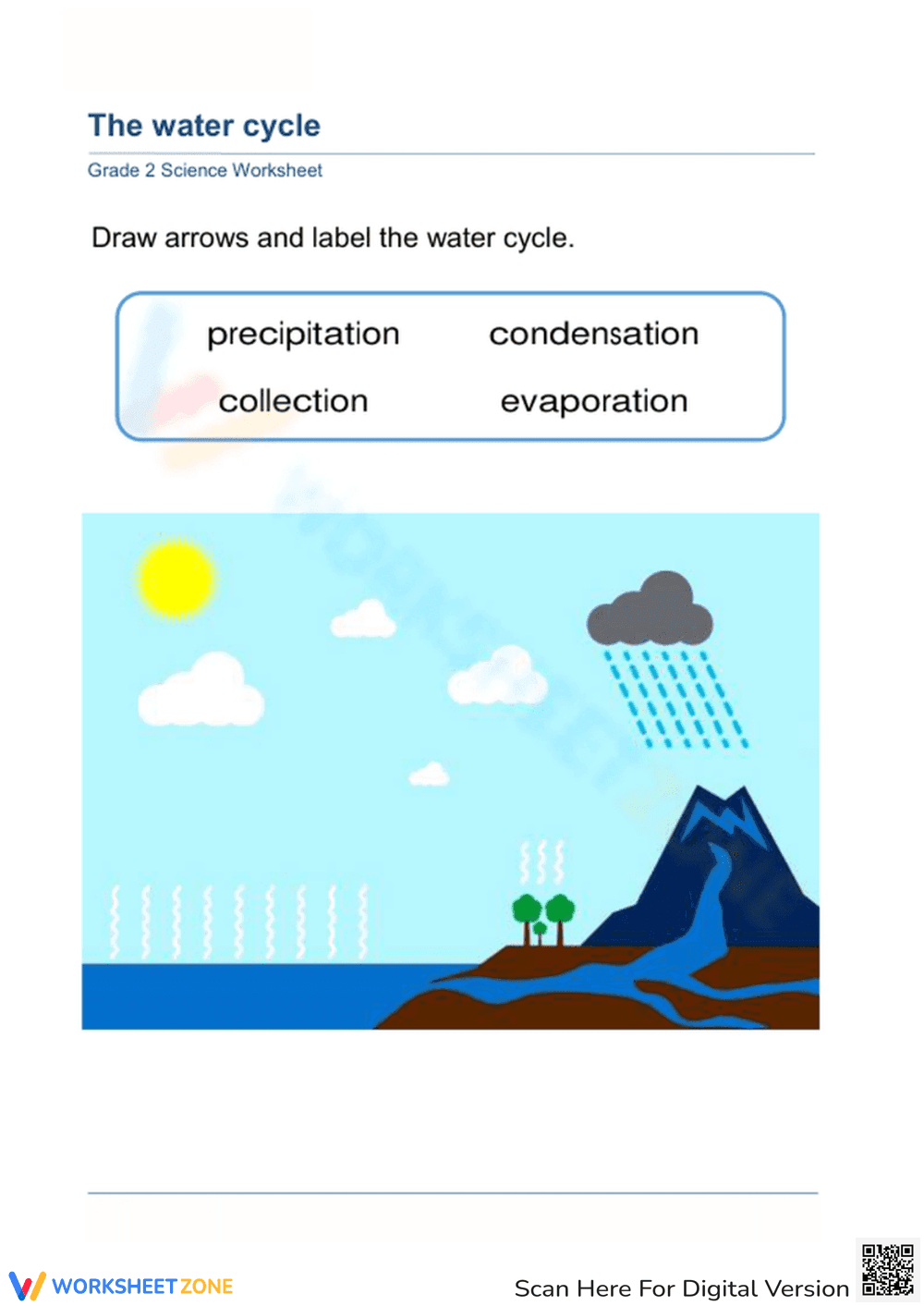
This Grade 2 water cycle labeling worksheet provides a visual way for students to identify the primary stages of Earth's water movement. By connecting terms like evaporation and precipitation to a detailed diagram, learners develop a concrete understanding of how water cycles. This printable resource ensures scientific vocabulary becomes second-nature through active labeling.
At a Glance
- Grade: 2 · Subject: Science
- Standard:
2-ESS2-1— Describe how water changes state and moves through Earth systems- Skill Focus: Water Cycle Stages
- Format: 2 pages · 8 tasks · Answer key included · PDF
- Best For: Science centers and independent practice
- Time: 15–20 minutes
What's Inside
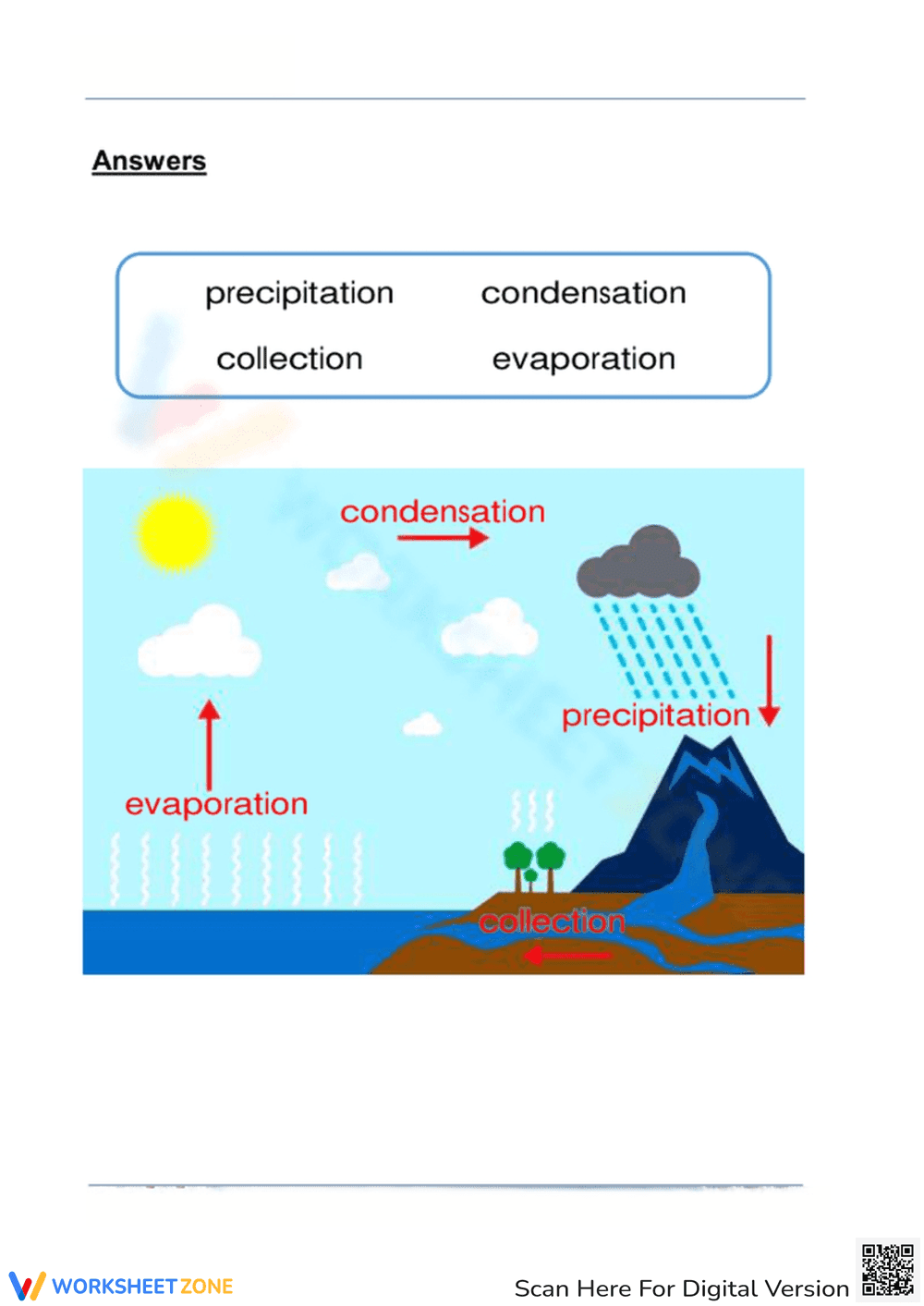
This 2-page PDF features a water cycle diagram with labeling boxes and directional arrows. Students use a word bank containing "evaporation," "condensation," "precipitation," and "collection" to complete the scene. The second page provides a color answer key, making it easy for students to self-correct or for teachers to grade 8 tasks quickly.
Zero-Prep Workflow
This worksheet is designed for high-efficiency classroom workflow with zero setup. First, print the student sheet (30 seconds). Next, distribute to students for independent work during science centers (1 minute). Finally, project the included answer key to review the cycle as a whole class (5 minutes). Total prep is under 2 minutes, making it an ideal sub plan.
Standards Alignment
Aligned to 2-ESS2-1, this resource helps students understand Earth's surface processes by mapping the movement of water. The worksheet also supports foundational literacy in science by matching technical terms to visual representations. Both standard codes can be copied directly into lesson plans, IEP goals, or district curriculum mapping tools.
How to Use It
Use this worksheet as a formative assessment after a lesson on weather. Observe if students can correctly place "evaporation" near the water source and "precipitation" near the clouds. It also works as a retrieval practice activity a week after the unit concludes to ensure long-term retention of the four cycle stages within 20 minutes of class time.
Who It's For
This resource is perfect for second and third-grade students exploring Earth science. It includes visual scaffolds like clouds and mountains to help English Language Learners associate vocabulary with imagery. Pair this with a "Water Cycle in a Bag" experiment or a weather anchor chart for a complete science unit that meets diverse learner needs.
The 2-ESS2-1 standard focuses on the roles of water in Earth's surface processes. This worksheet targets the foundational understanding of the water cycle, a concept supported by EdReports 2024 for its visual and tactile approach to science literacy. Research from Fisher & Frey (2014) emphasizes that labeling diagrams helps primary students bridge the gap between abstract cycles and observable natural phenomena like rain. By identifying evaporation, condensation, precipitation, and collection, learners build a conceptual model of how water moves through the atmosphere. This 2-page resource provides the repetition necessary for vocabulary retention while allowing for quick formative assessment. Educators can use these 8 tasks to gauge whether students understand the directionality of the cycle before moving to more complex meteorological discussions.


