


























Views
Downloads

W.4.4 Worksheet: Paragraph Rubric — Grade 4 Ready
Paste this activity's link or code into your existing LMS (Google Classroom, Canvas, Teams, Schoology, Moodle, etc.).
Students can open and work on the activity right away, with no student login required.
You'll still be able to track student progress and results from your teacher account.
This paragraph writing rubric provides a clear, structured framework for students to evaluate their own writing. By breaking down the writing process into specific, actionable criteria, this resource helps learners understand expectations and improve their paragraph structure, supporting details, and conventions before final submission.
At a Glance
- Grade: 4 · Subject: ELA
- Standard:
CCSS.ELA-LITERACY.W.4.4— Produce clear and coherent writing appropriate to task.- Skill Focus: Paragraph Structure and Self-Assessment
- Format: 1 page · 9 assessment points · No answer key · PDF
- Best For: Formative assessment and peer review
- Time: 10–15 minutes
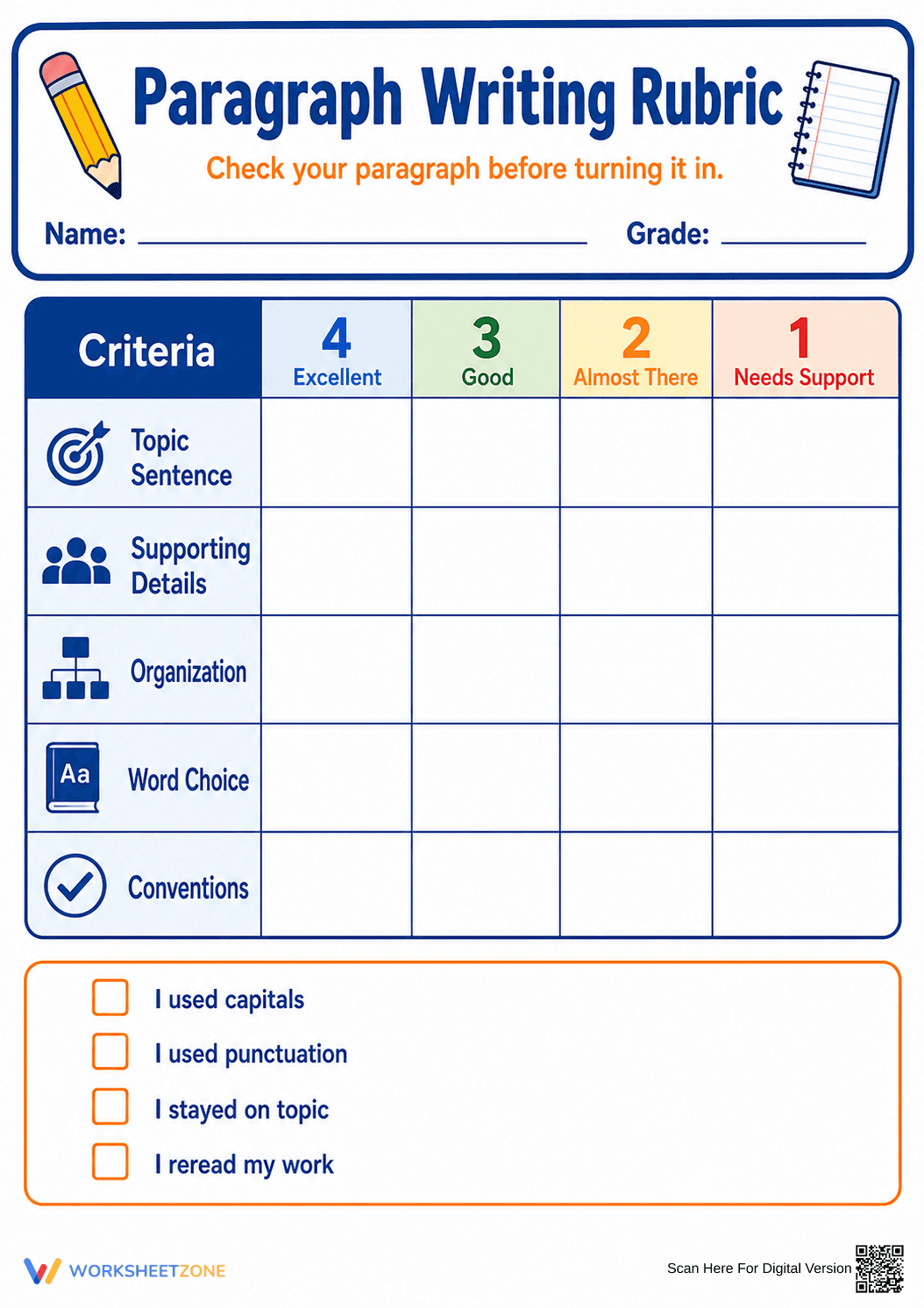
Inside this single-page resource, educators will find a four-point assessment table covering five essential writing components: Topic Sentence, Supporting Details, Organization, Word Choice, and Conventions. The layout features a clean design with distinct columns for Excellent, Good, Almost There, and Needs Support. A built-in four-step checklist at the bottom encourages immediate self-correction, prompting students to verify capitalization, punctuation, focus, and readability.
This assessment tool provides concrete evidence of student mastery through defined performance tiers. The four-level scale allows teachers to pinpoint exactly where a student falls on the continuum of writing proficiency. Each row maps directly to a critical sub-skill of effective communication, ensuring feedback is specific and actionable. Because the criteria are standardized, the resulting scores can be entered directly into gradebooks, shared during conferences, or used to track IEP progress notes over multiple assignments.
This rubric is aligned with CCSS.ELA-LITERACY.W.4.4: "Produce clear and coherent writing in which the development and organization are appropriate to task, purpose, and audience." It supports foundational language standards by explicitly checking conventions. Both standard codes can be copied directly into lesson plans, IEP goals, or district curriculum mapping tools.
Integrate this rubric during the drafting and revision phases. First, introduce the tool before students write so they understand expectations. Second, require students to complete the self-assessment checklist prior to peer review. As a formative assessment observation tip, watch how students rate their "Supporting Details"; those who overrate this area often need targeted mini-lessons on evidence expansion. Expect the self-evaluation process to take 10 to 15 minutes.
This resource is designed for upper elementary students developing foundational composition skills. It serves as an excellent scaffold for diverse learners, as the visual icons make expectations accessible to English Language Learners and students with specific needs. Pair this rubric with a graphic organizer or a direct instruction lesson on crafting strong topic sentences to maximize effectiveness.
Effective writing instruction requires clear expectations and consistent feedback mechanisms. By utilizing tools aligned with CCSS.ELA-LITERACY.W.4.4, educators can effectively help students produce clear and coherent writing appropriate to task. Research consistently highlights the critical role of self-assessment in developing independent, capable writers. According to Fisher & Frey (2014), providing students with explicit criteria and structured opportunities to evaluate their own work significantly increases their metacognitive awareness and overall writing proficiency. When learners actively engage with a rubric during the drafting process, they transition from passive recipients of grades to active participants in their learning journey. This structured approach clarifies the essential components of a strong paragraph and fosters a classroom culture of continuous improvement, ultimately leading to higher achievement in complex communication tasks across all subject areas.


