


























Views
Downloads
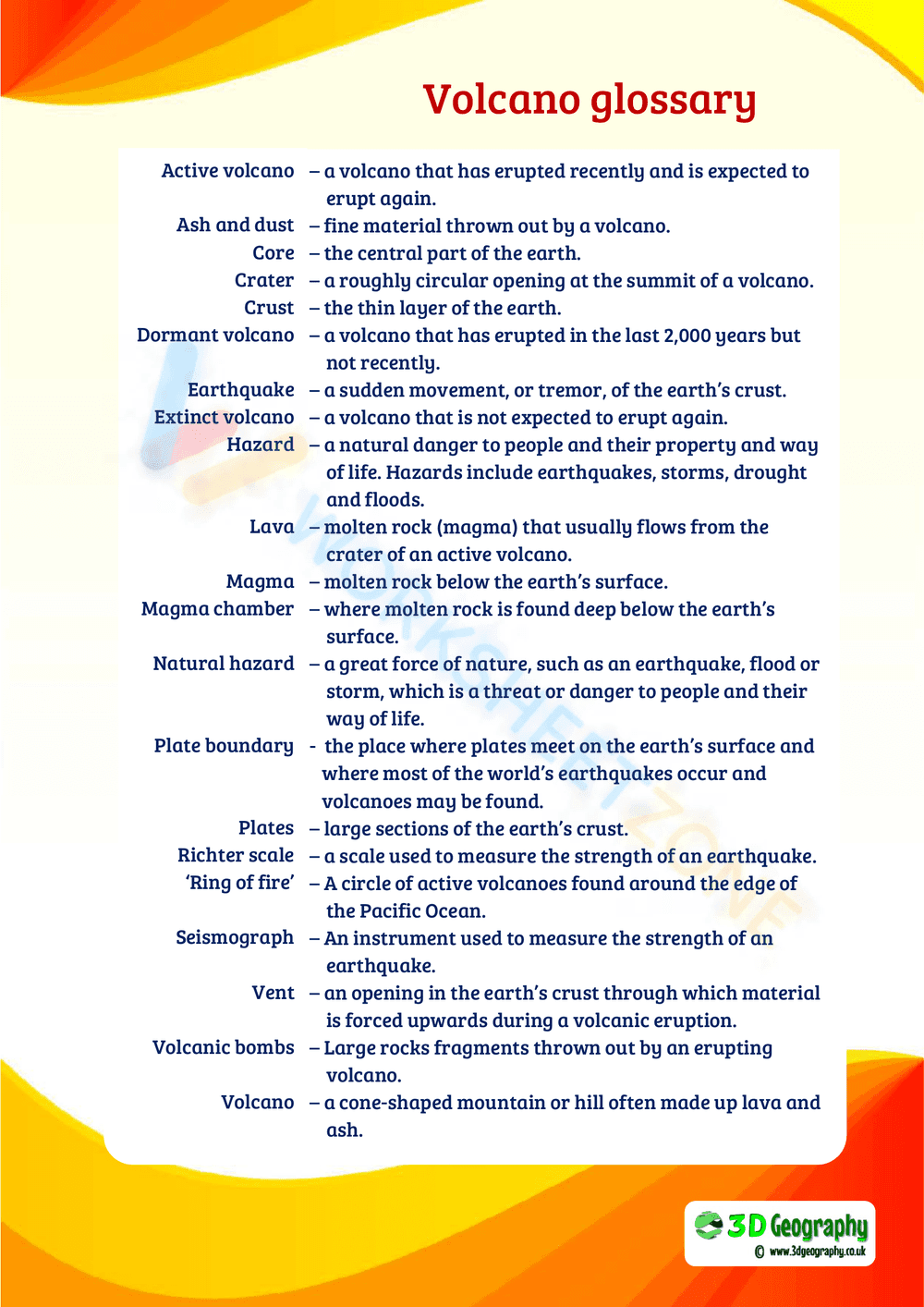

Printable Volcano Vocabulary Glossary | Grade 6 Science
Paste this activity's link or code into your existing LMS (Google Classroom, Canvas, Teams, Schoology, Moodle, etc.).
Students can open and work on the activity right away, with no student login required.
You'll still be able to track student progress and results from your teacher account.
This Grade 6 Earth Science glossary equips students with essential volcano vocabulary to comprehend complex geological processes. By providing clear definitions for twenty-two domain-specific terms, this reference sheet ensures learners can accurately discuss tectonic activity, magma chambers, and seismic events during their earth science units.
At a Glance
- Grade: 6 · Subject: Earth Science
- Standard:
CCSS.ELA-LITERACY.RST.6-8.4— Determine the meaning of domain-specific scientific words- Skill Focus: Scientific Vocabulary
- Format: 1 page · 22 terms · No answer key needed · PDF
- Best For: Study guide or reference
- Time: 10–15 minutes
This single-page reference document features a comprehensive alphabetical list of twenty-two critical earth science terms. Students will find concise, student-friendly definitions for concepts ranging from active and dormant volcanoes to plate boundaries and the Richter scale. The clean layout makes it an ideal study companion or binder insert, eliminating the need for an answer key since all factual information is directly provided.
Designed for immediate classroom implementation, this resource requires zero teacher setup:
- Print (1 minute): Generate enough copies for the entire class or print a few to laminate for a science center.
- Distribute (1 minute): Hand out the glossary at the beginning of a new geology unit or before a reading assignment.
- Review (5 minutes): Briefly read through the most challenging terms together to ensure accurate pronunciation and basic understanding.
With under two minutes of total prep time, this sheet is highly suitable for emergency sub plans or quick reference during independent reading.
This resource aligns with CCSS.ELA-LITERACY.RST.6-8.4: Determine the meaning of symbols, key terms, and other domain-specific words and phrases as they are used in a specific scientific or technical context relevant to grades 6-8 texts and topics. It also supports NGSS MS-ESS2-2 by giving students the language needed to explain geoscience processes. Both standard codes can be copied directly into lesson plans, IEP goals, or district curriculum mapping tools.
Teachers can utilize this glossary before direct instruction as a front-loading tool to build background knowledge. Have students keep it in their science folders to reference during reading assignments about the Ring of Fire or tectonic plates. As a formative assessment observation tip, listen to student group discussions and note whether they are accurately incorporating terms like "magma chamber" or "seismograph" into their conversations. Expected review time is 10 to 15 minutes.
This reference sheet is primarily designed for middle school earth science students. It serves as an excellent differentiation tool for English Language Learners (ELLs) or students with IEPs who benefit from having explicit vocabulary definitions readily available. It pairs naturally with informational reading passages about volcanic eruptions or interactive plate tectonics lessons.
Mastering domain-specific vocabulary is a critical component of scientific literacy. According to Fisher & Frey (2014), explicit vocabulary instruction in the content areas significantly improves reading comprehension and the ability to engage in complex disciplinary discourse. This glossary directly supports CCSS.ELA-LITERACY.RST.6-8.4 by helping students determine the meaning of domain-specific scientific words. When learners have immediate access to clear definitions for terms like "dormant volcano" and "plate boundary," they experience reduced cognitive load during complex reading tasks. This allows them to focus on understanding the broader geological processes rather than stumbling over unfamiliar terminology. Providing a structured reference sheet ensures that all students, regardless of their prior background knowledge, have the foundational language required to participate meaningfully in earth science investigations and classroom discussions.


