


























Views
Downloads

Essential Grade 4 Vocabulary: Context Clues Practice
Paste this activity's link or code into your existing LMS (Google Classroom, Canvas, Teams, Schoology, Moodle, etc.).
Students can open and work on the activity right away, with no student login required.
You'll still be able to track student progress and results from your teacher account.
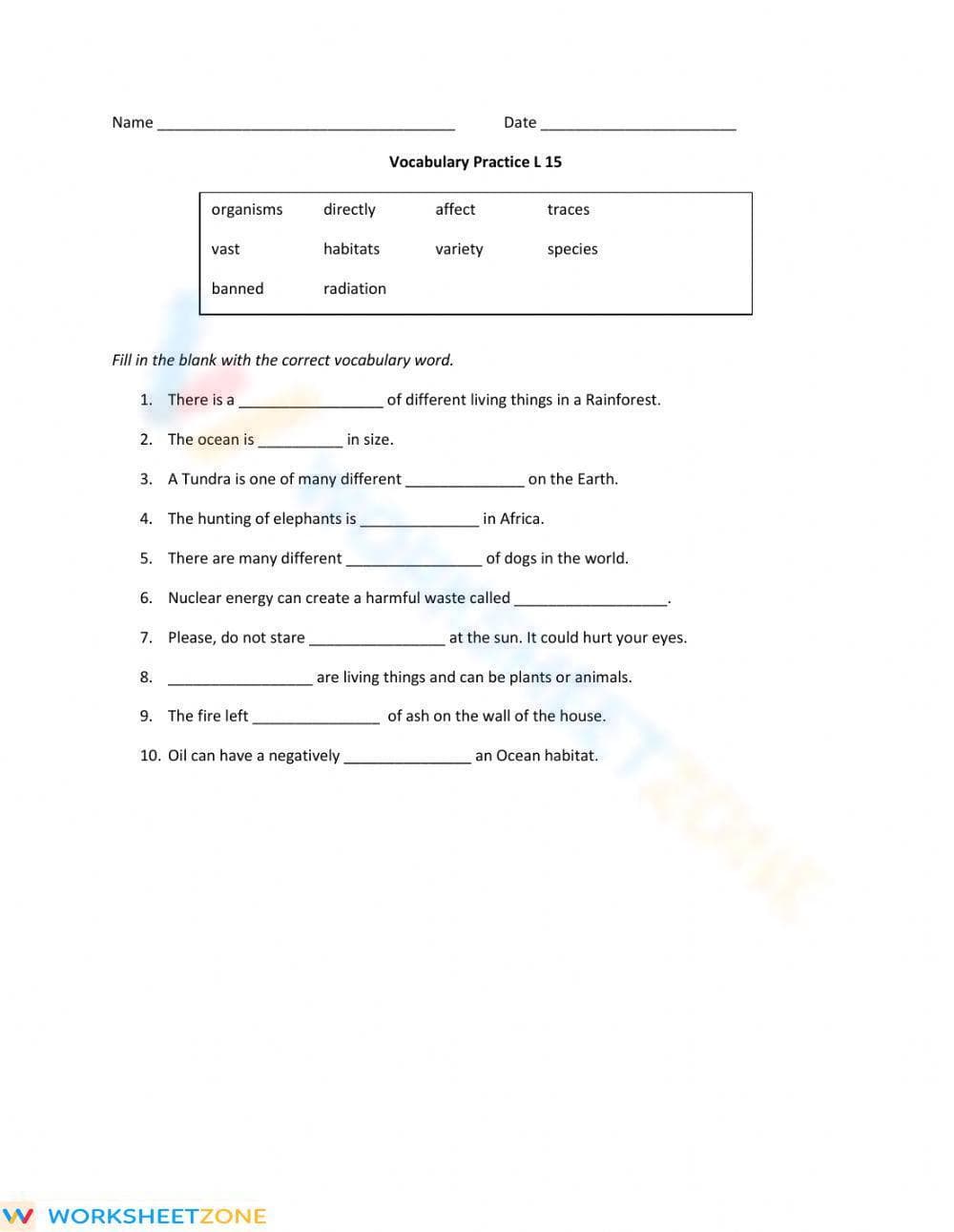
This Grade 4 vocabulary worksheet helps students master ten essential academic words through targeted context clue practice. By applying a word bank to sentence-level prompts, learners develop the ability to select the most appropriate terms based on surrounding semantic cues. This exercise ensures students accurately use science-related vocabulary in varied structures.
At a Glance
- Grade: 4 · Subject: ELA
- Standard:
CCSS.ELA-LITERACY.L.4.4.A— Use context as a clue to the meaning of a word or phrase- Skill Focus: Vocabulary Application & Context Clues
- Format: 2 pages · 10 problems · Answer key included · PDF
- Best For: Independent practice and quick formative assessment
- Time: 15–20 minutes
This printable features a clear word bank containing ten diverse terms including "organisms" and "habitats." Ten numbered sentences provide specific contexts requiring students to discern the correct word for each blank. The clean layout minimizes visual distractions, helping students focus on the reading task. A full answer key is included for rapid grading or student self-correction.
This resource allows for immediate classroom implementation with under 2 minutes of teacher prep time. First, print the required number of copies (30 seconds). Second, distribute the worksheets to students (30 seconds). Finally, review the completed answers as a group or use the provided key for individual grading (1 minute). This streamlined workflow makes it an ideal resource for substitute plans.
This resource aligns directly with `CCSS.ELA-LITERACY.L.4.4.A`: "Use context as a clue to the meaning of a word or phrase." It also supports `CCSS.ELA-LITERACY.L.4.6` by requiring students to acquire and use grade-appropriate general academic and domain-specific words. Both standard codes can be copied directly into lesson plans, IEP goals, or district curriculum mapping tools.
Use this worksheet as a morning warm-up activity or a formative assessment after a direct instruction lesson on context clues. During the activity, observe if students use the elimination method by crossing out words in the word bank as they use them. This helps identify learners who struggle with semantic associations. Expect completion within 15 to 20 minutes.
While perfect for Grade 4 students, this activity also provides excellent review for Grade 5 learners or scaffolded support for Grade 3 students. It is particularly beneficial for English Language Learners (ELLs) who need structured practice with sentence-level context clues. Pair this worksheet with an informational passage about ecosystems to see these vocabulary words in a larger text environment.
Academic vocabulary acquisition in the intermediate grades requires frequent, structured encounters with new words to move from passive recognition to active usage. According to Fisher & Frey (2014), the gradual release of responsibility model is most effective when students have opportunities to apply new terms in controlled environments before attempting open-ended composition. This worksheet addresses `CCSS.ELA-LITERACY.L.4.4.A` by providing ten distinct semantic frames that challenge students to synthesize sentence clues with their existing lexicon. Research indicates that using word banks as a scaffold helps reduce cognitive load for developing readers, allowing them to focus on the linguistic nuances of the sentences rather than the recall of the words themselves. This balanced approach ensures that learners build the confidence necessary to navigate more complex informational texts independently while maintaining alignment with rigorous national ELA standards. This tool is essential for evidence-based ELA instruction, providing a reliable bridge between vocabulary instruction and reading comprehension for diverse learners.


