


























Views
Downloads


Printable Story Moral Vocabulary Cards | Grade 2 ELA
Paste this activity's link or code into your existing LMS (Google Classroom, Canvas, Teams, Schoology, Moodle, etc.).
Students can open and work on the activity right away, with no student login required.
You'll still be able to track student progress and results from your teacher account.
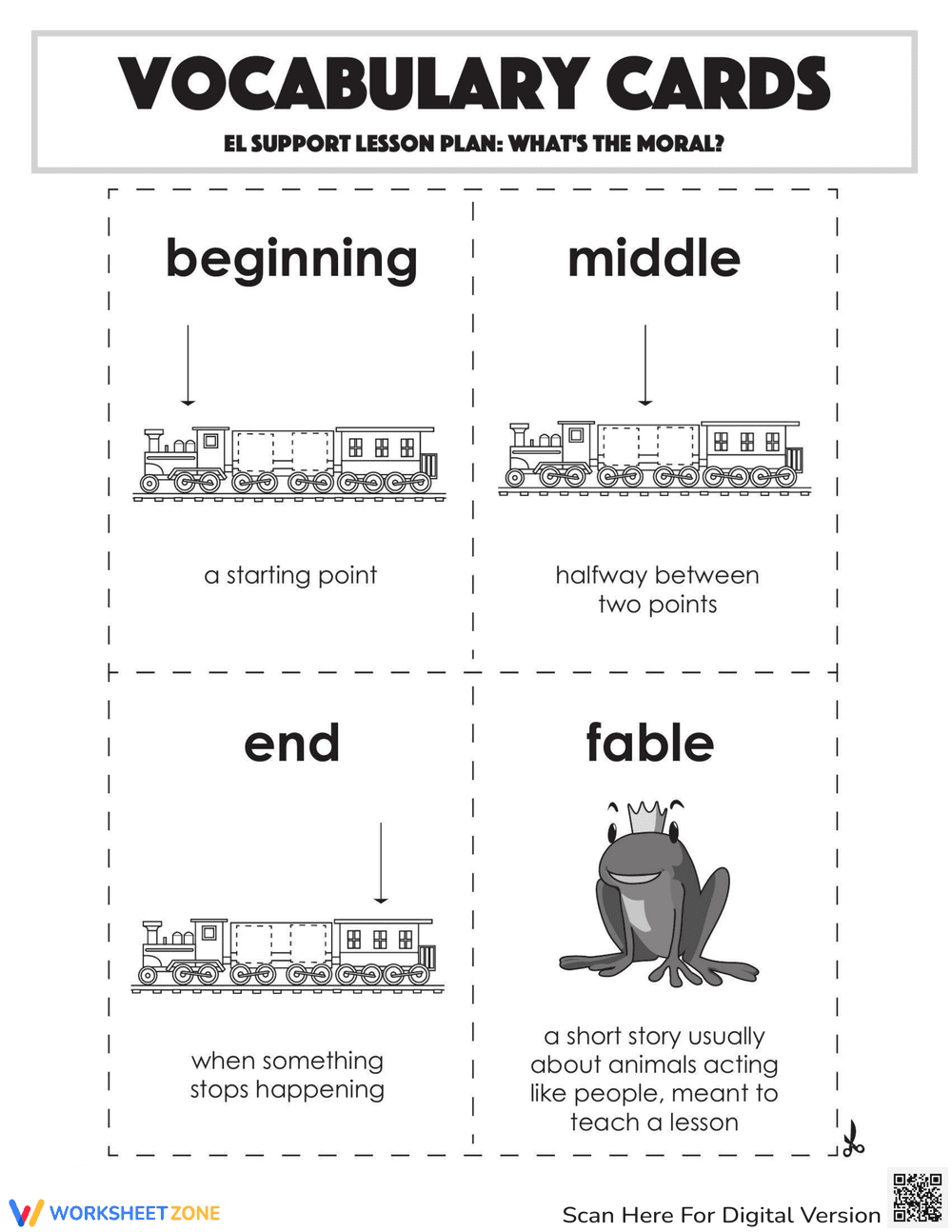
This Grade 2 reading worksheet provides printable vocabulary cards to help students define key terms related to story morals. By mastering words like fable, folktale, and moral, learners build the vocabulary needed to determine the central lesson of a text.
At a Glance
- Grade: Grade 2 · Subject: ELA
- Standard:
CCSS.ELA-LITERACY.RL.2.2— Recount stories and determine their moral- Skill Focus: Story structure and moral vocabulary
- Format: 2 pages · 8 cards · Definitions included · PDF
- Best For: EL support and vocabulary introduction
- Time: 10–15 minutes
This resource contains two pages featuring eight vocabulary cards. Seven cards define essential literary terms—beginning, middle, end, fable, folktale, moral, and tradition—with student-friendly definitions and illustrations. One blank card is included for custom vocabulary words.
Zero-Prep Classroom Workflow
Integrate this resource into your reading block with under two minutes of prep time:
- Print (1 minute): Print the two-page PDF on standard paper or cardstock.
- Distribute (1 minute): Have students cut along the dashed lines to create their cards.
- Review (5 minutes): Guide students through the definitions using the visual cues.
These cards require no setup, making them perfect for sub plans or literacy centers.
Standards Alignment
This resource aligns with `CCSS.ELA-LITERACY.RL.2.2`, requiring students to recount stories and determine their central message, lesson, or moral. It also supports `CCSS.ELA-LITERACY.L.2.6` by expanding academic vocabulary. Both standard codes can be copied directly into lesson plans, IEP goals, or district curriculum mapping tools.
How to Use It
Use these cards before direct instruction to prime students for identifying story morals. Alternatively, use them during reading as interactive desk references. Formatively assess comprehension by observing if students can explain the difference between a folktale and a fable. Completion takes 10 to 15 minutes.
Who It's For
This resource is ideal for second-grade students, especially English language learners needing visual vocabulary support. Pair these cards with a shared reading passage of Aesop's fables to maximize engagement.
This educational resource targets `CCSS.ELA-LITERACY.RL.2.2` by providing structured vocabulary support to help second-grade students identify the moral or lesson in fables and folktales. According to research by Fisher & Frey (2014) on vocabulary systems, providing students with visual representations alongside student-friendly definitions significantly accelerates academic language acquisition, particularly for English language learners. By breaking down complex literary terms like "tradition," "fable," and "moral" into digestible cards, this tool scaffolds the cognitive load required to analyze narrative texts. The inclusion of a customizable blank card encourages active student participation and personalized learning. Educators can easily integrate these cards into daily reading blocks to build the foundational vocabulary necessary for deeper comprehension and successful story recounting.


