


























Views
Downloads
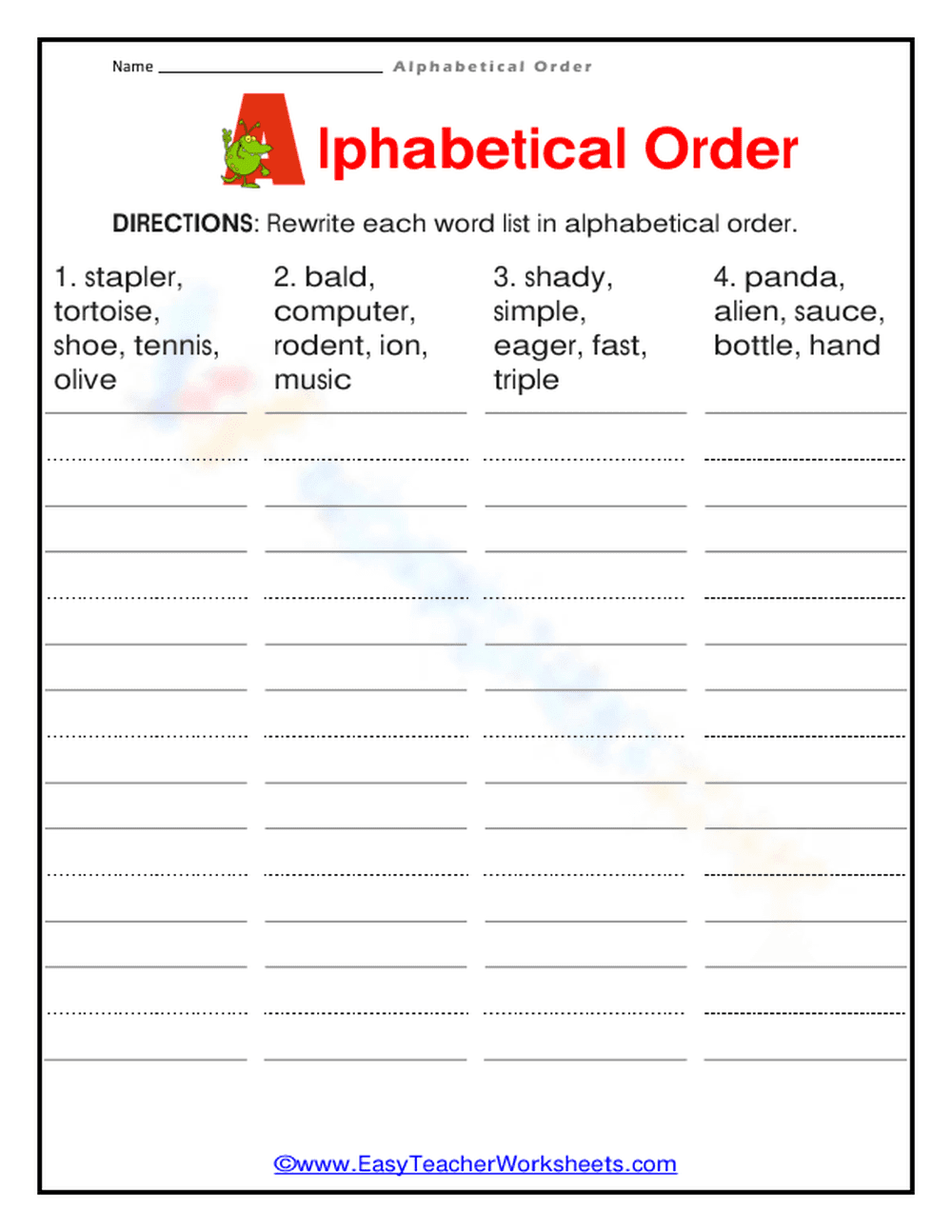

Alphabetical Order Worksheet | Essential Grade 1 ELA
Paste this activity's link or code into your existing LMS (Google Classroom, Canvas, Teams, Schoology, Moodle, etc.).
Students can open and work on the activity right away, with no student login required.
You'll still be able to track student progress and results from your teacher account.
This foundational Grade 1 alphabetical order worksheet helps young learners master the essential skill of organizing words by their initial letters. By sorting common vocabulary words vertically, students strengthen their understanding of the English alphabet while improving their dictionary readiness and general language conventions in a clear, structured format.
At a Glance
- Grade: 1 · Subject: English Language Arts
- Standard:
CCSS.ELA-LITERACY.L.1.1— Demonstrate command of the conventions of standard English grammar and usage when writing- Skill Focus: Alphabetical Order (ABC Order)
- Format: 1 page · 20 problems · Answer key included · PDF
- Best For: Literacy centers and independent vocabulary practice
- Time: 10–15 minutes
The worksheet contains four distinct word banks, each featuring five words for students to reorganize. The vertical layout provides ample writing space for primary learners to practice letter formation as they sort. This single-page PDF includes a variety of common nouns and adjectives, ensuring students encounter familiar terms while focusing on the sorting logic. A full answer key is provided for quick grading or self-correction.
This activity follows a structured progression to ensure student success through a gradual-release model:
- Guided Practice: Students identify the starting letter of each word in the provided lists to establish the sorting baseline.
- Supported Practice: Learners use the vertical lines to rewrite words, focusing on one of the four lists at a time to minimize cognitive load.
- Independent Practice: Students complete all twenty sorting tasks across the four categories to demonstrate full concept mastery.
This approach aligns with the I Do, We Do, You Do instructional framework, moving students from initial recognition to independent application.
The primary standard for this resource is CCSS.ELA-LITERACY.L.1.1, which requires students to demonstrate command of the conventions of standard English grammar and usage. Sorting words alphabetically is a critical prerequisite for building vocabulary and using reference materials as outlined in CCSS.ELA-LITERACY.L.1.4. Both standard codes can be copied directly into lesson plans, IEP goals, or district curriculum mapping tools.
Use this worksheet as a focused literacy center activity during your daily ELA block to reinforce letter sequencing. It also serves as an effective formative assessment tool; observe whether students can identify the anchor letter in each word before they begin sorting. Expect most Grade 1 students to complete the twenty sorting tasks within 15 minutes of independent work time.
This resource is designed for Grade 1 students, though it is highly suitable for Kindergarten enrichment or Grade 2 review. The clear layout supports English Language Learners (ELL) by providing familiar word sets like stapler and panda. Pair this worksheet with a classroom alphabet chart or an introductory lesson on how to use a dictionary for maximum instructional impact.
Organizing information alphabetically is a foundational cognitive task that bridges the gap between simple letter recognition and complex information retrieval. According to the RAND AIRS 2024 report, early exposure to systematic organizational tasks like ABC sorting significantly enhances a student's ability to navigate more complex informational texts later in their academic career. This worksheet directly addresses the CCSS.ELA-LITERACY.L.1.1 requirement by focusing on the conventions of standard English. By providing twenty specific word-sorting tasks, teachers can quantify student progress in recognizing alphabetical patterns. Research by Fisher & Frey (2014) emphasizes that such structured practice is essential for the gradual release of responsibility, moving students from teacher-led modeling to independent mastery of language mechanics. This printable PDF ensures that Grade 1 learners have the necessary scaffolded environment to develop these critical vocabulary management skills, serving as a reliable tool for both classroom instruction and supplemental home practice.


