


























Views
Downloads

Valentine's Day Counting Worksheet | Grade K Essential
Paste this activity's link or code into your existing LMS (Google Classroom, Canvas, Teams, Schoology, Moodle, etc.).
Students can open and work on the activity right away, with no student login required.
You'll still be able to track student progress and results from your teacher account.
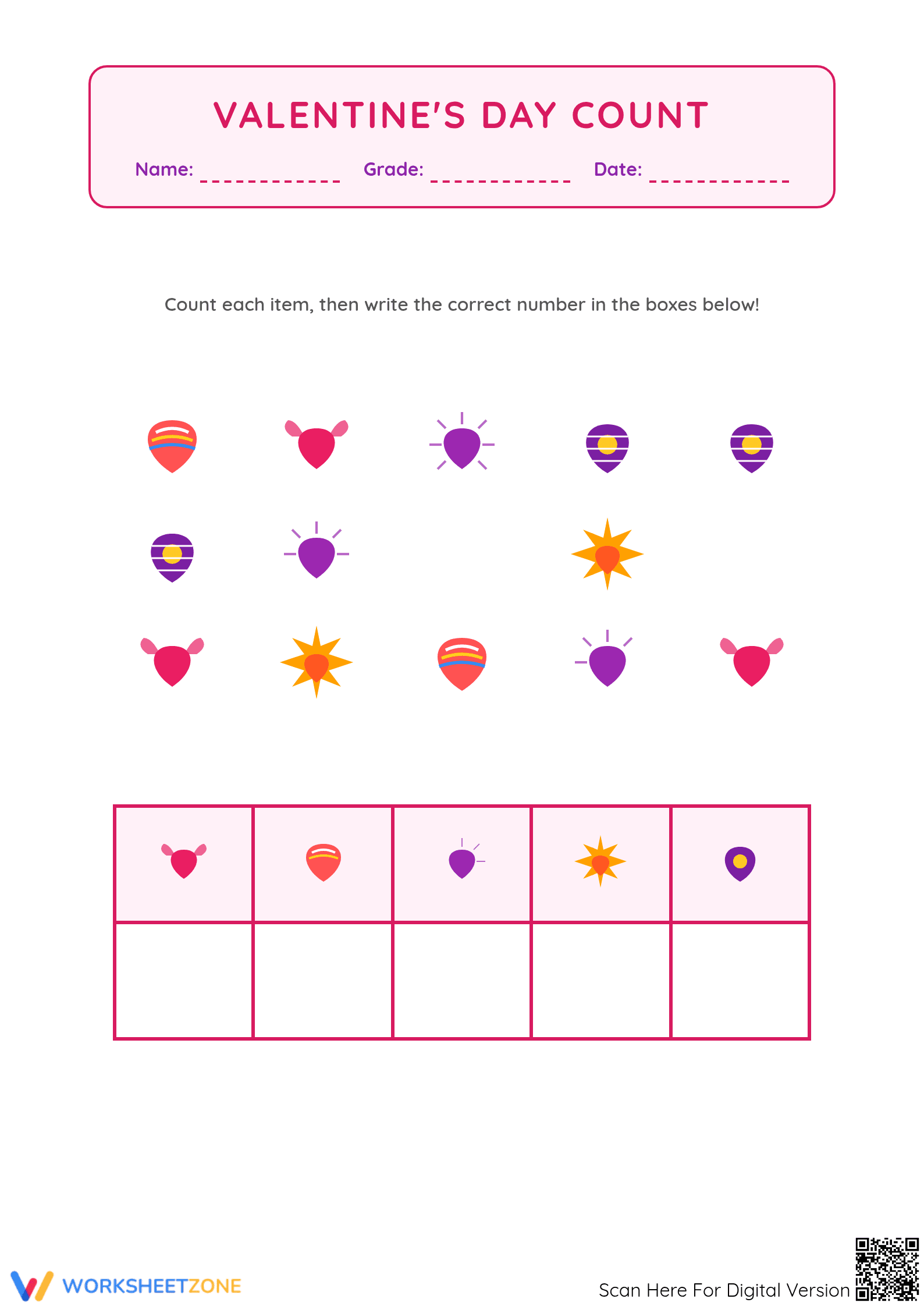
Mastering the fundamental skill of one-to-one correspondence becomes a festive celebration with this Valentine's Day counting activity. Designed specifically for Kindergarten students, this resource ensures learners can accurately identify, count, and record quantities of scattered objects. By engaging with colorful, themed icons, students build the confidence needed for more complex arithmetic operations and set a strong foundation for early numeracy success.
At a Glance
- Grade: Kindergarten · Subject: Mathematics
- Standard:
CCSS.MATH.CONTENT.K.CC.B.5— Count to answer "how many?" questions about things in a scattered configuration- Skill Focus: Counting and Cardinality
- Format: 2 pages · 8 problems · Answer key included · PDF
- Best For: Seasonal math centers and morning work
- Time: 15–20 minutes
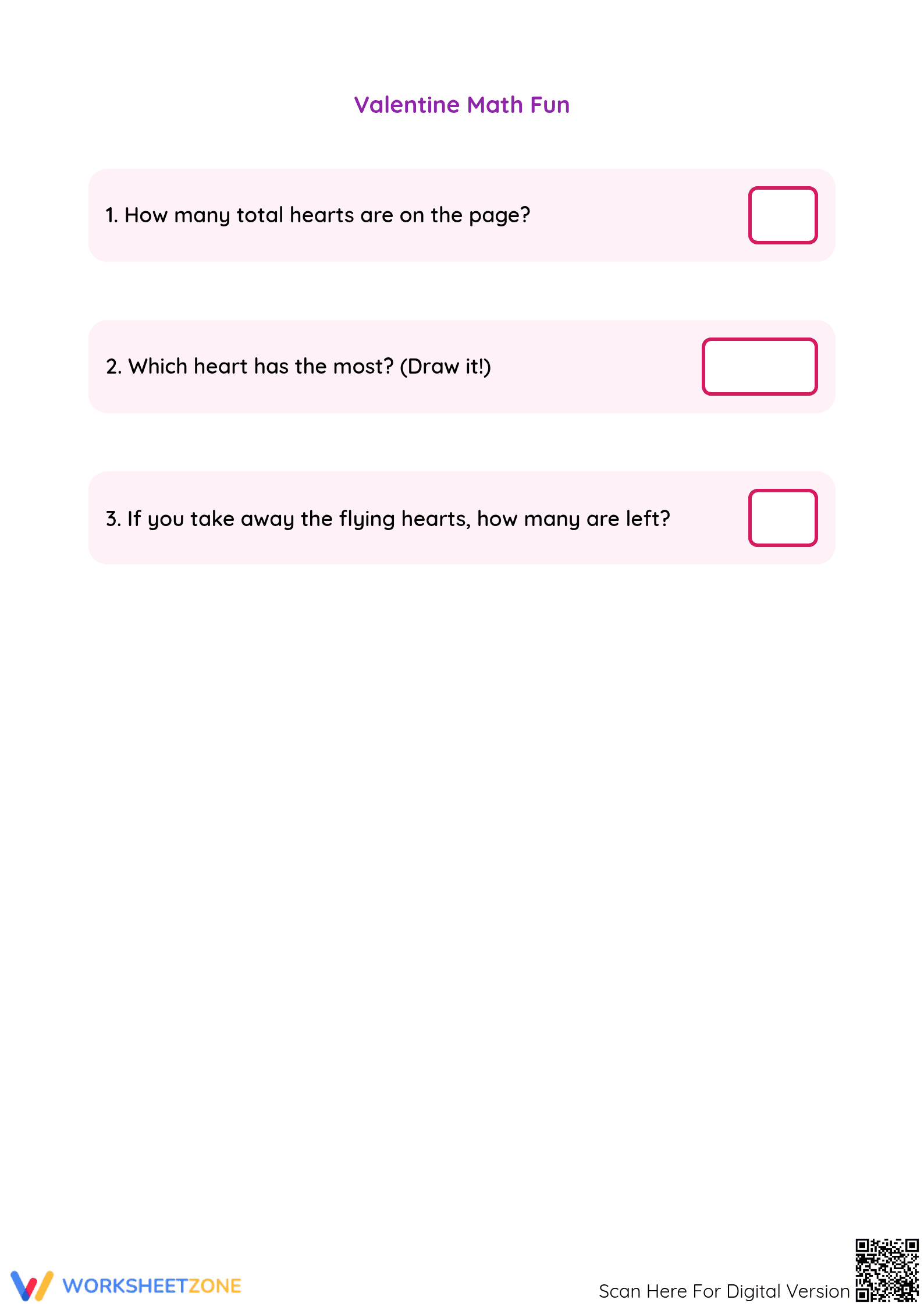
This comprehensive two-page PDF includes a variety of interactive counting tasks. The first page features a collection of thirteen Valentine-themed icons—including hearts and sunbursts—arranged in a scattered configuration to challenge spatial reasoning. Students record their findings in a structured five-column recording table. The second page introduces critical thinking through three targeted word problems that cover total sums and the concept of "taking away" or subtraction.
Implementing this resource requires zero teacher preparation, making it an ideal choice for busy February schedules. First, print the two-page document in under one minute. Next, distribute the sheets to your class; the clear instructions allow students to begin immediately with minimal guidance. Finally, review the completed work using the included answer key in less than two minutes. This efficient workflow is perfect for emergency sub plans or last-minute holiday celebrations.
The primary alignment for this worksheet is CCSS.MATH.CONTENT.K.CC.B.5, which requires students to count to tell the number of objects in scattered configurations. Students must demonstrate that the last number name said tells the total number of objects counted. This standard code can be copied directly into lesson plans, IEP goals, or district curriculum mapping tools to ensure instructional consistency and rigor.
Use this worksheet as a formative assessment during your math block to observe how students track counted objects (e.g., crossing them out or pointing). It also serves as an excellent independent practice station during a Valentine-themed math rotation. Observe if students can transition from counting individual groups to answering the higher-order questions on the second page, providing a clear window into their developing conceptual understanding of totals.
This resource is tailored for Kindergarten students but offers valuable reinforcement for Grade 1 learners needing a cardinality refresher. It provides natural differentiation through visual cues and varied task complexity. Pair this worksheet with physical manipulatives like heart-shaped erasers or a standard-aligned number line anchor chart to support students who require a more tactile approach to counting and number recognition.
According to the RAND AIRS 2024 report on early childhood education, seasonal integration in math curriculum significantly increases student engagement and retention of cardinality concepts. This worksheet directly addresses the critical milestone of one-to-one correspondence by requiring students to map number names onto specific visual targets. The inclusion of the CCSS.MATH.CONTENT.K.CC.B.5 standard ensures that the practice remains rigorous while maintaining a high-interest holiday theme. Research by Fisher & Frey (2014) highlights that structured recording tasks, like the table included here, help students internalize the relationship between quantities and their written numeral representations. By combining scattered counting with conceptual word problems, this resource provides a complete instructional loop that moves from basic recognition to early analytical thinking. Educators can confidently use this printable as a validated tool for measuring student progress toward year-end math goals in any standards-aligned classroom.


