


























Views
Downloads
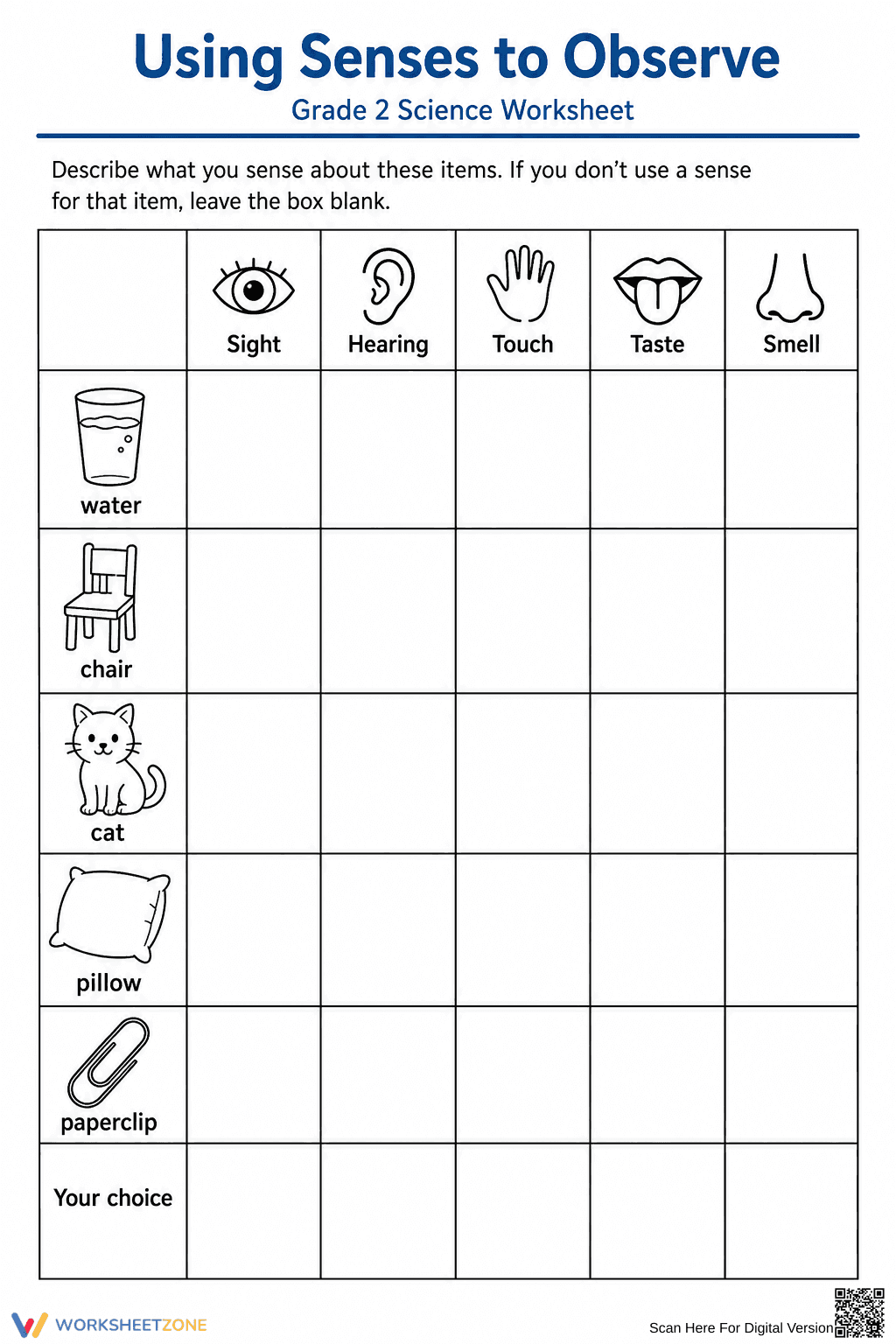

Grade 2 Five Senses — Printable No-Prep Worksheet
Paste this activity's link or code into your existing LMS (Google Classroom, Canvas, Teams, Schoology, Moodle, etc.).
Students can open and work on the activity right away, with no student login required.
You'll still be able to track student progress and results from your teacher account.
Students begin their scientific journey by accurately describing the world around them. This worksheet guides Grade 2 learners to use their five senses to record observable properties of everyday objects. By evaluating items like water and a chair, children develop the foundational vocabulary necessary for material classification and scientific inquiry.
At a Glance
- Grade: 2 · Subject: Science
- Standard:
2-PS1-1— Describe and classify materials by their observable properties- Skill Focus: Five Senses Observation
- Format: 1 page · 30 problems · Answer key included · PDF
- Best For: Introduction to material properties
- Time: 15–25 minutes
What's Inside
This single-page PDF features a structured observation grid designed for young scientists. It lists five specific items—water, a chair, a cat, a pillow, and a paperclip—plus a "Your choice" row. Students record findings across five columns corresponding to sight, hearing, touch, taste, and smell. Clear instructions remind students to leave boxes blank if a sense is not applicable. A complete answer key is included.
Zero-Prep Workflow
This resource follows a highly efficient zero-prep workflow. First, Print the single-page PDF (1 minute). Next, Distribute the copies (1 minute). Finally, Review the instructions and model the first row together (3 minutes). With a total teacher prep time of under 5 minutes, this worksheet is an excellent choice for emergency sub plans or as a quick transition activity between science units.
Standards Alignment
This activity is directly aligned to NGSS 2-PS1-1, which requires students to "Plan and conduct an investigation to describe and classify different kinds of materials by their observable properties." By focusing on sensory input, the worksheet provides the evidentiary basis for classifying matter by texture, sound, and appearance. Both standard codes can be copied directly into lesson plans, IEP goals, or district curriculum mapping tools.
How to Use It
Use this worksheet as a guided practice activity immediately following a direct instruction lesson on the five senses. Teachers can model the first row using water, demonstrating how to describe "sight" (clear) and "touch" (wet) while explaining why "hearing" might be left blank. Alternatively, assign it as independent seatwork during science centers. As a formative assessment, observe students during the "Your choice" task to see if they can independently select an appropriate object and apply the correct sensory filters. Expected completion time is 15 to 25 minutes.
Who It's For
This resource is designed for second-grade students learning the basics of physical science and material properties. It includes helpful scaffolds like visual icons for each sense to support English Language Learners and struggling readers. It pairs naturally with a classroom "mystery box" investigation or an anchor chart listing descriptive adjectives for each sense.
According to the RAND AIRS 2024 report on elementary science literacy, structured observation tasks are critical for developing the scientific habits of mind required for later success in complex laboratory environments. This Grade 2 worksheet facilitates that development by prompting students to isolate sensory inputs and record them systematically. By focusing on the ability to describe and classify materials by their observable properties, the activity directly supports the NGSS 2-PS1-1 framework. Scaffolded graphic organizers help young learners transition from intuitive descriptions to technical scientific language. This worksheet provides 30 distinct opportunities for students to practice this skill, ensuring evidence collection becomes second nature. It serves as a vital bridge between casual play and rigorous data collection, making it a staple for any elementary science curriculum.


