


























Views
Downloads

Printable 5 Senses Worksheet | Grade 2 Science
Paste this activity's link or code into your existing LMS (Google Classroom, Canvas, Teams, Schoology, Moodle, etc.).
Students can open and work on the activity right away, with no student login required.
You'll still be able to track student progress and results from your teacher account.
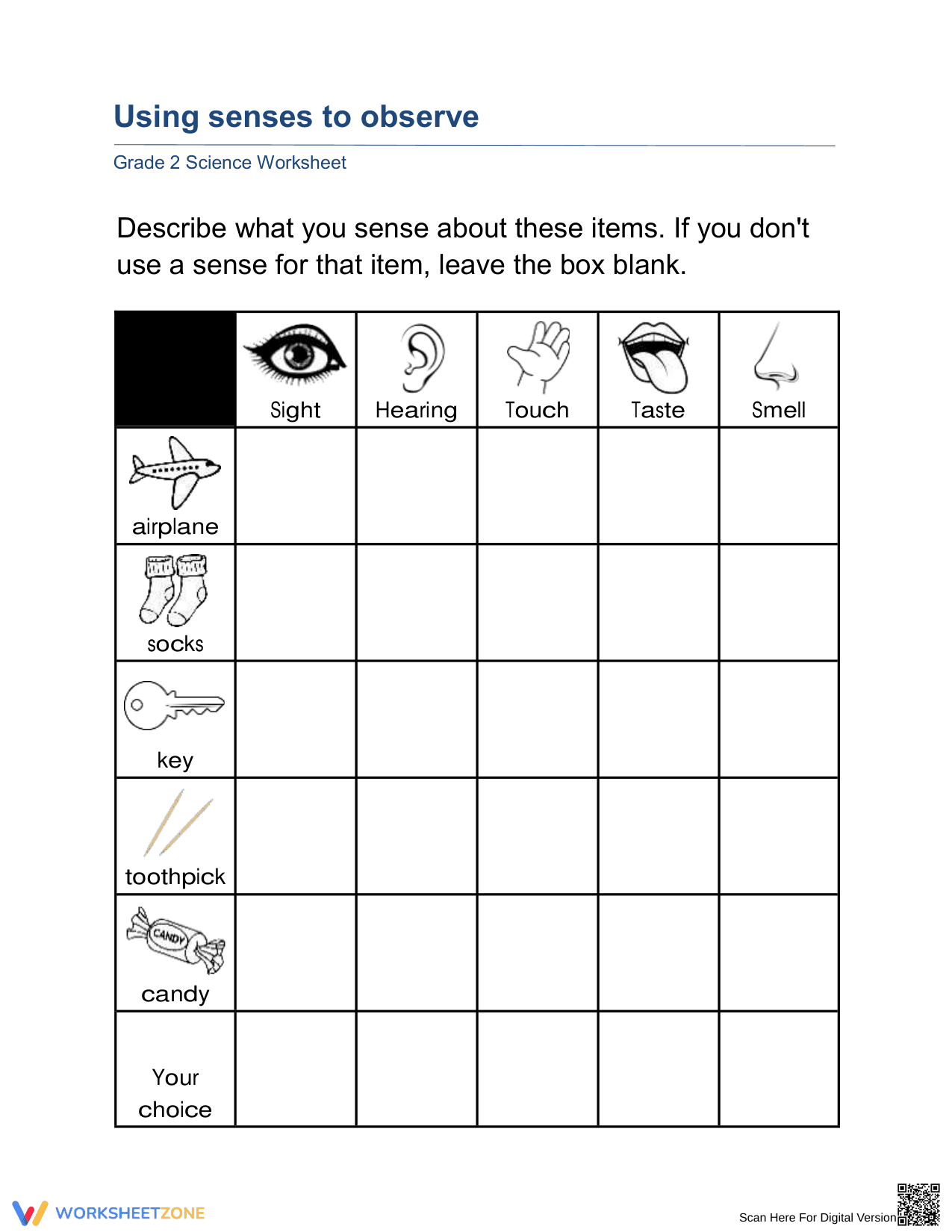
This Grade 2 science worksheet helps students use their five senses to observe and describe everyday objects. By completing a structured observation table, learners identify the physical properties of materials like metal, fabric, and food, building foundational skills in scientific inquiry and data collection.
At a Glance
- Grade: 2 · Subject: Science
- Standard:
2-PS1-1— Describe and classify materials by observable properties- Skill Focus: Sensory observation
- Format: 1 page · 6 problems · Answer key included · PDF
- Best For: Independent practice
- Time: 15–20 minutes
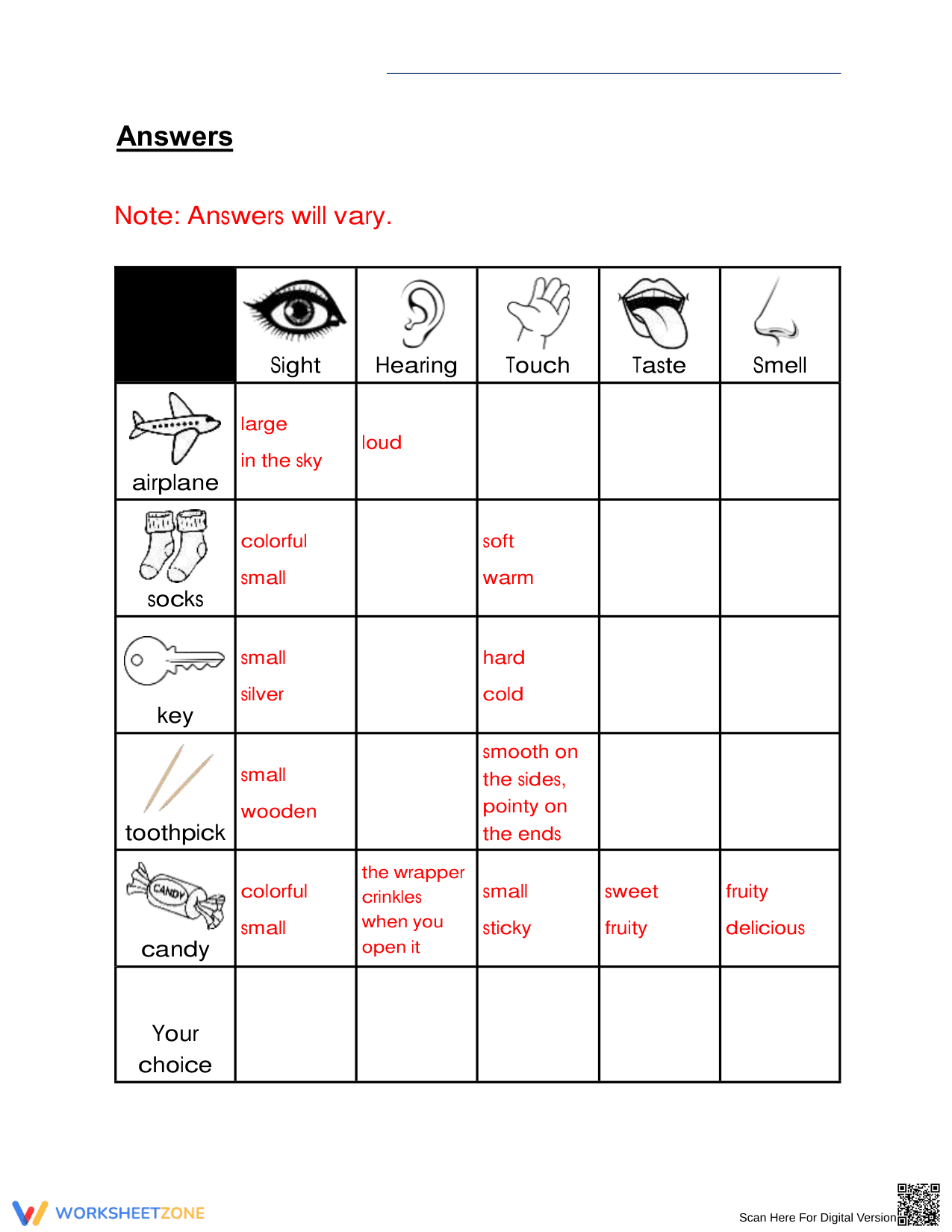
Inside this resource, educators will find a single-page graphic organizer featuring six distinct items, including an airplane, socks, a key, and a student-choice object. The grid prompts students to record observations using sight, hearing, touch, taste, and smell. A sample answer key is provided to help teachers quickly evaluate student responses and guide discussions on material properties.
This resource is designed for a zero-prep workflow:
- Print (1 minute): The single-page layout is optimized for standard black-and-white printing.
- Distribute (1 minute): Hand out the sheets alongside physical examples of the objects if desired.
- Review (3 minutes): Use the sample answer key to quickly check student understanding.
With under two minutes of total teacher prep time, this activity is highly suitable for emergency sub plans or quick science center rotations.
This activity aligns with 2-PS1-1, requiring students to plan and conduct an investigation to describe and classify different kinds of materials by their observable properties. It also supports early scientific communication skills. Both standard codes can be copied directly into lesson plans, IEP goals, or district curriculum mapping tools.
Teachers can introduce this worksheet during direct instruction on the five senses or assign it as an independent science center activity. As a formative assessment tip, observe whether students correctly identify that not all senses apply to every object (e.g., tasting a key). The expected completion time ranges from 15 to 20 minutes.
This resource is ideal for second-grade general education students and early elementary learners needing structured science practice. The visual cues in the table provide excellent differentiation for English Language Learners and visual learners. It pairs perfectly with a hands-on sensory bin activity or an introductory lesson on the states of matter.
Developing early scientific observation skills through structured graphic organizers significantly improves long-term retention of core science concepts. According to a ScienceDirect TpT Analysis, elementary students who regularly practice categorizing physical properties using visual matrices demonstrate higher proficiency in subsequent STEM assessments. This worksheet directly targets 2-PS1-1, helping students describe and classify materials by observable properties. By requiring learners to explicitly link their five senses to specific physical traits, the activity reinforces the fundamental principles of empirical data collection. The inclusion of a student-choice row further encourages independent inquiry, a critical component of early childhood science education. Educators utilizing this tool can effectively bridge the gap between abstract scientific concepts and tangible, everyday experiences, ensuring a robust foundation for future scientific exploration.


