


























Views
Downloads

Using Senses to Observe Worksheet | Grade 2 Essential
Paste this activity's link or code into your existing LMS (Google Classroom, Canvas, Teams, Schoology, Moodle, etc.).
Students can open and work on the activity right away, with no student login required.
You'll still be able to track student progress and results from your teacher account.
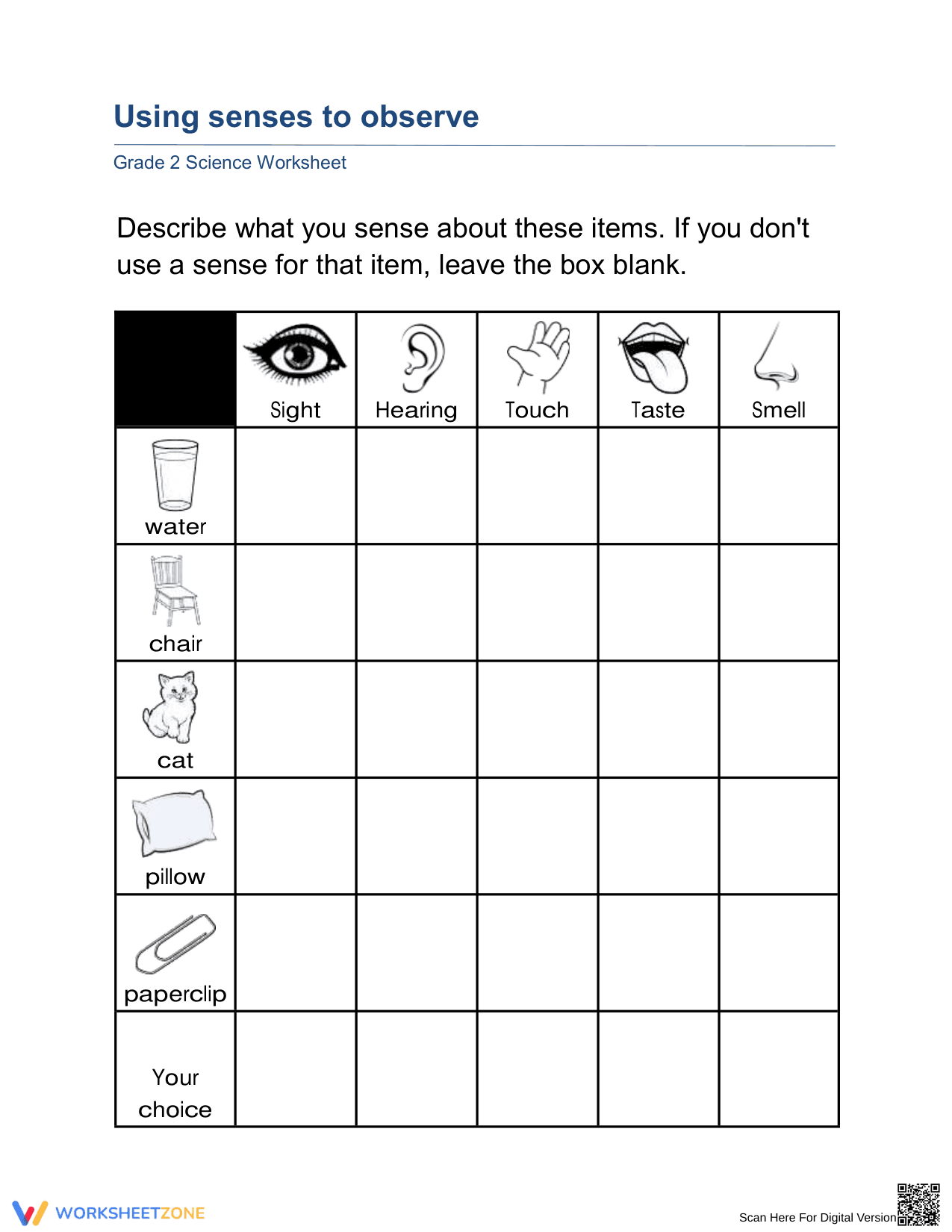
This Grade 2 science worksheet helps students master the art of scientific observation by using their five senses to describe everyday objects. By identifying specific properties like texture, sound, and appearance, learners build a foundation for classifying materials. This activity transforms abstract sensory concepts into concrete descriptive language, fostering critical thinking and early scientific inquiry skills.
At a Glance
- Grade: 2 · Subject: Science
- Standard:
2-PS1-1— Plan and conduct an investigation to describe and classify materials by observable properties- Skill Focus: Sensory observation and descriptive language
- Format: 2 pages · 6 items · Answer key included · PDF
- Best For: Introductory science labs or homework
- Time: 15–20 minutes
What's Inside
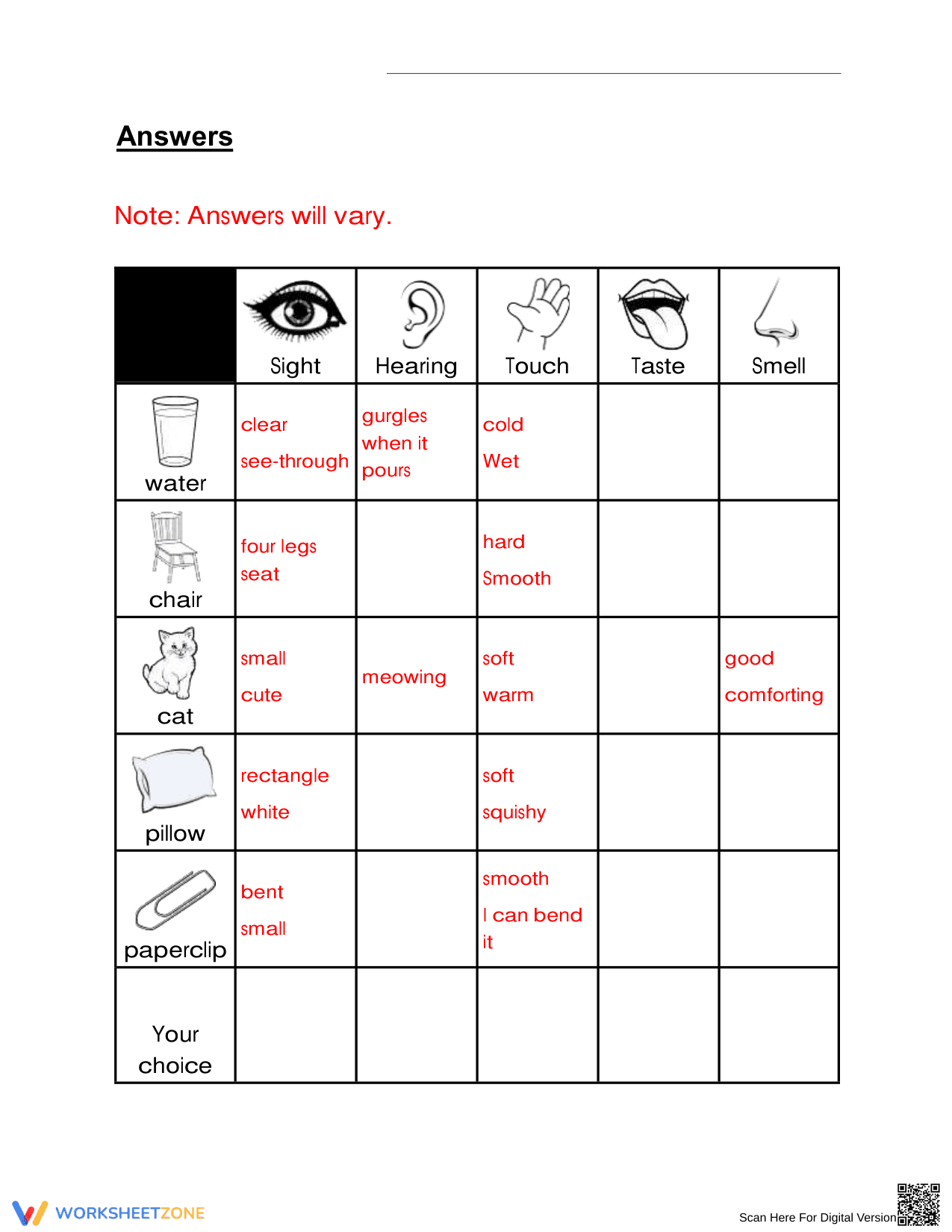
The resource features a structured observation grid containing five pre-selected items—water, a chair, a cat, a pillow, and a paperclip—plus a "your choice" slot for personalization. Students are prompted to record observations for sight, hearing, touch, taste, and smell. The layout includes clear icons for each sense, making it accessible for early readers, and a comprehensive answer key provides sample descriptive terms for each category.
Zero-Prep Workflow
- Print: Generate copies of the single-page grid for each student in under 30 seconds.
- Distribute: Hand out the sheets and briefly explain the "leave blank" rule for safety, ensuring students know not to taste non-food items (1 minute).
- Review: Use the included answer key to facilitate a whole-group discussion, building a shared descriptive vocabulary (5 minutes).
Total teacher preparation time is under two minutes, making this an ideal sub plan or last-minute addition to a physical science unit.
Standards Alignment
Aligned to `2-PS1-1`, this worksheet requires students to conduct a guided investigation into the properties of matter. By recording qualitative data, students meet the requirement to describe materials based on observable characteristics. Both standard codes can be copied directly into lesson plans, IEP goals, or district curriculum mapping tools.
How to Use It
Use this worksheet during the "Explore" phase of a 5E lesson cycle to gather initial data on material properties. It also serves as an effective formative assessment tool; observe if students can distinguish between tactile (touch) and visual (sight) properties during the activity. Completion typically takes 20 minutes, depending on the depth of description required by the instructor.
Who It's For
This is designed for Grade 2 students but is highly effective for Grade 1 learners beginning their sensory units. It supports English Language Learners by providing visual cues for each sense. Pair this with a physical "mystery box" activity or an anchor chart listing descriptive adjectives to maximize student engagement and vocabulary acquisition.
Scientific observation is a foundational literacy skill that bridges the gap between perception and communication. According to Fisher & Frey (2014), providing students with structured scaffolds—such as the sensory grid used in this 2-PS1-1 worksheet—allows them to organize their thoughts before engaging in complex scientific writing. By focusing on the five senses, students develop the precise vocabulary needed to describe and classify materials, a core requirement of the Next Generation Science Standards. Research indicates that when young learners are prompted to use multiple sensory inputs, their retention of material properties increases significantly. This worksheet facilitates that multi-sensory engagement while maintaining a clear, manageable format for early elementary classrooms. It ensures that students are not just looking at objects, but actively investigating them through a systematic lens, which is essential for long-term success in STEM disciplines and evidence-based reasoning.


