




























Views
Downloads

Printable Proper Nouns Worksheet | Grade 1 ELA

Paste this activity's link or code into your existing LMS (Google Classroom, Canvas, Teams, Schoology, Moodle, etc.).
Students can open and work on the activity right away, with no student login required.
You'll still be able to track student progress and results from your teacher account.
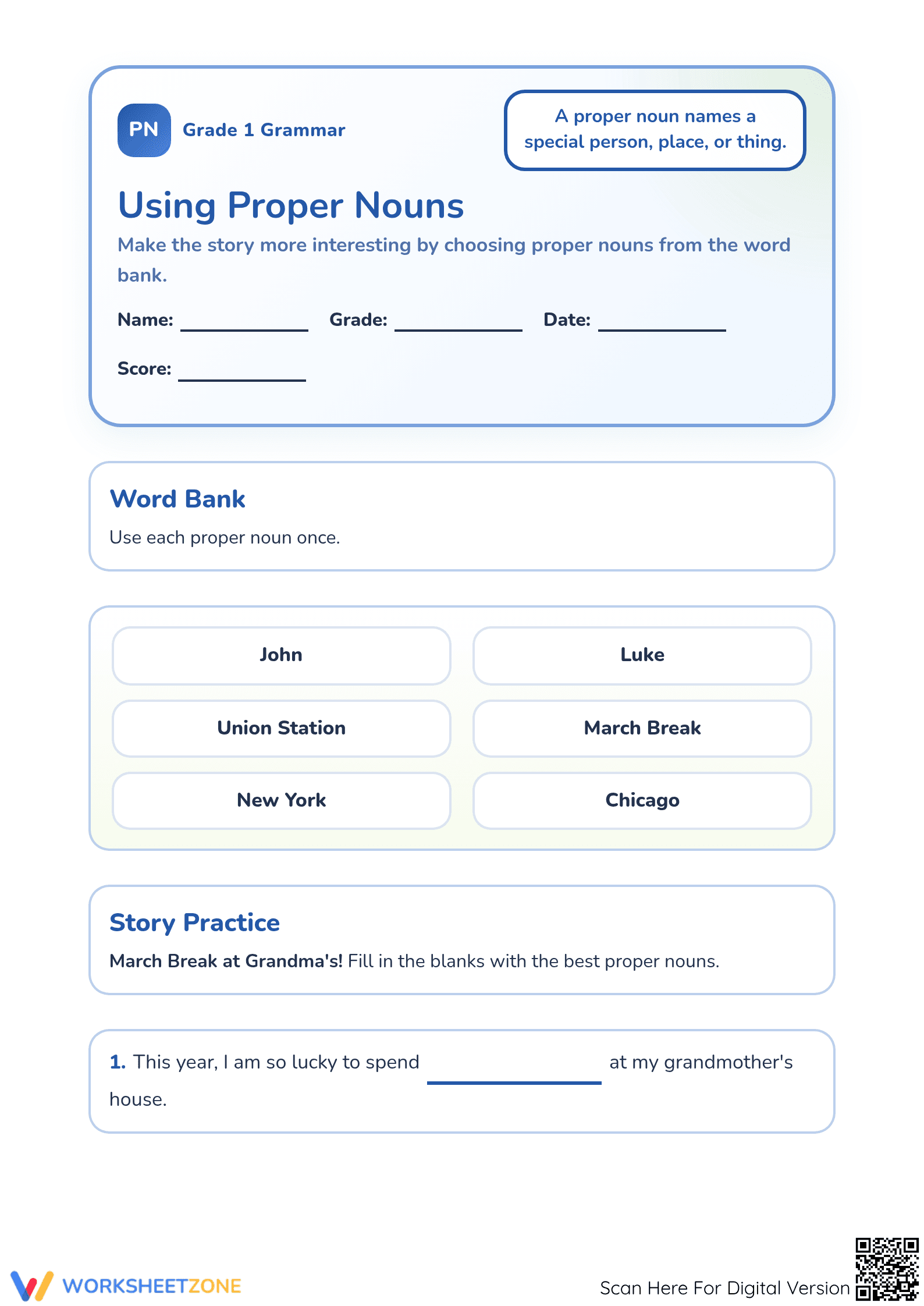
This Grade 1 grammar worksheet helps young learners master proper nouns through a structured story-completion activity. By selecting names, places, and events from a word bank, students practice identifying and applying capitalized nouns in context. This resource ensures students understand that specific names require capital letters for proper identification and clear writing.
At a Glance
- Grade: 1 · Subject: ELA
- Standard:
CCSS.ELA-LITERACY.L.1.2.A— Capitalize dates and names of people in written sentences- Skill Focus: Identifying and using proper nouns
- Format: 2 pages · 6 problems · Answer key included · PDF
- Best For: Grammar centers and independent practice
- Time: 10–15 minutes
What's Inside
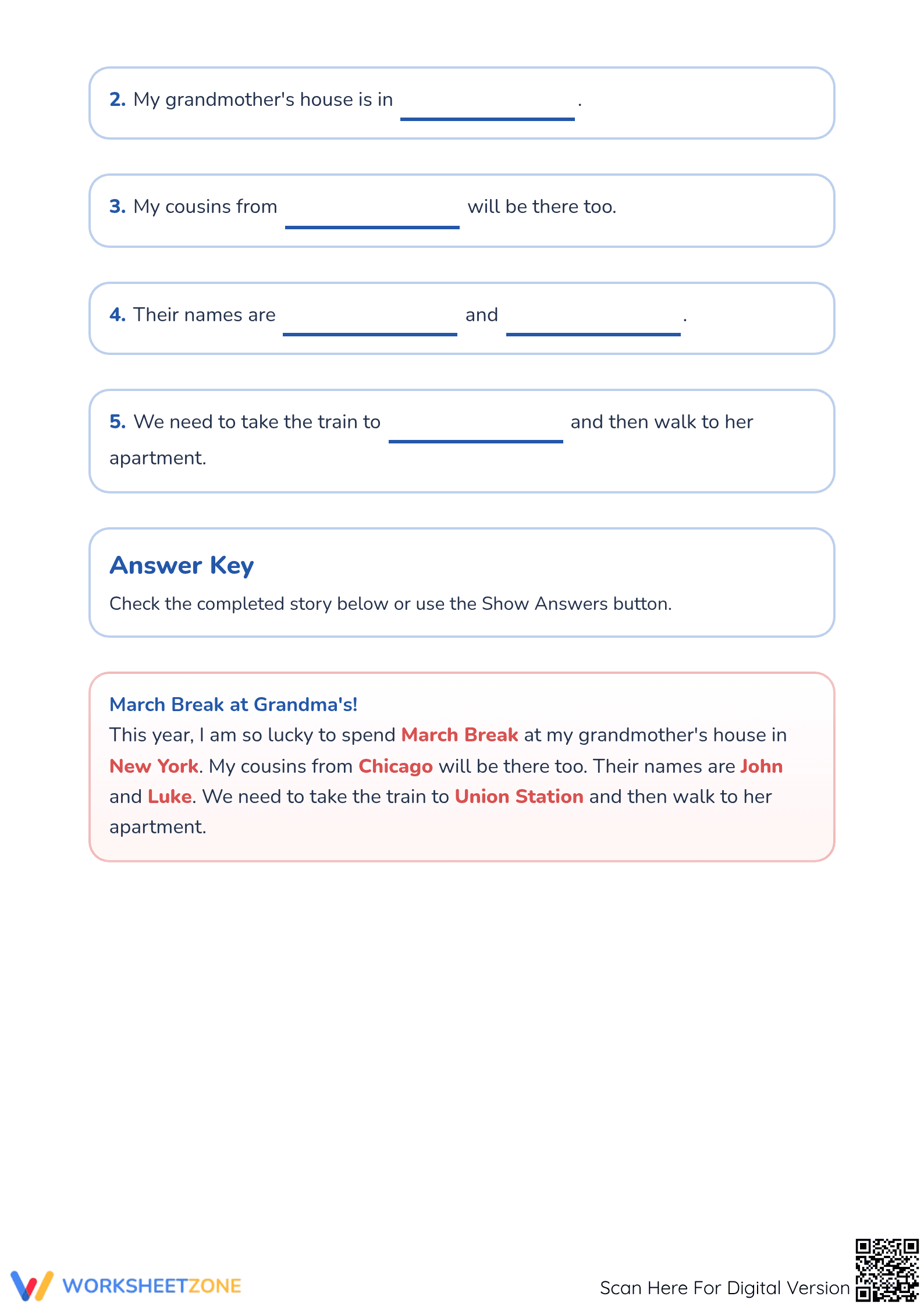
This two-page PDF features a "Story Practice" activity titled "March Break at Grandma's!" The first page defines proper nouns as naming a special person, place, or thing. It provides a word bank with six terms: John, Luke, Union Station, March Break, New York, and Chicago. Students complete five sentences by matching these nouns to the correct narrative context.
Zero-Prep Workflow
The zero-prep workflow is designed for maximum efficiency. Print the two pages in seconds, then distribute them during your grammar block or morning work. Use the integrated answer key on the second page for immediate self-correction or rapid grading. This streamlined process requires under two minutes of teacher preparation, making it an ideal choice for emergency sub plans or literacy centers.
Standards Alignment
Aligned to `CCSS.ELA-LITERACY.L.1.2.A`, this resource requires students to "Capitalize dates and names of people." It supports demonstrating command of standard English capitalization. By working with names of people, places, and events, students build a concrete understanding of lexical rules. Both standard codes can be copied directly into lesson plans, IEP goals, or district curriculum mapping tools.
How to Use It
Use this worksheet as a summative check after teaching capitalization. Provide it during independent work and observe if students differentiate between names and general categories. For formative assessment, have students read their completed stories aloud to check for understanding. This activity typically takes students 10 to 15 minutes to complete with accuracy.
Who It's For
This worksheet is for first-grade students exploring word classes. It is particularly helpful for English Language Learners who need practice identifying specific entities. This resource pairs naturally with a class anchor chart illustrating the difference between common and proper nouns to reinforce capitalization rules visually through clear, real-world examples.
Effective capitalization instruction in early elementary grades is a foundational component of writing fluency. Research cited in EdReports 2024 shows that providing students with structured "fill-in-the-blank" context improves their ability to distinguish between common and proper nouns. This worksheet addresses `CCSS.ELA-LITERACY.L.1.2.A` by requiring students to apply capitalization to names of people and specific locations within a narrative. By using a word bank, the cognitive load is focused on semantic meaning and grammatical roles rather than spelling. Fisher & Frey (2014) emphasize that this scaffolded practice supports the gradual release of responsibility, moving students from identification to independent application. This Grade 1 ELA resource provides the repetition necessary for students to internalize that special names require capital letters, a skill that correlates with higher NAEP writing scores in subsequent grade levels.


