


























Views
Downloads
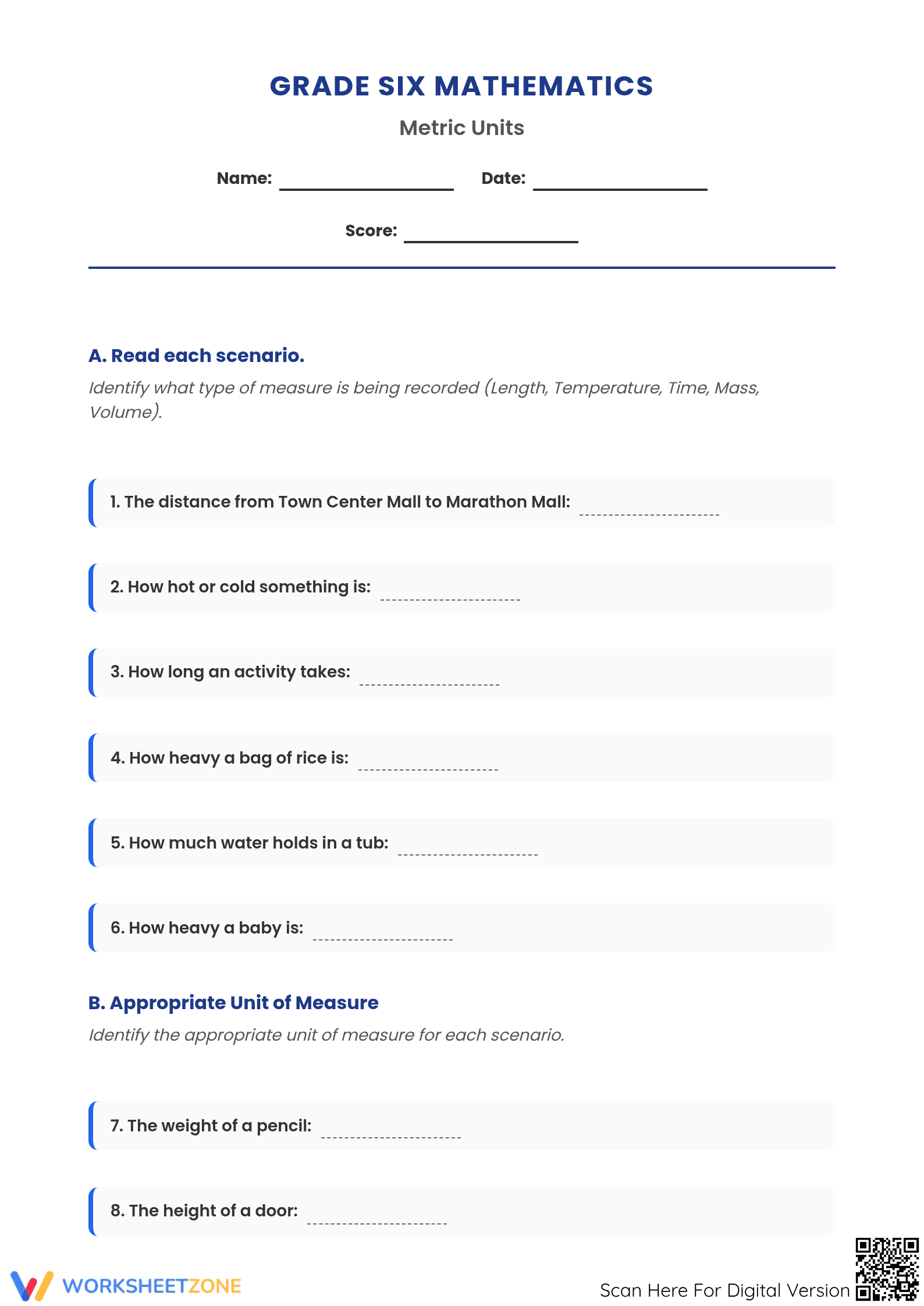



Printable Metric Units Worksheet | Grade 6 Math
Paste this activity's link or code into your existing LMS (Google Classroom, Canvas, Teams, Schoology, Moodle, etc.).
Students can open and work on the activity right away, with no student login required.
You'll still be able to track student progress and results from your teacher account.
Mastering metric units is a foundational skill for middle school mathematics and real-world science applications. This comprehensive Grade 6 worksheet helps students bridge the gap between abstract measurements and concrete objects. Students will identify measurement types, choose appropriate units, and practice realistic estimation to build strong mathematical intuition and spatial reasoning skills.
At a Glance
- Grade: 6 · Subject: Units
- Standard:
CCSS.MATH.CONTENT.5.MD.A.1— Identify and convert standard measurement units within the metric system.- Skill Focus: Metric Unit Identification & Estimation
- Format: 3 pages · 20 problems · Answer key included · PDF
- Best For: Independent practice or homework
- Time: 20–30 minutes
What's Inside
This three-page resource contains twenty targeted problems divided into three distinct sections. Section A requires students to categorize scenarios into length, temperature, time, mass, or volume. Section B challenges students to identify the specific appropriate metric unit (such as grams or liters) for common items. Section C provides multiple-choice estimation tasks where students must select the most logical measurement for various real-world objects. A complete three-page answer key is included for rapid grading.
Zero-Prep Workflow
Designed for the busy educator, this worksheet requires absolutely no setup. Simply print the three-page PDF and distribute it to your class. The clear section headings and scenario-based questions allow students to begin immediately with minimal teacher intervention. Total teacher preparation time is less than two minutes, making this an ideal resource for emergency sub plans, bell-ringers, or quick formative assessments during a measurement unit.
Standards Alignment
The primary alignment is `CCSS.MATH.CONTENT.5.MD.A.1`, which requires students to understand the relationship between different-sized units and convert within the metric system. By identifying appropriate units for mass, volume, and length, students demonstrate a mastery of measurement attributes. This standard code can be copied directly into lesson plans, IEP goals, or district curriculum mapping tools to ensure instructional compliance.
How to Use It
Use this worksheet as a mid-unit check for understanding after students have been introduced to the basic metric prefixes. Alternatively, assign it as a homework packet to reinforce estimation skills. For a formative assessment, observe students during Section C to identify if they have a conceptual grasp of unit magnitude—such as distinguishing between milliliters and kiloliters—before moving on to complex conversions.
Who It's For
This resource is tailored for Grade 5 and Grade 6 students who are solidifying their understanding of the metric system. It is particularly useful for students who struggle with the physical scale of units. This worksheet pairs naturally with a hands-on measurement lab or a metric conversion anchor chart to provide a balanced mix of conceptual and practical application.
Effective measurement instruction requires a shift from rote conversion to conceptual understanding of unit magnitude. According to NAEP research, students often struggle not with the math of conversion, but with selecting the correct unit for a given context. This Grade 6 Metric Units worksheet addresses this gap by forcing students to categorize measurements and estimate values based on physical properties like mass and volume. By engaging with twenty varied scenarios, students build the "measurement sense" necessary for higher-level science and technical education. This approach aligns with EdReports 2024 guidelines for high-quality mathematics instructional materials, which emphasize the importance of conceptual foundations before procedural fluency. Teachers using this standards-aligned resource can confidently document student progress toward mastery of `CCSS.MATH.CONTENT.5.MD.A.1` while providing the repetition needed to move information from short-term memory into long-term mathematical proficiency.


