


























Views
Downloads

Irregular Plural Nouns Worksheet | Grade 1 Printable
Paste this activity's link or code into your existing LMS (Google Classroom, Canvas, Teams, Schoology, Moodle, etc.).
Students can open and work on the activity right away, with no student login required.
You'll still be able to track student progress and results from your teacher account.
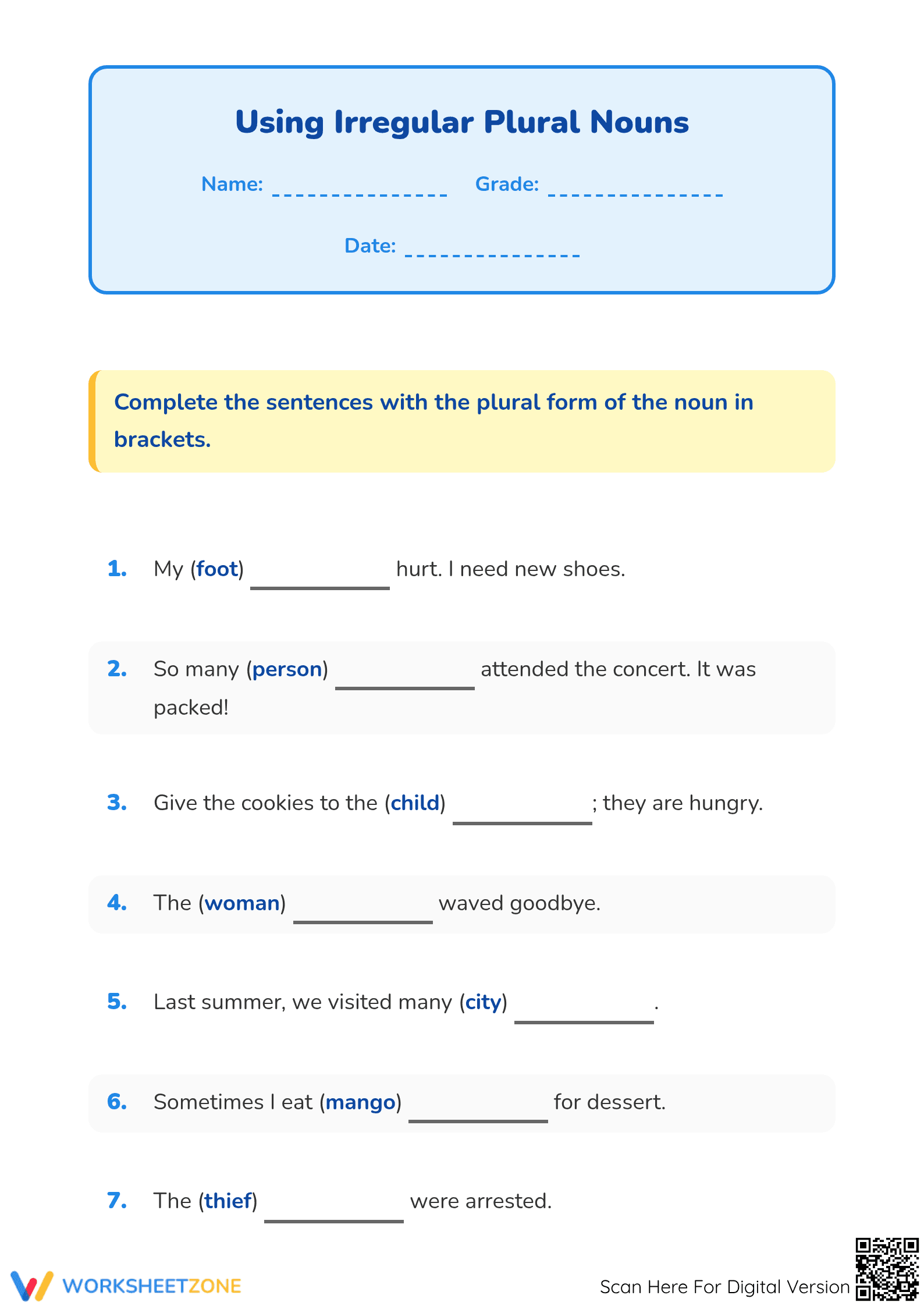
This Grade 1 irregular plural nouns worksheet provides students with 10 targeted practice sentences to master complex word endings and vowel shifts. By transforming singular nouns into their plural forms within a sentence context, learners develop the linguistic flexibility required for fluent reading and writing. It is an essential tool for early grammar mastery.
At a Glance
- Grade: 1 · Subject: ELA
- Standard:
CCSS.ELA-LITERACY.L.1.1.C— Use singular and plural nouns with matching verbs in basic sentences- Skill Focus: Irregular plural nouns
- Format: 2 pages · 10 problems · Answer key included · PDF
- Best For: Independent grammar practice or homework
- Time: 15–20 minutes
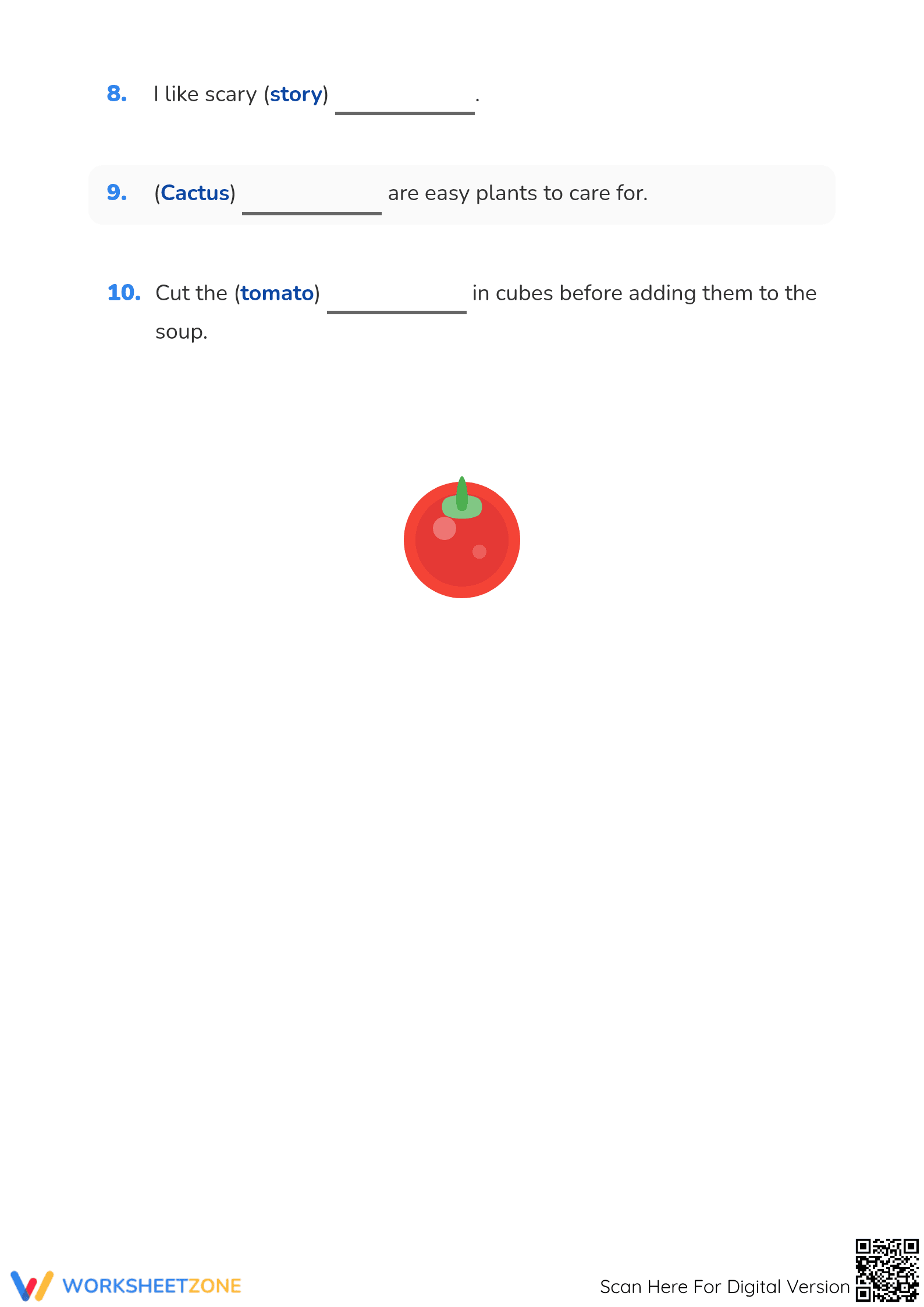
Inside this 2-page resource, you will find 10 fill-in-the-blank sentences designed to challenge young learners. Each item provides a singular noun in brackets, such as "foot" or "cactus," requiring the student to identify and write the correct irregular plural form. A comprehensive answer key is included to facilitate quick grading or student self-correction.
Skill Progression
- Guided practice: The first few items use common irregulars like "feet" and "people" to build initial confidence and establish the pattern of non-standard pluralization.
- Supported practice: Middle tasks introduce spelling changes like "cities" and "thieves," requiring more careful attention to word structure and ending rules.
- Independent practice: The final problems challenge students with less common forms like "cacti" and "tomatoes," testing their ability to apply diverse rules.
This gradual-release approach ensures students move from simple recall to applying complex spelling rules independently using the I Do, We Do, You Do method.
Standards Alignment
This resource is specifically aligned to `CCSS.ELA-LITERACY.L.1.1.C`, which focuses on the correct use of singular and plural nouns with matching verbs. While Grade 1 often focuses on regular plurals, introducing irregular forms early prepares students for the complexities of the English language. Both standard codes can be copied directly into lesson plans, IEP goals, or district curriculum mapping tools.
How to Use It
Use this worksheet during the independent practice phase of a grammar lesson after introducing the concept of nouns that do not follow the standard "-s" rule. It also serves as an excellent formative assessment; observe if students struggle with vowel shifts (man/men) versus ending changes (thief/thieves). Expected completion time ranges from 15 to 20 minutes.
Who It's For
This practice is ideal for first-grade students, English Language Learners (ELLs) who need explicit grammar instruction, and second graders requiring a review. Pair this worksheet with a plural noun anchor chart or a shared reading passage to reinforce the concept in a broader literacy context.
Mastery of irregular plural nouns is a critical milestone in early literacy development. According to Fisher & Frey (2014), the gradual release of responsibility model—moving from teacher modeling to independent application—is highly effective for internalizing complex linguistic rules like those found in CCSS.ELA-LITERACY.L.1.1.C. This worksheet facilitates that transition by providing 10 structured opportunities for students to practice irregular forms such as "children," "women," and "cacti." Research indicates that early exposure to irregular morphological patterns prevents the fossilization of common errors in student writing. By engaging with these specific lexical challenges, Grade 1 students build the phonological and orthographic awareness necessary for advanced reading comprehension. This resource provides a clear, evidence-based pathway for students to demonstrate mastery of noun-verb agreement and pluralization within authentic sentence structures, ensuring they meet foundational ELA benchmarks.


