


























Views
Downloads

Irregular Plural Nouns Worksheet | Grade 3 Essential
Paste this activity's link or code into your existing LMS (Google Classroom, Canvas, Teams, Schoology, Moodle, etc.).
Students can open and work on the activity right away, with no student login required.
You'll still be able to track student progress and results from your teacher account.
Irregular plural nouns often pose a challenge for young writers because they deviate from the standard rules of English suffixation. This Grade 3 worksheet provides focused, high-repetition practice to help students internalize these linguistic exceptions. By applying the correct plural forms within the context of complete sentences, learners bridge the gap between isolated memorization and functional writing application.
At a Glance
- Grade: 3 · Subject: ELA
- Standard:
CCSS.ELA-LITERACY.L.3.1.B— Form and use regular and irregular plural nouns- Skill Focus: Irregular Plural Nouns
- Format: 2 pages · 10 problems · Answer key included · PDF
- Best For: Independent grammar practice or quick assessment
- Time: 15–20 minutes
What's Inside
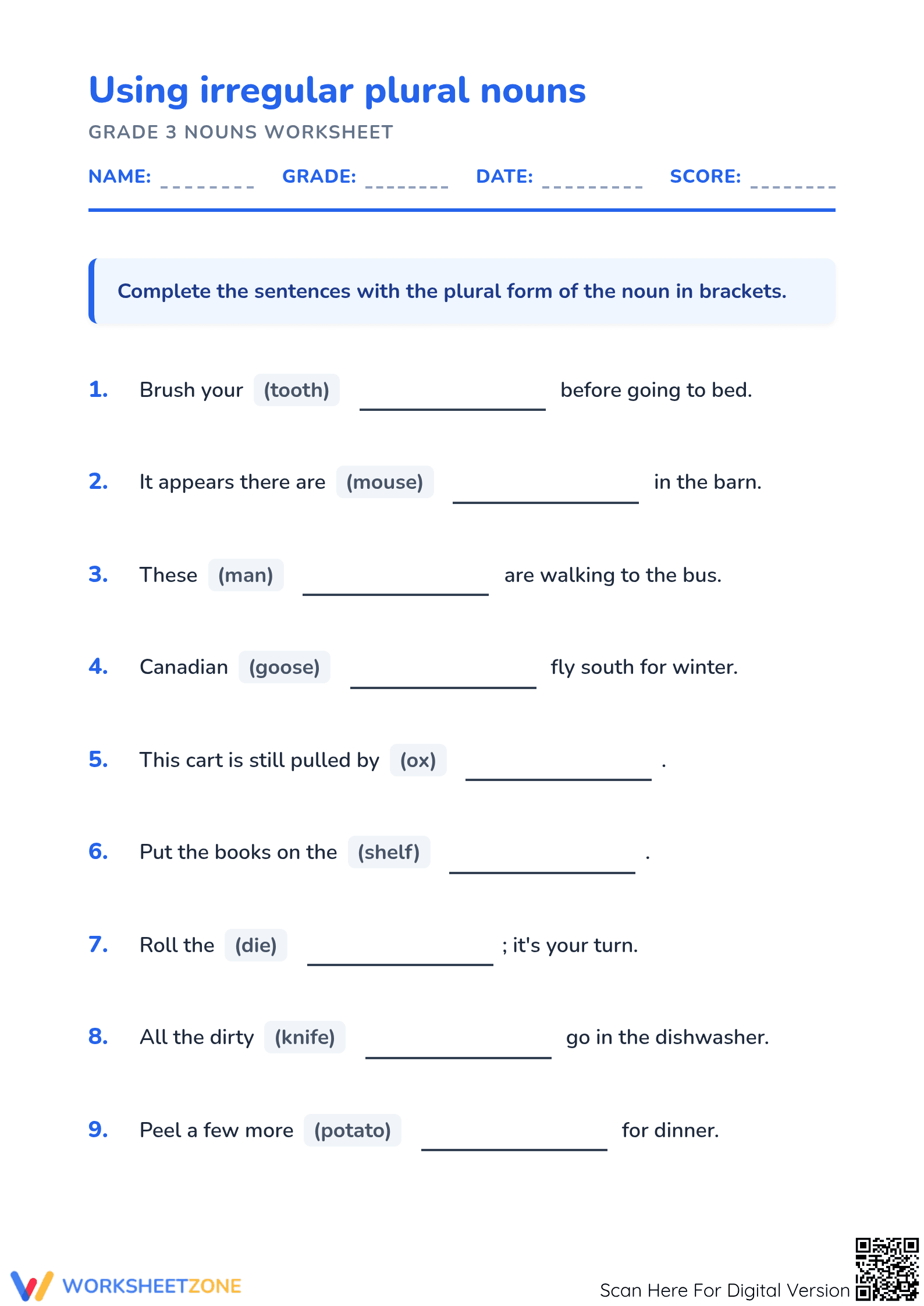
This resource consists of a two-page PDF featuring 10 carefully crafted sentence-completion tasks. Each problem presents a singular noun in brackets, such as "tooth," "mouse," or "shelf," requiring the student to determine and write the correct irregular plural form. The layout is clean and distraction-free, featuring a dedicated score box and a comprehensive answer key for rapid grading or student self-correction.
Zero-Prep Workflow
- Print: Generate the two-page PDF in seconds (30 seconds).
- Distribute: Hand out to students as a morning warm-up or independent grammar station (1 minute).
- Review: Use the included answer key to provide immediate feedback or facilitate peer-grading (5 minutes).
Total teacher preparation time is under 2 minutes, making this an ideal resource for substitute teacher folders or unexpected schedule changes.
Standards Alignment
This worksheet is directly aligned with CCSS.ELA-LITERACY.L.3.1.B, which requires students to form and use regular and irregular plural nouns. It specifically targets the "irregular" component of the standard, covering vowel shifts, internal changes, and nouns ending in -f or -fe. This standard code can be copied directly into lesson plans, IEP goals, or district curriculum mapping tools.
How to Use It
This worksheet is most effective when used as a formative assessment after an introductory lesson on noun types. Assign it during the "independent practice" phase of your writing block to gauge which students have mastered the concept and which require further intervention. For a quick check, observe students as they tackle problem number 7 ("die" to "dice"), as this is often the most frequently missed item in the set.
Who It's For
While designed for Grade 3 students, this resource is also highly effective for English Language Learners (ELL) and older students requiring remedial support in basic grammar conventions. It pairs naturally with an anchor chart displaying common irregular plural patterns or a direct instruction lesson on morphological changes in English nouns.
According to the Fisher & Frey (2014) gradual release of responsibility model, students require targeted practice to move from conceptual understanding to linguistic mastery. This worksheet facilitates that transition by isolating the specific morphological changes required for irregular plural nouns, such as vowel shifts (tooth to teeth) and terminal changes (knife to knives). Research from the NAEP indicates that early mastery of these conventions is a strong predictor of later writing fluency and reading comprehension. By focusing on CCSS.ELA-LITERACY.L.3.1.B, this resource ensures that Grade 3 students develop the necessary vocabulary to navigate complex texts. The structured sentence-completion format provides enough context to support meaning while requiring the student to generate the correct orthographic form independently. This balance of support and challenge is essential for long-term retention of non-standard grammatical rules in the English language.


