


























Views
Downloads
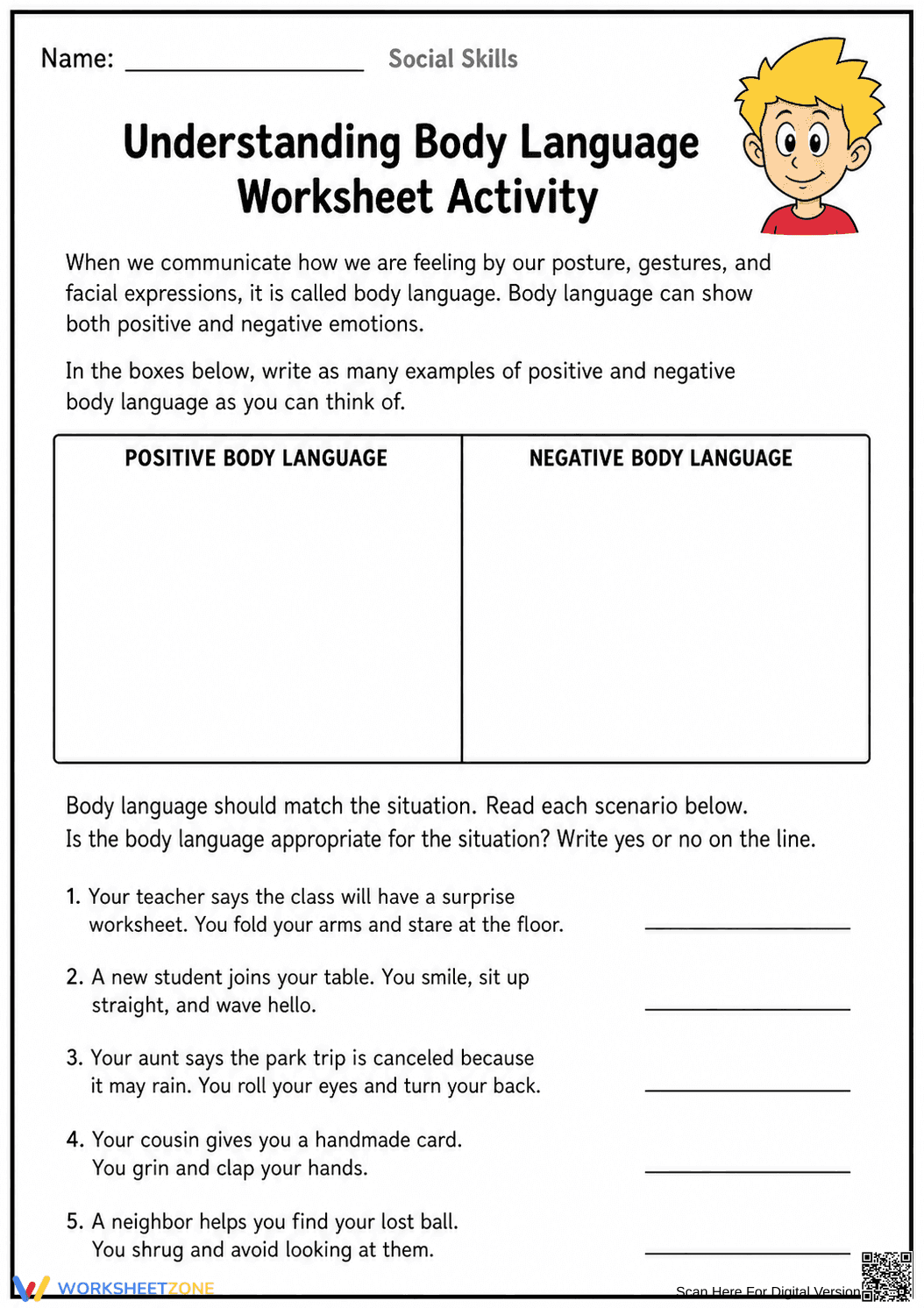

Grade 6 Body Language — Printable No-Prep Worksheet
Paste this activity's link or code into your existing LMS (Google Classroom, Canvas, Teams, Schoology, Moodle, etc.).
Students can open and work on the activity right away, with no student login required.
You'll still be able to track student progress and results from your teacher account.
This Grade 6 social skills worksheet helps students interpret nonverbal communication by analyzing positive and negative body language. By evaluating real-world scenarios, learners develop critical social-emotional skills, build empathy, and learn to match their physical responses to appropriate situations for better peer interactions.
At a Glance
- Grade: 6 · Subject: Social Skills
- Standard:
CCSS.ELA-LITERACY.SL.6.2— Interpret visual and nonverbal communication cues- Skill Focus: Understanding Body Language
- Format: 1 page · 7 problems · Answer key included · PDF
- Best For: Independent practice or SEL blocks
- Time: 15–20 minutes
This single-page resource features two distinct sections to build nonverbal awareness. First, an open-ended brainstorming activity prompts students to list examples of positive and negative body language. Next, students read five relatable social scenarios—such as receiving a surprise quiz or meeting a new student—and determine whether the described physical reaction is appropriate by answering "yes" or "no." A complete answer key is provided for quick grading.
Zero-Prep Workflow
- Print (1 minute): The single-page layout is formatted for standard letter paper, requiring no special cutting or assembly.
- Distribute (1 minute): Hand out the worksheet during morning meeting, advisory, or a dedicated social-emotional learning block.
- Review (3 minutes): Use the included answer key to quickly check student responses or guide a whole-class discussion on why certain reactions fit specific situations.
With under two minutes of prep, this activity is perfect for emergency sub plans.
Standards Alignment
This resource is aligned to CCSS.ELA-LITERACY.SL.6.2, requiring students to interpret information presented in diverse media and formats, including visual and nonverbal communication. By analyzing how posture and facial expressions contribute to a social interaction, students meet core speaking and listening expectations. Both standard codes can be copied directly into lesson plans, IEP goals, or district curriculum mapping tools.
How to Use It
Deploy this worksheet during advisory before direct instruction on conflict resolution. It serves as an excellent primer to get students thinking about how their physical presence affects others. Alternatively, use it as a formative assessment after a lesson on nonverbal cues. As students work, observe their brainstorming process; if they struggle to identify negative body language beyond "frowning," pause the class to model subtle cues like crossed arms or avoiding eye contact. Expect students to complete the tasks within 15 to 20 minutes.
Who It's For
This activity is designed for Grade 6 students developing social awareness and self-regulation skills. It is particularly beneficial for neurodivergent learners or students with IEP goals focused on peer interactions and reading social cues. Pair this worksheet with a role-playing activity or an anchor chart displaying various facial expressions to reinforce the concepts.
Mastering nonverbal communication is a critical component of middle school social-emotional development and academic success. Aligned with CCSS.ELA-LITERACY.SL.6.2, this resource helps students interpret visual and nonverbal communication cues effectively in various contexts. According to a 2024 report by EdReports, integrating structured social skills practice into daily academic routines significantly improves classroom climate, reduces behavioral disruptions, and enhances peer-to-peer collaboration. When students can accurately identify and regulate their own body language, they are better equipped to navigate complex social dynamics and resolve conflicts peacefully. This worksheet provides the targeted, scenario-based practice necessary to build these essential interpersonal skills. By evaluating relatable situations—such as reacting to unexpected news or welcoming a new peer—learners transition from passive observers to active participants in their social environments, fostering a more empathetic and communicative classroom culture.


