


























Views
Downloads

Essential Adjectives Practice | Grade 1 ELA
Paste this activity's link or code into your existing LMS (Google Classroom, Canvas, Teams, Schoology, Moodle, etc.).
Students can open and work on the activity right away, with no student login required.
You'll still be able to track student progress and results from your teacher account.
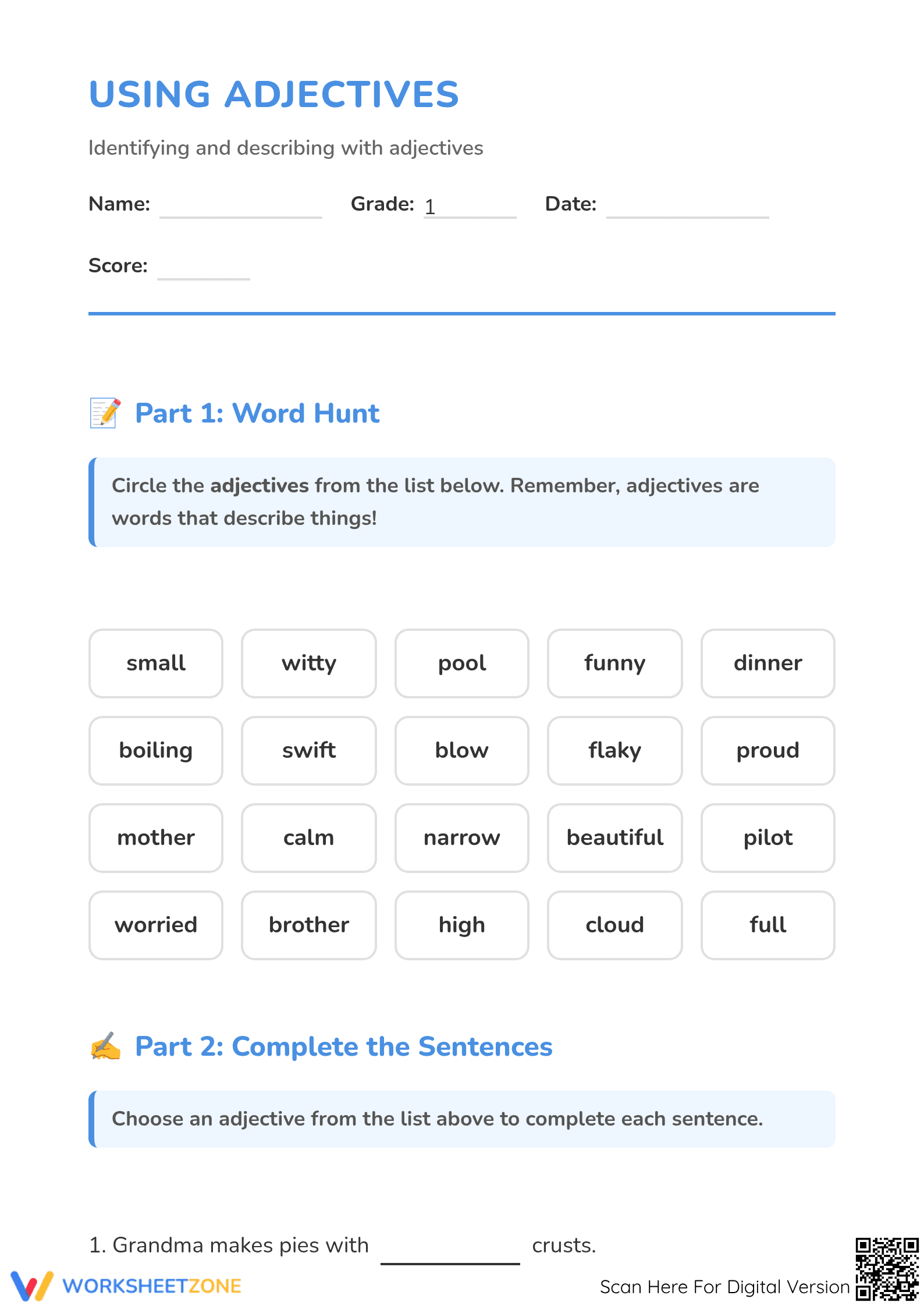
This Grade 1 ELA worksheet provides comprehensive practice for identifying and using adjectives to enhance descriptive writing. Students progress from recognizing descriptive words in a list to applying them in context and finally generating their own adjectives through a creative drawing task. It ensures students understand how adjectives modify nouns to provide detail.
At a Glance
- Grade: 1 · Subject: ELA
- Standard:
CCSS.ELA-LITERACY.L.1.1.F— Use frequently occurring adjectives to describe people, places, and things- Skill Focus: Adjective Identification and Application
- Format: 3 pages · 34 problems · Answer key included · PDF
- Best For: Independent grammar practice and formative assessment
- Time: 20–30 minutes
What's Inside
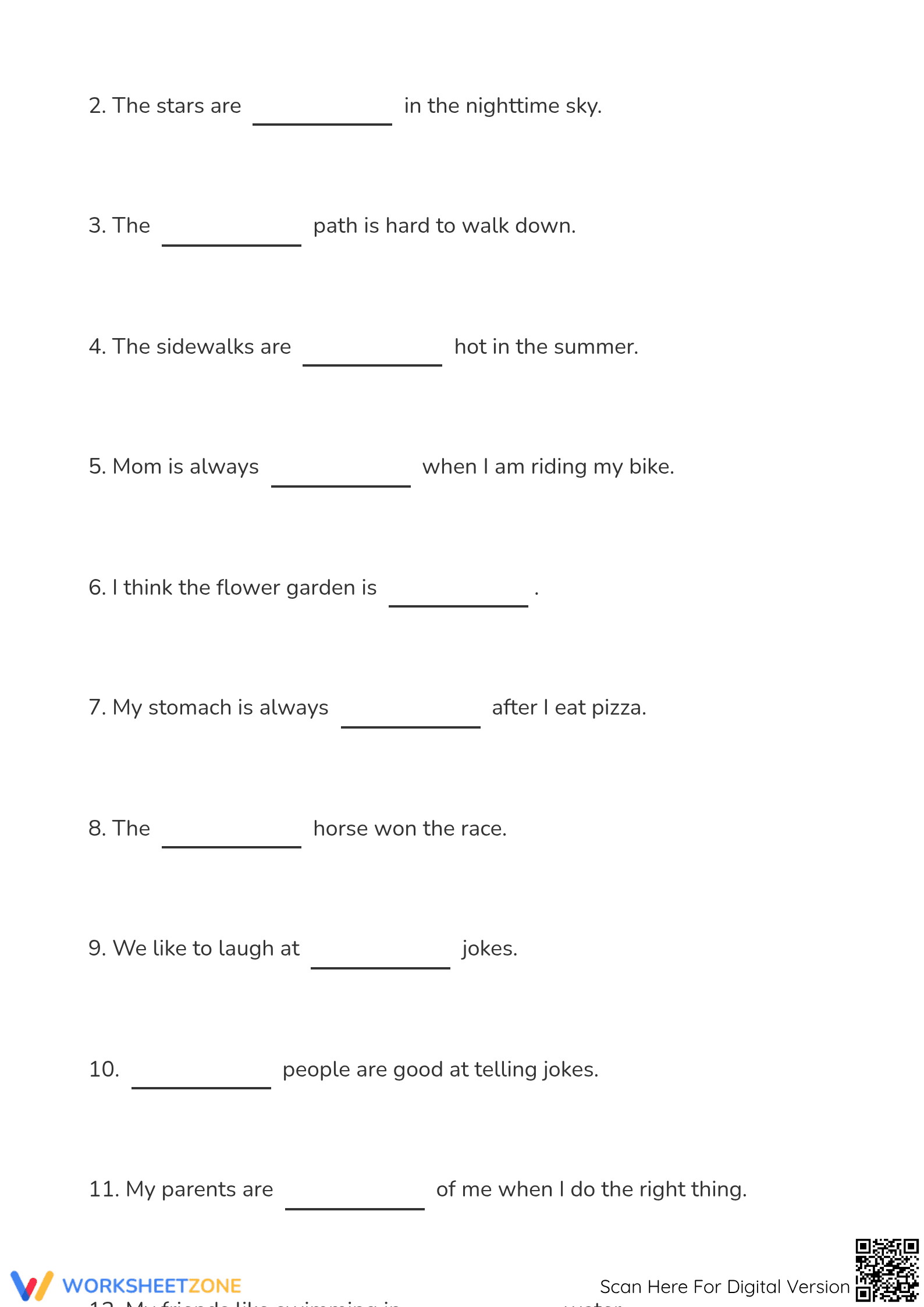
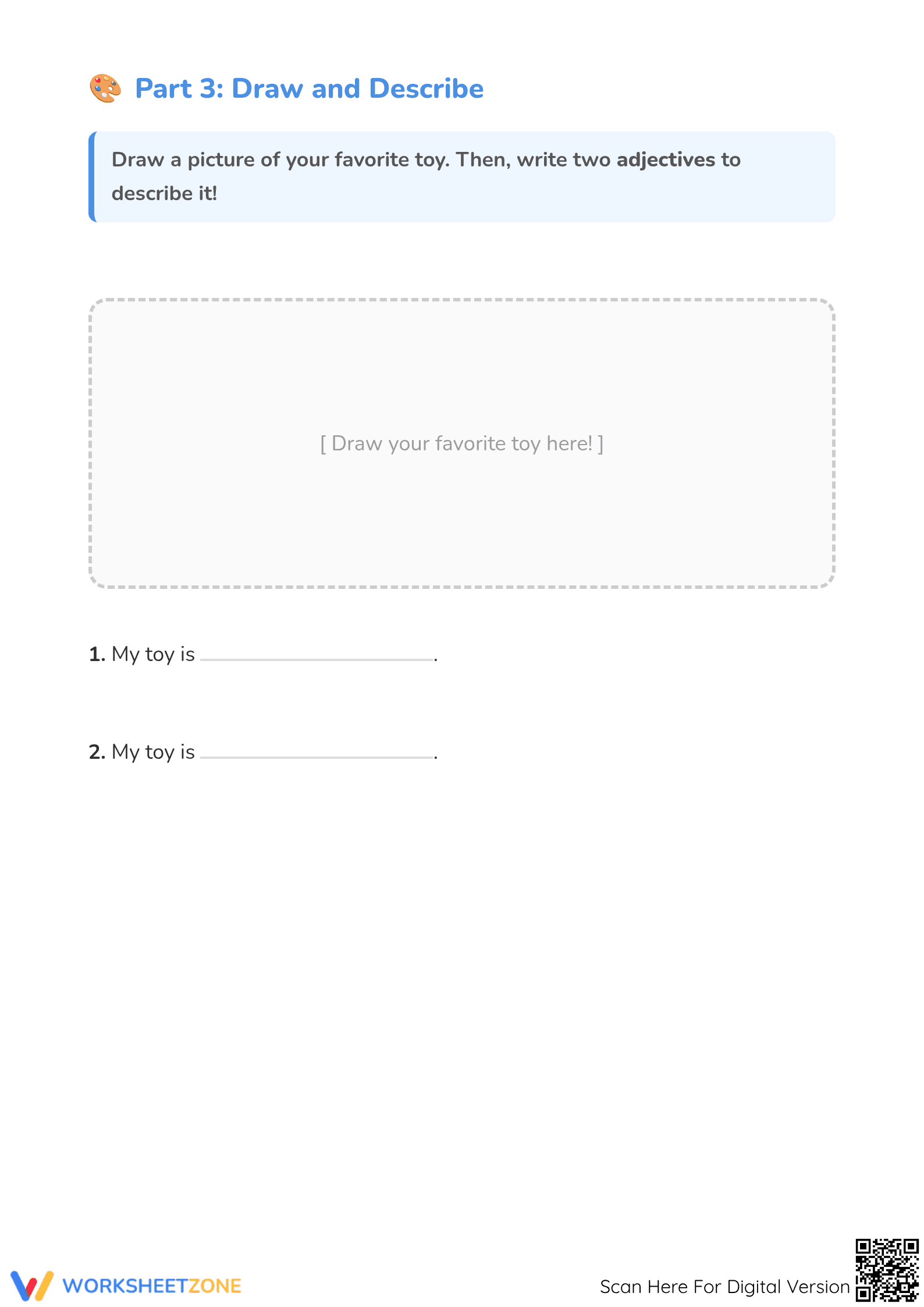
The resource consists of three distinct pages. Part 1 features a "Word Hunt" where students evaluate 20 different words to isolate adjectives. Part 2 provides 11 fill-in-the-blank sentences that require students to select the most appropriate adjective from their previous list. The final page includes a creative "Draw and Describe" prompt, allowing for open-ended application. A full 3-page answer key is provided for rapid grading.
Zero-Prep Workflow
- Print: Select the three content pages and the answer key (30 seconds).
- Distribute: Hand out the packets during your grammar block or as a morning work assignment (1 minute).
- Review: Use the provided answer key to conduct a whole-class check or peer-grading session (5 minutes).
Standards Alignment
This worksheet is specifically aligned to CCSS.ELA-LITERACY.L.1.1.F, which requires students to use frequently occurring adjectives. By distinguishing between nouns and adjectives, students develop the linguistic precision necessary for early literacy success. Standard codes can be copied directly into lesson plans, IEP goals, or district curriculum mapping tools.
How to Use It
Use this worksheet during the "You Do" phase of a gradual release model. After introducing adjectives with an anchor chart, assign the Word Hunt to check for initial recognition. For a formative assessment tip, observe students during Part 2; if they struggle to match adjectives to the correct sentence context, they may need additional support with vocabulary meaning. Completion typically takes 25 minutes.
Who It's For
This resource is tailored for Grade 1 students but serves as an excellent intervention tool for Grade 2 students needing a refresher. It is also highly effective for English Language Learners (ELL) who are building their descriptive vocabulary. Pair this worksheet with a descriptive picture book or a "Show and Tell" activity to reinforce the concept of describing objects.
The instructional design of this adjective worksheet aligns with the "Gradual Release of Responsibility" framework popularized by Fisher & Frey (2014). By moving from recognition to scaffolded application and finally to independent generation, the resource supports the cognitive shift from surface-level knowledge to functional mastery. Research indicates that explicit instruction in word classes, particularly adjectives, significantly improves the syntactic complexity of student writing in early elementary grades. According to the NAEP frameworks, early mastery of descriptive language is a primary predictor of later reading comprehension success, as it allows students to visualize text more effectively. This 34-task set provides the high-repetition practice necessary for first-grade learners to internalize these CCSS.ELA-LITERACY.L.1.1.F grammar rules. The inclusion of a visual drawing component further bridges the gap between concrete objects and abstract linguistic descriptors, ensuring a multi-modal learning experience.


