


























Views
Downloads
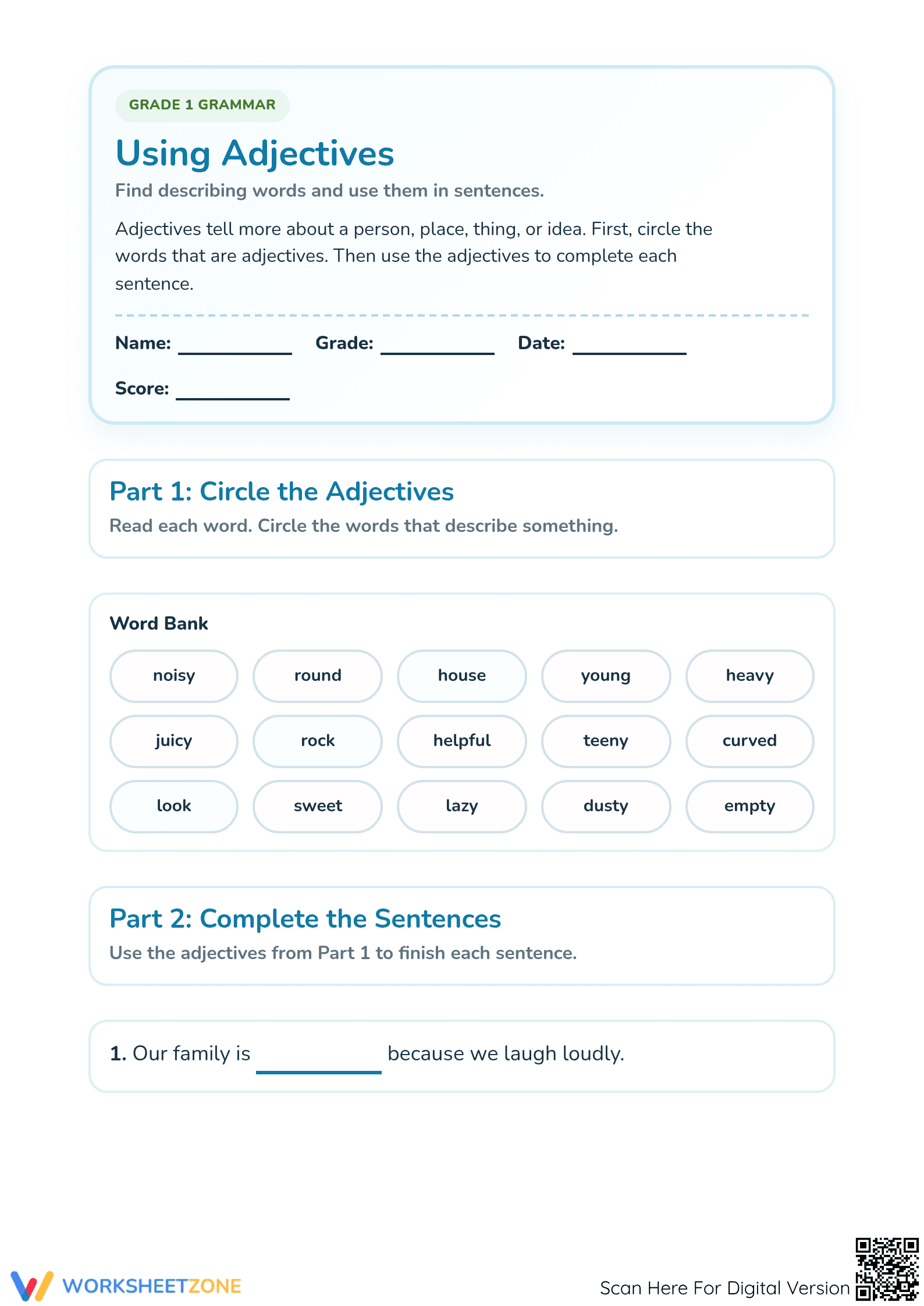


Grade 1 Adjectives — Printable No-Prep Worksheet
Paste this activity's link or code into your existing LMS (Google Classroom, Canvas, Teams, Schoology, Moodle, etc.).
Students can open and work on the activity right away, with no student login required.
You'll still be able to track student progress and results from your teacher account.
This Grade 1 adjectives worksheet helps students identify descriptive words and apply them in context to enhance their writing. By distinguishing adjectives from other parts of speech and using them to complete sentences, learners build the foundational grammar skills necessary for descriptive communication and reading comprehension.
At a Glance
- Grade: 1 · Subject: ELA
- Standard:
CCSS.ELA-LITERACY.L.1.1.F— Use frequently occurring adjectives to describe people, places, and things- Skill Focus: Adjective identification and usage
- Format: 2 pages · 25 problems · Answer key included · PDF
- Best For: Independent practice or homework
- Time: 15–20 minutes
This comprehensive 2-page PDF features a 15-word bank where students must circle the adjectives. Following this identification phase, the worksheet provides 10 fill-in-the-blank sentences that require students to select the most appropriate descriptive word from their identified list. The layout is clean and student-friendly, featuring a clear word bank and spacious lines for writing. A full answer key is included for quick grading or student self-correction.
Zero-Prep Workflow
- Print: Select the 2-page PDF and print enough copies for your class in approximately 30 seconds.
- Distribute: Hand out the worksheets as a warm-up, independent center activity, or morning work in under 1 minute.
- Review: Use the included answer key to check for understanding or have students self-correct their work in 30 seconds.
Total teacher prep time is under 2 minutes, making this an ideal sub plan or last-minute grammar reinforcement tool for busy classrooms.
This resource is aligned to CCSS.ELA-LITERACY.L.1.1.F, which requires students to use frequently occurring adjectives. It also supports L.1.1.B by reinforcing common noun-adjective relationships through contextual sentence completion. Both standard codes can be copied directly into lesson plans, IEP goals, or district curriculum mapping tools to ensure instructional alignment.
Assign this worksheet during the independent practice phase of a lesson on descriptive language. It works effectively as a formative assessment to see if students can distinguish adjectives from nouns (like "house" or "rock") within a mixed list. Expect a completion time range of 15 to 20 minutes depending on student reading levels.
Designed for first-grade students, this resource is also suitable for second-grade review or English Language Learners (ELL) focusing on basic descriptive vocabulary. For best results, pair it with a picture book read-aloud to have students find adjectives in the text before completing the written tasks on the page.
According to Fisher & Frey (2014), the gradual release of responsibility is most effective when students move from identifying linguistic components to applying them in sentence-level contexts. This worksheet facilitates that transition by first asking students to isolate adjectives within a word bank before requiring their use in 10 unique sentences. By focusing on CCSS.ELA-LITERACY.L.1.1.F, the resource ensures that Grade 1 learners are building the specific lexical categories required for early literacy mastery. Research from EdReports 2024 emphasizes that high-quality instructional materials must provide clear, scaffolded opportunities for students to practice grammar in isolation and in context. This 2-page printable meets those criteria by offering 25 distinct tasks that reinforce descriptive language. The inclusion of an answer key allows for immediate feedback, a critical component in the acquisition of new grammatical structures for young learners.


