


























Views
Downloads
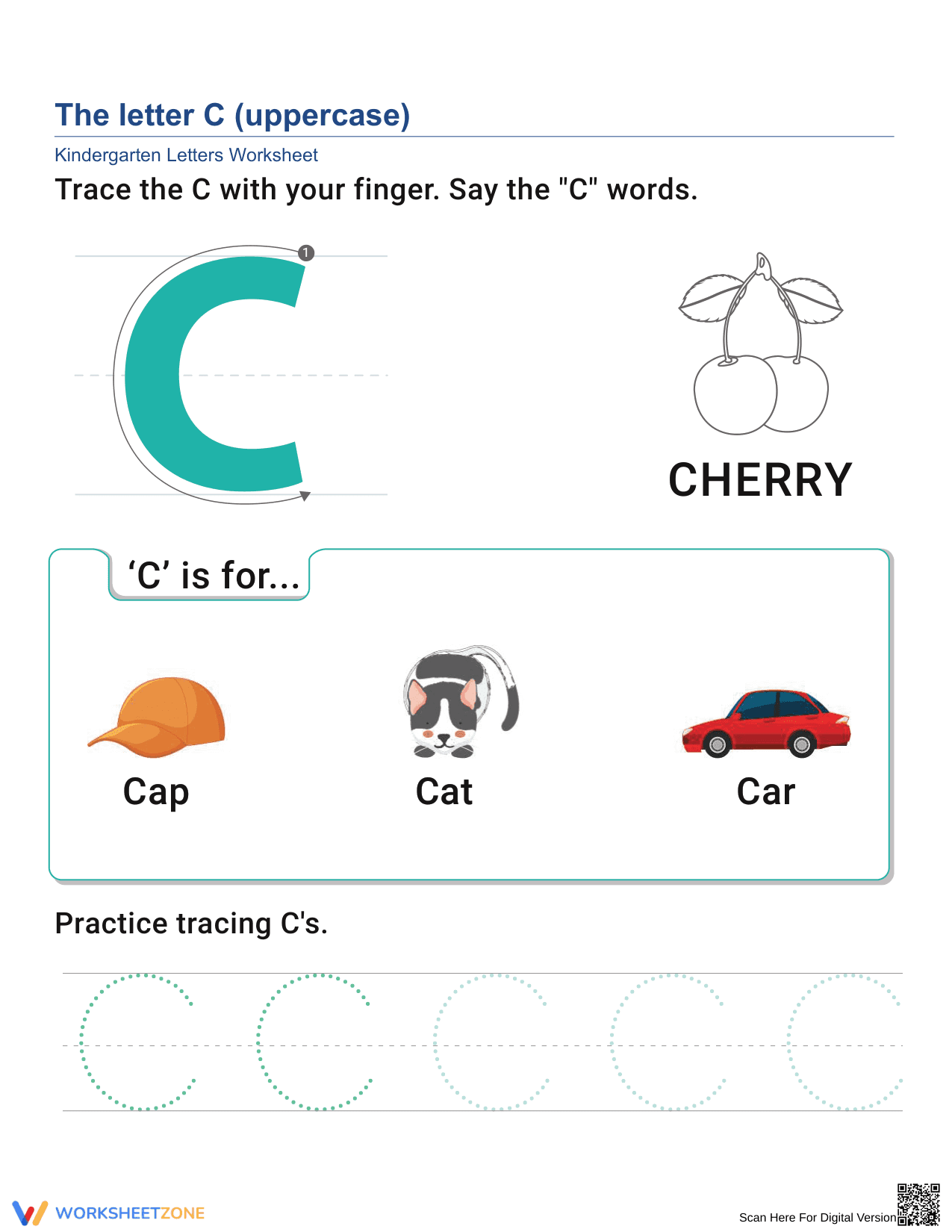

Uppercase Letter C Printable Worksheet | Grade K
Paste this activity's link or code into your existing LMS (Google Classroom, Canvas, Teams, Schoology, Moodle, etc.).
Students can open and work on the activity right away, with no student login required.
You'll still be able to track student progress and results from your teacher account.
This foundational early literacy worksheet helps young learners master the uppercase letter C through guided tracing and vocabulary association. By combining tactile finger-tracing with pencil practice and beginning sound recognition, students build essential fine motor skills and phonics awareness required for reading readiness.
At a Glance
- Grade: K · Subject: ELA
- Standard:
CCSS.ELA-LITERACY.L.K.1.A— Print upper- and lowercase letters- Skill Focus: Letter recognition and tracing
- Format: 1 page · 5 problems · No answer key · PDF
- Best For: Independent practice
- Time: 5–10 minutes
Inside this single-page resource, educators will find a multi-sensory approach to letter formation. The page begins with a large, directional letter C for finger-tracing, paired with a target vocabulary word (cherry). A visual word bank introduces three additional words starting with C (cap, cat, car) to reinforce beginning sounds. Finally, standard handwriting lines provide structured space for students to trace five dotted uppercase C's using a pencil.
This resource is designed for immediate classroom implementation with zero teacher setup required.
- Print (1 minute): Simply download the PDF and print a class set. The black-and-white design is ink-friendly.
- Distribute (1 minute): Hand out to students along with pencils or crayons. The visual instructions are intuitive for early learners.
- Review (3 minutes): Quickly check student tracing for proper stroke direction and letter sizing on the provided handwriting lines.
With under two minutes of total prep time, this worksheet is an excellent addition to emergency sub plans, morning work folders, or literacy centers.
This activity is directly aligned to CCSS.ELA-LITERACY.L.K.1.A, requiring students to print many upper- and lowercase letters. It also supports foundational phonics skills by associating the letter C with its primary sound in familiar words. Both standard codes can be copied directly into lesson plans, IEP goals, or district curriculum mapping tools.
Teachers can utilize this worksheet during morning work to establish a calm, focused start to the day while reinforcing the letter of the week. Alternatively, it serves as an effective literacy center activity following direct instruction on the letter C. While students work, teachers can conduct formative assessments by observing pencil grip and stroke direction, ensuring students start at the top line and curve downward. Expected completion time ranges from five to ten minutes.
This resource is primarily designed for kindergarten students, though it is equally beneficial for preschool learners developing early writing skills or first graders needing targeted remediation. For students requiring extra support, teachers can provide textured materials like glitter glue over the large letter for enhanced tactile feedback. This worksheet pairs perfectly with a read-aloud focused on the letter C or a classroom alphabet anchor chart.
Developing automaticity in letter recognition and formation is a critical predictor of later reading success. This worksheet targets CCSS.ELA-LITERACY.L.K.1.A, helping students print upper- and lowercase letters accurately and confidently. According to Fisher & Frey (2014), providing structured, gradual-release practice opportunities significantly improves early literacy outcomes by reducing cognitive load during the writing process. By integrating tactile tracing, visual vocabulary cues, and standard handwriting practice, this resource supports multiple learning modalities in the early childhood classroom. The explicit connection between the uppercase letter C and its corresponding beginning sounds bridges the gap between basic alphabet knowledge and essential phonemic awareness. Early childhood educators can rely on this targeted, standards-aligned practice to build the foundational fine motor and cognitive skills necessary for fluent reading and writing development in young learners, ensuring a strong start to their academic journey.


