


























Views
Downloads
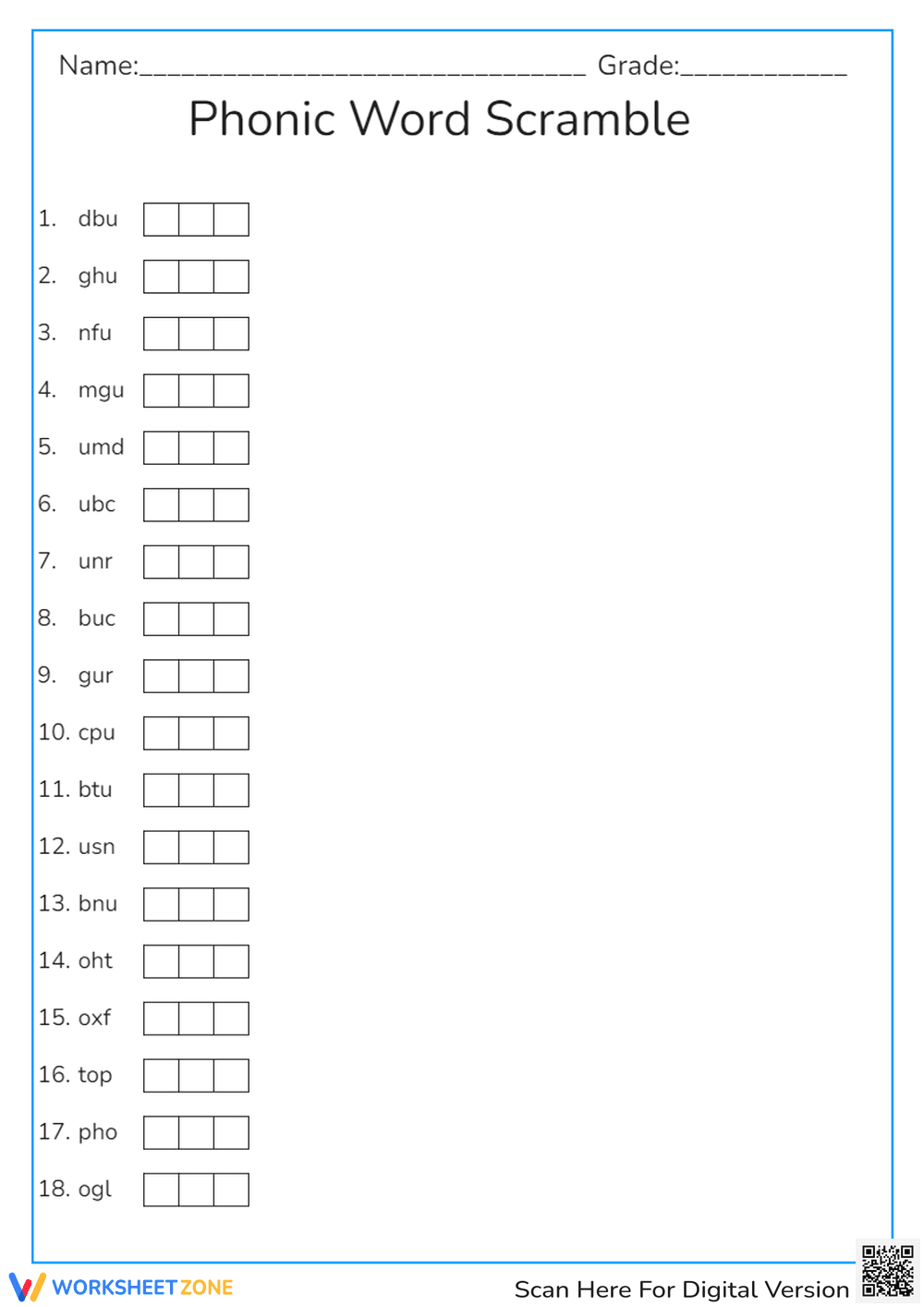


Phonics Word Scramble Worksheet | Grade K Essential
Paste this activity's link or code into your existing LMS (Google Classroom, Canvas, Teams, Schoology, Moodle, etc.).
Students can open and work on the activity right away, with no student login required.
You'll still be able to track student progress and results from your teacher account.
This Kindergarten phonics worksheet provides extensive practice in letter-sound correspondence and spelling. Students unscramble 63 different three-letter words to build foundational literacy skills. By rearranging letters into the correct sequence, learners strengthen their phonemic awareness and orthographic processing in a structured, repetitive format that builds confidence and mastery.
At a Glance
- Grade: Kindergarten · Subject: ELA Phonics
- Standard:
CCSS.ELA-LITERACY.L.K.2.D— Spell simple words phonetically using sound-letter relationships- Skill Focus: 3-Letter Word Unscrambling
- Format: 4 pages · 63 problems · Answer key included · PDF
- Best For: Independent morning work or literacy centers
- Time: 15–20 minutes per page
This comprehensive 4-page PDF contains 63 individual word scramble tasks. Each problem presents three scrambled letters followed by three empty boxes, providing a clear visual structure for students to write their answers. The repetitive layout is designed for young learners to work independently without constant teacher intervention, making it an ideal resource for busy classrooms.
The zero-prep workflow is designed for maximum efficiency. First, print the four-page set (30 seconds). Second, distribute the worksheets during literacy blocks or as a transition activity (1 minute). Third, review the completed words using the included answer key or via a quick choral response session (2 minutes). Total teacher preparation time is under two minutes, making this an excellent choice for emergency sub plans.
This resource aligns with CCSS.ELA-LITERACY.L.K.2.D, which requires students to "Spell simple words phonetically, drawing on knowledge of sound-letter relationships." It also supports RF.K.3 by reinforcing phonics and word recognition skills. Both standard codes can be copied directly into lesson plans, IEP goals, or district curriculum mapping tools to ensure instructional compliance.
Use this worksheet during the "You Do" phase of a gradual release lesson on CVC words or phonics. It serves as an excellent formative assessment tool; teachers can observe which letter combinations cause hesitation to identify specific phonemic gaps. Expect students to complete one page in approximately 15 to 20 minutes depending on their current level of phonetic proficiency.
This resource is tailored for Kindergarten students, but it also serves as a valuable intervention for first graders needing remedial spelling support. It pairs naturally with letter tiles, magnetic letters, or a CVC anchor chart to provide additional scaffolding for emerging readers who are still mastering the alphabetic principle and basic word construction.
Research from Fisher & Frey (2014) emphasizes that repetitive, structured practice with phonemic manipulation is critical for developing automaticity in early readers. This worksheet applies these principles by requiring students to mentally manipulate phonemes before committing them to paper. By engaging with 63 distinct word patterns, students move beyond rote memorization toward a functional understanding of how English orthography represents spoken sounds. The alignment with CCSS.ELA-LITERACY.L.K.2.D ensures that the tasks are developmentally appropriate for Kindergarten learners, focusing on the phonetic spelling of simple words. According to NAEP data, early mastery of these sound-letter relationships is a primary predictor of later reading fluency and comprehension. This resource provides the high-volume practice necessary to bridge the gap between letter recognition and independent writing, making it a reliable addition to any evidence-based literacy program.


