




























Views
Downloads


Linking Verbs Quiz Worksheet | Essential Grade 5-6 Aligned

Paste this activity's link or code into your existing LMS (Google Classroom, Canvas, Teams, Schoology, Moodle, etc.).
Students can open and work on the activity right away, with no student login required.
You'll still be able to track student progress and results from your teacher account.
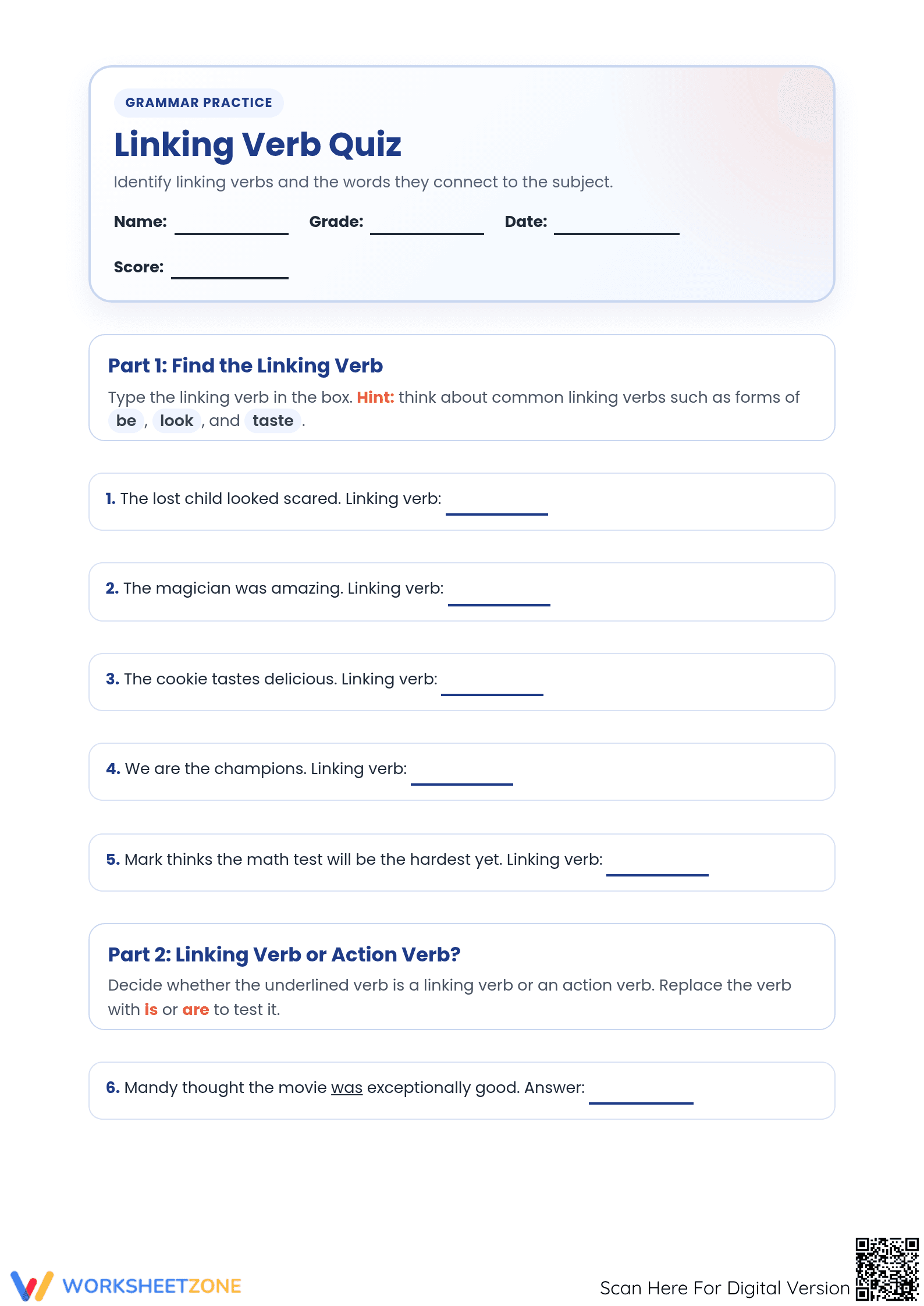
Strengthen student command of sentence structure with this comprehensive grammar assessment designed for middle-grade learners. This worksheet moves beyond simple identification, requiring students to analyze the functional role of verbs as connectors between subjects and their complements. By the end of these exercises, students will demonstrate a clear understanding of how state-of-being verbs differ from action-oriented predicates in varied contexts.
At a Glance
- Grade: 5-6 · Subject: English Language Arts
- Standard:
CCSS.ELA-LITERACY.L.5.1— Identify linking verbs and distinguish them from action verbs within complete sentences- Skill Focus: Subject-Complement Relationships
- Format: 1 page · 20 problems · Answer key included · PDF
- Best For: Formative grammar assessment or unit review
- Time: 15–20 minutes
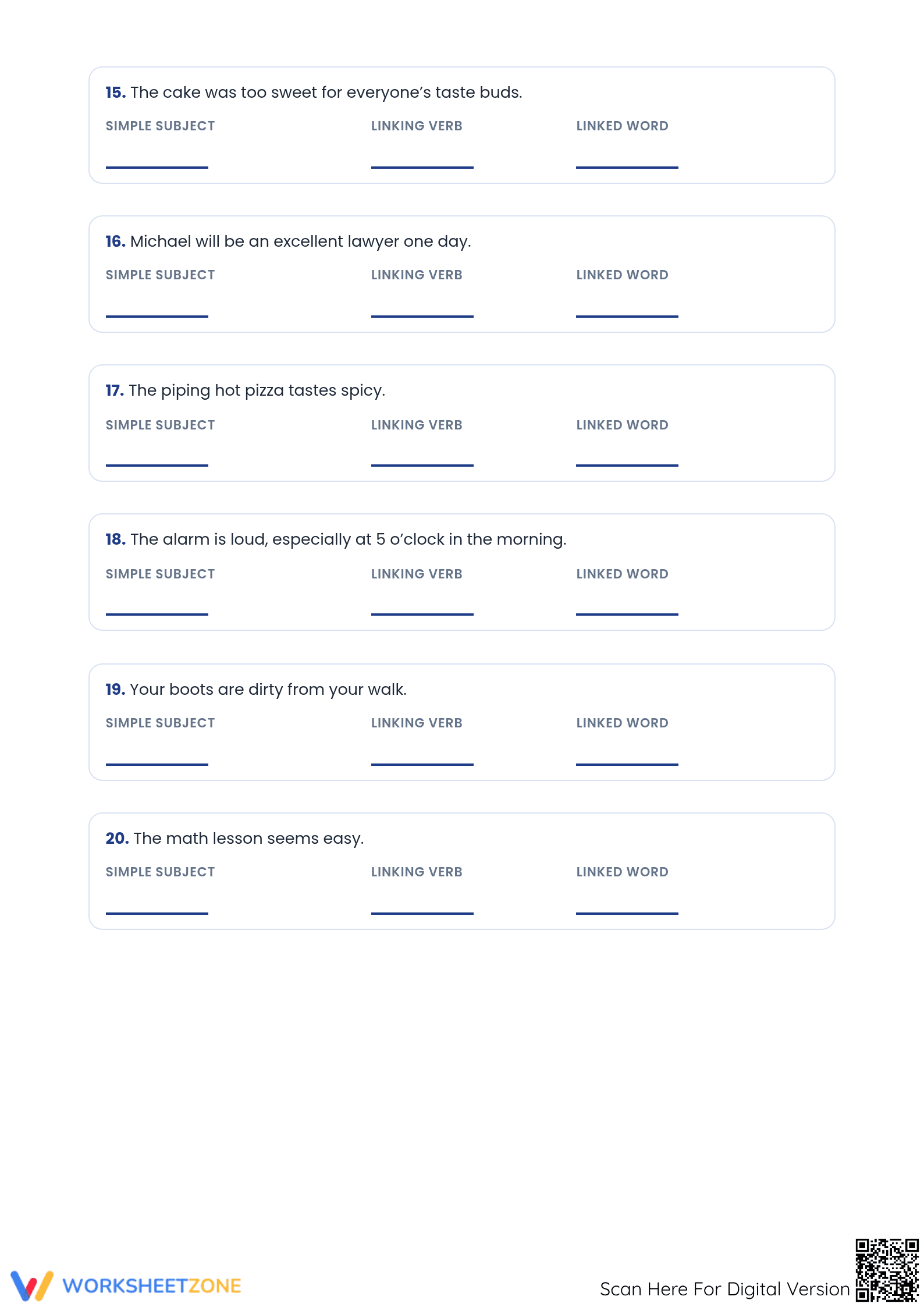
Inside this resource, you will find 20 structured problems divided into three distinct phases of analysis. The first section provides five identification tasks where students isolate the linking verb. The second phase challenges students to differentiate between linking and action verbs using substitution rules. Finally, the third section requires an in-depth analysis of sentence mechanics, asking students to extract the simple subject, the linking verb, and the target complement it describes.
This assessment provides concrete evidence for student mastery of CCSS.ELA-LITERACY.L.5.1. Tasks are categorized by complexity: the initial identification focuses on foundational recognition (Approaching Mastery), while the differentiation section tests conceptual boundaries (Meeting Standards). The final subject-complement analysis section serves as an indicator for exceeding standards, as it requires students to map the entire grammatical arc of the sentence. Results can be easily transcribed into digital gradebooks or used as a baseline for IEP progress monitoring.
Standards alignment focuses on CCSS.ELA-LITERACY.L.5.1, which requires students to demonstrate command of the conventions of standard English grammar and usage. Specifically, this worksheet targets the ability to explain the function of different verb types in sentences. Both standard codes can be copied directly into lesson plans, IEP goals, or district curriculum mapping tools to ensure instructional compliance and vertical alignment across the ELA curriculum.
For optimal results, use this worksheet as a summative check during the "You Do" phase of a gradual release lesson. It serves as an excellent exit ticket after a week of direct instruction on word classes. Teachers should observe students during Section 2 to see if they are applying the "is/are substitution" rule mentioned in the hints. Completion typically takes 15 to 20 minutes depending on prior exposure to sensory linking verbs like "smells" or "tastes."
This resource is specifically designed for general education students in Grades 5 and 6, but it offers excellent scaffolding for ELL students who struggle with auxiliary and state-of-being verbs. It pairs naturally with an anchor chart listing common linking verbs like "was," "were," "seems," and "becomes." The inclusion of clear directions and contextual hints makes it an ideal independent task for literacy centers or a reliable sub-plan activity.
According to the research of Fisher & Frey (2014), the purposeful differentiation between word classes is a critical step in building the syntactic complexity required for academic writing. This worksheet facilitates that growth by isolating 20 specific instances of linking verb usage, allowing students to see the patterns of "subject-link-description" in action. By practicing with the CCSS.ELA-LITERACY.L.5.1 standard in a focused, assessment-driven format, learners move from rote memorization of verb lists to a functional understanding of sentence logic. The progression from simple identification to complex structural analysis ensures that the cognitive load is managed effectively, leading to higher retention rates. This methodical approach to grammar instruction is supported by recent NAEP data suggesting that students who can identify the function of sentence parts are significantly better prepared for high-school level composition. Educators can use these specific problem sets to pinpoint exactly where a student’s understanding of the subject-predicate connection might be breaking down during the writing process.


