


























Views
Plays

Essential Grade 5 Science Vocabulary: Space & Gravity
Paste this activity's link or code into your existing LMS (Google Classroom, Canvas, Teams, Schoology, Moodle, etc.).
Students can open and work on the activity right away, with no student login required.
You'll still be able to track student progress and results from your teacher account.
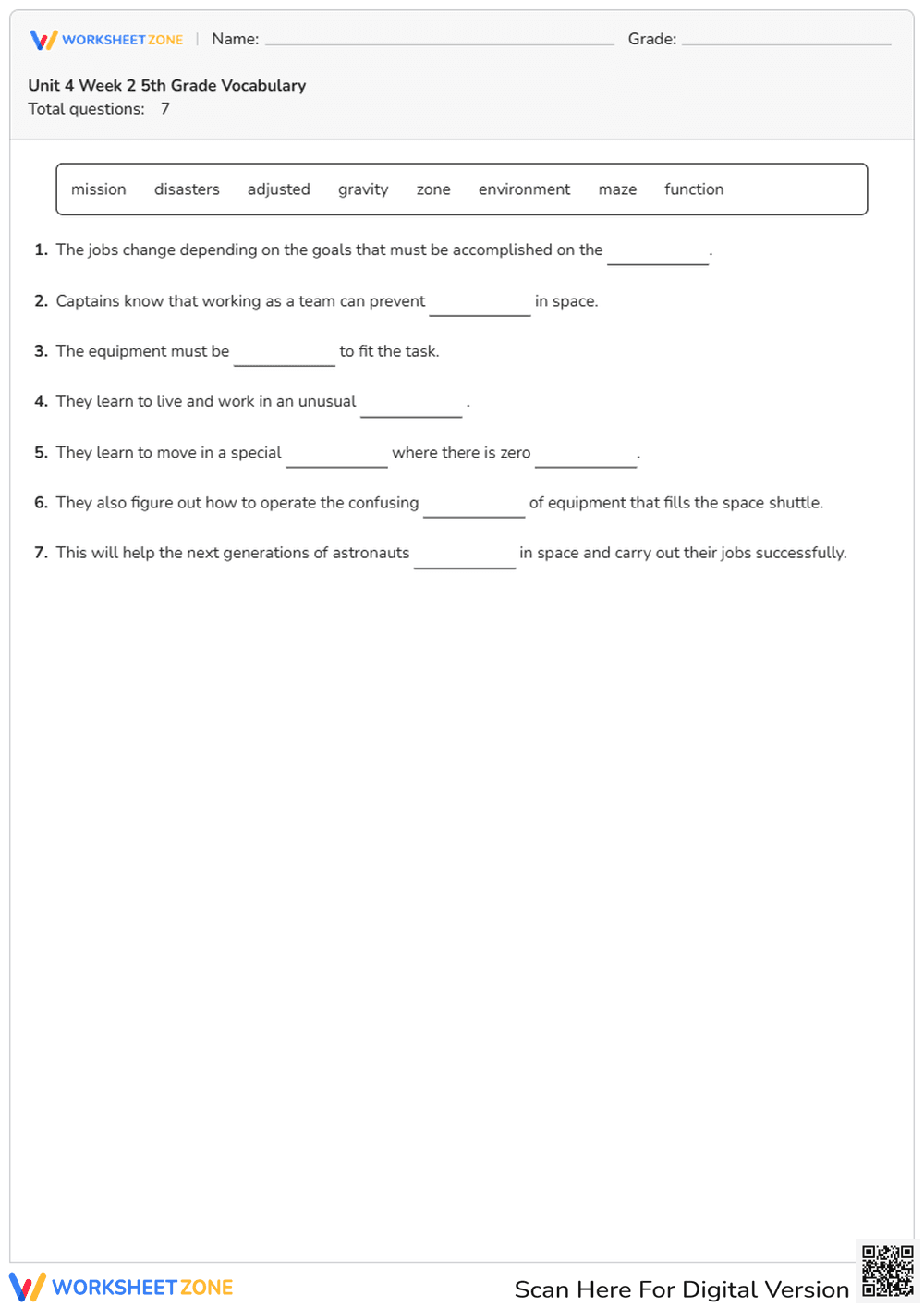
This Grade 5 science vocabulary worksheet helps students master domain-specific terms related to space exploration and gravity. By completing context-based sentences, learners solidify their understanding of technical language used in environmental and physical science units. It provides a clear path for students to demonstrate their comprehension of complex scientific concepts through precise word choice.
At a Glance
- Grade: 5 · Subject: Science
- Standard:
CCSS.ELA-LITERACY.L.5.6— Acquire and use grade-appropriate general academic and domain-specific words and phrases- Skill Focus: Space Science Vocabulary
- Format: 1 page · 7 problems · Answer key included · PDF
- Best For: Quick assessment or science center activity
- Time: 10–15 minutes
The worksheet features a clear word bank containing eight high-frequency science terms, including "gravity," "environment," and "mission." Students encounter seven fill-in-the-blank sentences that provide rich context clues about astronaut life and space shuttle operations. The single-page layout is designed for clarity, featuring a clean font and ample writing space for fifth-grade students.
This resource is designed for a zero-prep classroom workflow. Teachers can print the PDF in less than 30 seconds, distribute it to the class in 1 minute, and review the answers together in under 5 minutes. The self-contained nature of the word bank and sentences makes it an ideal choice for emergency sub plans or morning work, requiring no additional materials or teacher setup.
This resource aligns with CCSS.ELA-LITERACY.L.5.6, focusing on the acquisition of domain-specific words that are foundational to fifth-grade science standards. It also supports NGSS-aligned units on Earth's Place in the Universe by reinforcing the terminology of gravitational forces. Both standard codes can be copied directly into lesson plans, IEP goals, or district curriculum mapping tools.
Use this worksheet as a formative assessment after a lesson on gravity or space missions. It works effectively as a "ticket out the door" to check for vocabulary retention. Teachers should observe if students can identify context clues in sentence 5 to correctly place the word "gravity." Expected completion typically takes 10 to 15 minutes depending on the instructional setting.
This worksheet is for fifth-grade students exploring physical science or environmental units. It is particularly helpful for English Language Learners (ELLs) who benefit from the scaffolded word bank and sentence-level context. Pair this with a short reading passage about the International Space Station or an anchor chart on force and motion for a complete instructional block.
According to the RAND AIRS 2024 report, the integration of domain-specific vocabulary within content-area instruction significantly improves long-term retention of scientific concepts. This worksheet addresses CCSS.ELA-LITERACY.L.5.6 by requiring students to apply words like "gravity" and "environment" within the specific context of space exploration. Research from Fisher & Frey (2014) emphasizes that scaffolded vocabulary practice, such as fill-in-the-blank tasks with word banks, supports the gradual release of responsibility by moving students from recognition to application. By engaging with these 7 targeted tasks, students build the linguistic precision necessary for higher-level scientific inquiry and technical writing. This resource provides a structured environment for learners to bridge the gap between general literacy and specialized science communication. It serves as a reliable tool for educators seeking to meet rigorous standards while maintaining student engagement through relevant, real-world themes in the physical sciences.


