


























Views
Plays



Grade 7 Geometry Unit 4 Study Guide — Printable
Paste this activity's link or code into your existing LMS (Google Classroom, Canvas, Teams, Schoology, Moodle, etc.).
Students can open and work on the activity right away, with no student login required.
You'll still be able to track student progress and results from your teacher account.
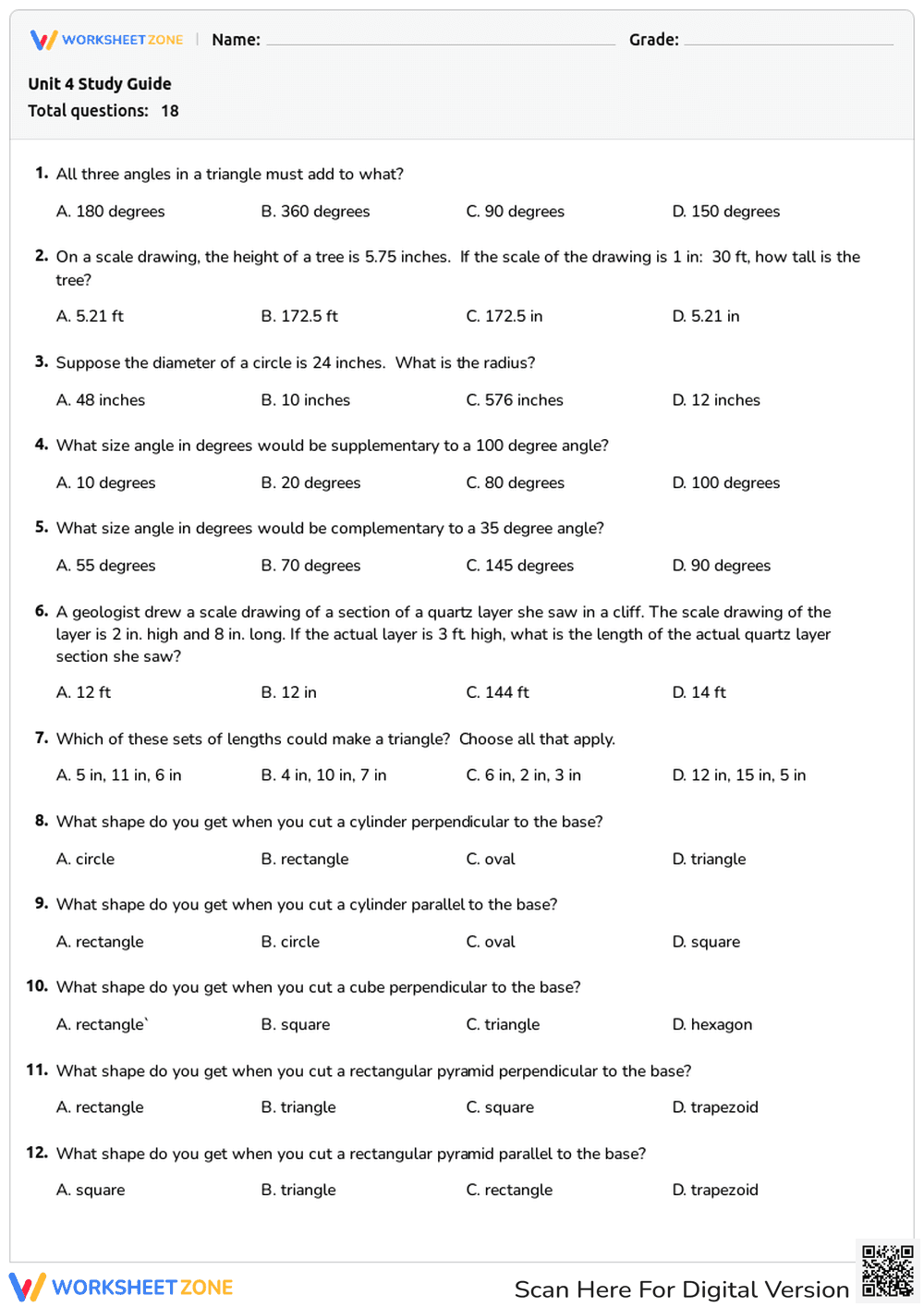
This Grade 7 geometry study guide provides a comprehensive review of essential middle school math concepts. Students solve 18 targeted problems to demonstrate mastery of angle relationships, scale drawings, and three-dimensional geometry. By completing this assessment, learners solidify their understanding of volume and surface area before high-stakes testing.
At a Glance
- Grade: 7 · Subject: Math
- Standard:
CCSS.MATH.CONTENT.7.G.B.6— Solve real-world problems involving area, volume and surface area of objects- Skill Focus: Geometry & Measurement
- Format: 4 pages · 18 problems · Answer key included · PDF
- Best For: Unit review and test preparation
- Time: 45–60 minutes
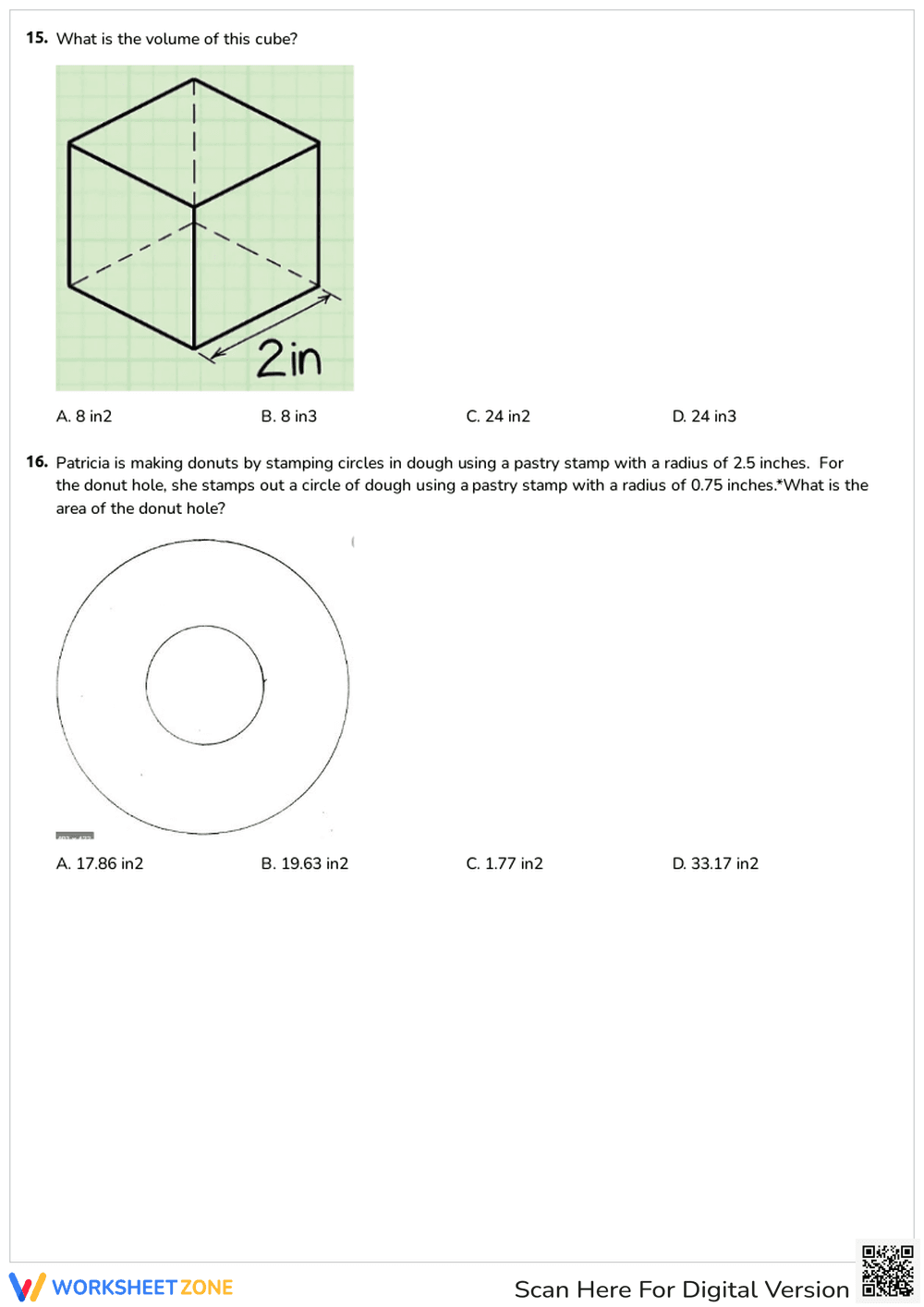
This four-page PDF contains 18 multiple-choice questions designed to mirror standardized test formats. The worksheet features clear diagrams for 3D prisms, cubes, and circular cross-sections. It includes specific tasks for calculating the area of composite shapes, such as a donut hole, and determining the results of slicing cylinders and pyramids. A full answer key is provided for rapid grading.
Zero-Prep Workflow
- Print: Select the 4-page PDF and print enough copies for your class in under 60 seconds.
- Distribute: Hand out the study guide as a silent individual assessment or a collaborative partner activity.
- Review: Use the included answer key to conduct a whole-class review, spending approximately 15 minutes on the most challenging 3D cross-section problems.
Total teacher preparation time is less than two minutes, making this an ideal resource for sub plans or last-minute review sessions.
Standards Alignment
The primary focus is `CCSS.MATH.CONTENT.7.G.B.6`, which requires students to solve real-world and mathematical problems involving area, volume, and surface area of two- and three-dimensional objects. Additionally, it supports `CCSS.MATH.CONTENT.7.G.A.3` by asking students to describe the two-dimensional figures that result from slicing three-dimensional figures. Both standard codes can be copied directly into lesson plans, IEP goals, or district curriculum mapping tools.
How to Use It
Assign this worksheet as a summative review at the end of a geometry unit to identify remaining misconceptions. During the activity, observe how students handle the scale drawing conversion in problem six; this serves as a formative check on their proportional reasoning skills. Expected completion time ranges from 45 to 60 minutes for thorough work.
Who It's For
This resource is ideal for Grade 7 students preparing for state assessments or Grade 8 students requiring a geometry refresher. It pairs naturally with an anchor chart on angle relationships or a direct instruction lesson on 3D cross-sections to support diverse learners.
This Grade 7 geometry study guide aligns with the CCSS.MATH.CONTENT.7.G.B.6 standard, focusing on the application of area, volume, and surface area formulas to solve complex mathematical problems. According to Fisher & Frey (2014), the use of structured study guides supports the gradual release of responsibility by providing students with a scaffolded framework to practice independent problem-solving before summative evaluations. The 18 problems included here cover a broad range of geometric skills, from simple angle identification to multi-step scale factor calculations. Research from EdReports 2024 emphasizes that high-quality curriculum materials must provide balanced practice across all aspects of rigor, including conceptual understanding and procedural fluency. This worksheet meets those criteria by requiring students to visualize 3D slices while performing precise calculations. It serves as a reliable tool for measuring student progress toward middle school geometry mastery.


