


























Views
Downloads
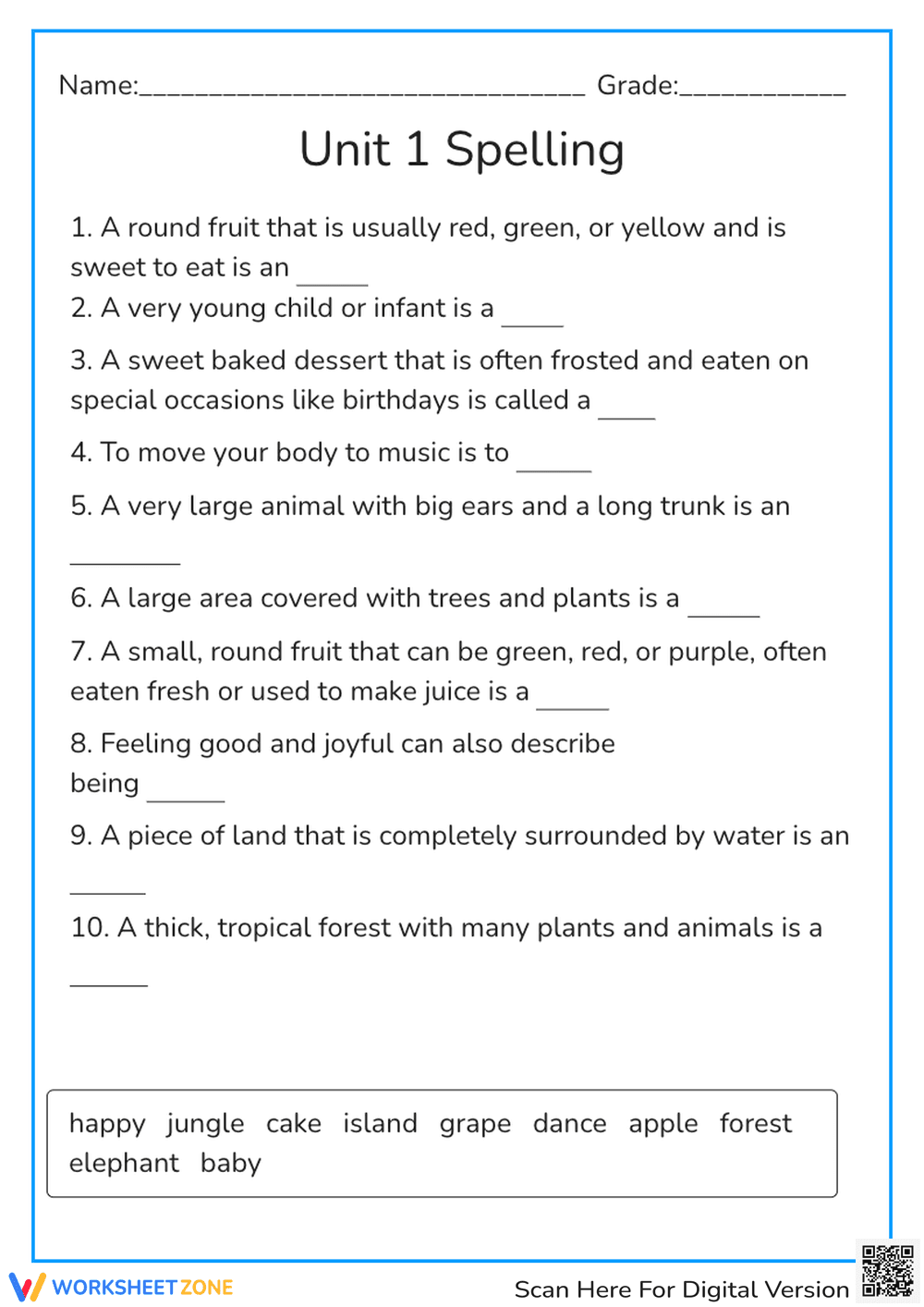

Printable Grade 3 Spelling and Vocabulary Worksheet
Paste this activity's link or code into your existing LMS (Google Classroom, Canvas, Teams, Schoology, Moodle, etc.).
Students can open and work on the activity right away, with no student login required.
You'll still be able to track student progress and results from your teacher account.
This ready-to-use worksheet helps third-grade students build foundational vocabulary and spelling skills by matching clear definitions to target words. By reading descriptive context clues, learners actively reinforce their reading comprehension and word recognition abilities, ensuring they can accurately identify and spell common everyday nouns and adjectives.
At a Glance
- Grade: 3 · Subject: ELA
- Standard:
CCSS.ELA-LITERACY.L.3.4.A— Use context clues to determine word meanings- Skill Focus: Vocabulary and Spelling
- Format: 1 page · 10 problems · Answer key included · PDF
- Best For: Independent practice and review
- Time: 10–15 minutes
Inside this resource, educators will find a single-page fill-in-the-blank activity featuring ten distinct vocabulary questions. Students read a short, descriptive sentence and select the correct matching word from a provided word bank at the bottom of the page. The word bank includes ten target words such as "island," "jungle," and "elephant," providing built-in scaffolding. A complete answer key is included to make grading fast and straightforward.
This resource is designed for a smooth, zero-prep classroom workflow:
- Print (1 minute): Simply download the PDF and print a class set. The black-and-white design is ink-friendly and requires no special formatting.
- Distribute (1 minute): Hand out the worksheet during morning work, literacy centers, or as a quick transition activity. The instructions are self-explanatory.
- Review (3 minutes): Use the included answer key to quickly check student work or project it on the board for self-correction.
Total teacher prep time is under two minutes, making this ideal for emergency sub plans.
This activity is directly aligned to CCSS.ELA-LITERACY.L.3.4.A: Use sentence-level context as a clue to the meaning of a word or phrase. It also supports general spelling conventions for third-grade vocabulary. Both standard codes can be copied directly into lesson plans, IEP goals, or district curriculum mapping tools.
Teachers can use this worksheet during independent literacy centers to reinforce spelling without direct supervision. Alternatively, it serves as an excellent morning work assignment to settle students into the academic day. As a formative assessment tip, observe which students rely heavily on the word bank versus those who can guess the word based solely on the definition before looking down. Expect most third graders to complete this task within 10 to 15 minutes.
This worksheet is primarily designed for third-grade general education students developing their vocabulary and spelling proficiency. The included word bank provides essential differentiation for English Language Learners (ELLs) and students needing additional scaffolding, as it eliminates the frustration of generating words from scratch. It pairs naturally with a direct instruction lesson on using context clues or a reading passage featuring similar descriptive language.
Mastering vocabulary through context is a critical component of early literacy development. According to the RAND AIRS 2024 report on reading comprehension strategies, students who regularly practice matching definitions to target words using sentence-level clues demonstrate significantly higher retention rates in both spelling and reading fluency. This worksheet directly targets CCSS.ELA-LITERACY.L.3.4.A by requiring students to use context clues to determine word meanings. By integrating a word bank, the activity reduces cognitive overload, allowing learners to focus on the semantic relationships between the descriptive sentences and the vocabulary terms. Consistent exposure to this type of structured, definition-based practice builds the automaticity necessary for tackling more complex texts in upper elementary grades, ensuring students develop a robust and flexible academic vocabulary foundation that will serve them across all subject areas.


