


























Views
Downloads

Properties of Water Worksheet | Essential Grade 6-12 Science
Paste this activity's link or code into your existing LMS (Google Classroom, Canvas, Teams, Schoology, Moodle, etc.).
Students can open and work on the activity right away, with no student login required.
You'll still be able to track student progress and results from your teacher account.
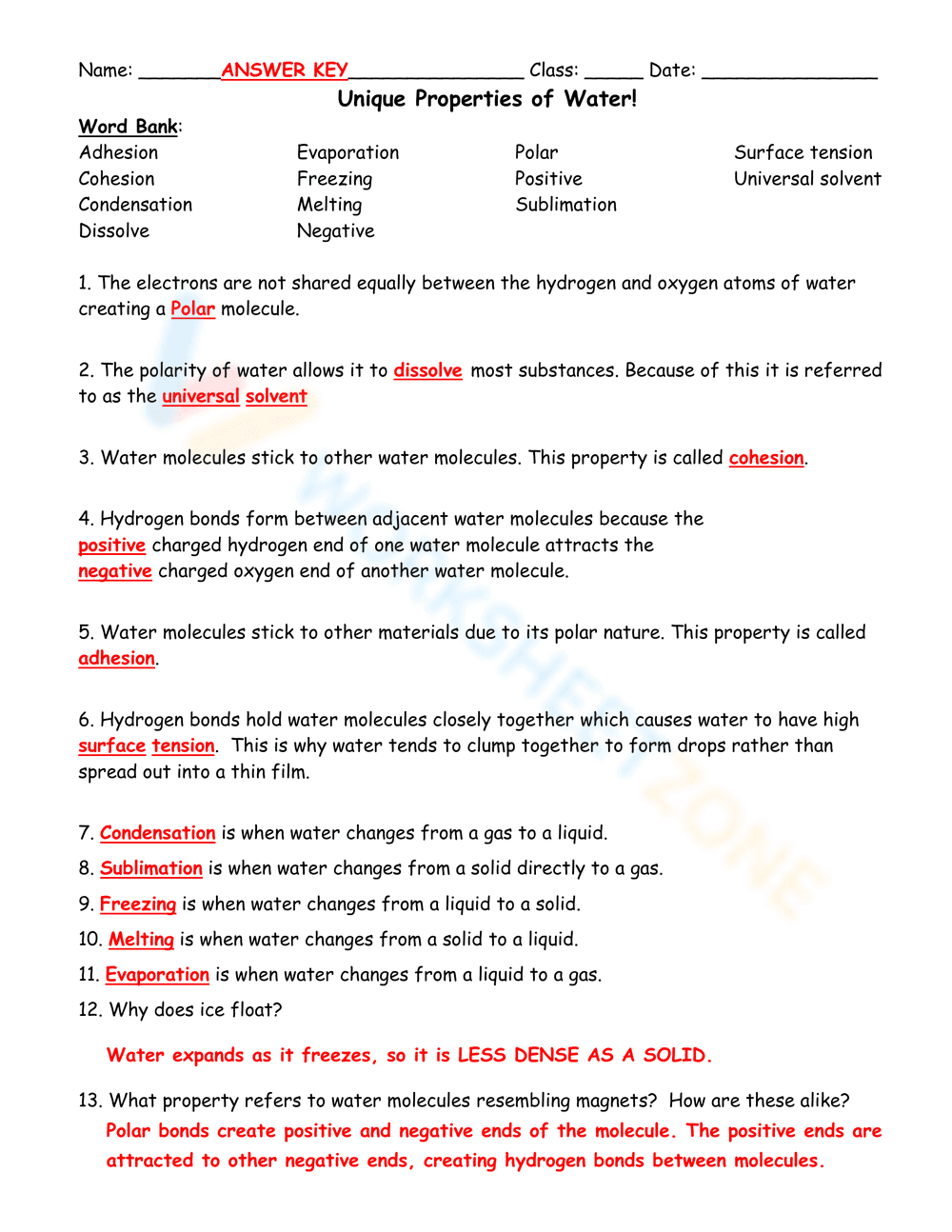
This Grade 6-12 science worksheet provides a comprehensive review of the unique chemical and physical properties of water. Students identify key concepts like polarity, hydrogen bonding, and phase changes to understand how water supports life and shapes the environment. It serves as a high-impact tool for reinforcing vocabulary and conceptual mastery in any secondary science classroom.
At a Glance
- Grade: 6-12 · Subject: Science
- Standard:
MS-PS1-1— Develop models to describe the atomic composition of simple molecules and extended structures- Skill Focus: Molecular Polarity & Phase Changes
- Format: 1 page · 13 problems · Answer key included · PDF
- Best For: Quick review or sub plans
- Time: 15–20 minutes
What's Inside
The resource features a single-page layout containing 13 targeted tasks supported by a 13-term word bank. Students engage with fill-in-the-blank sentences and short-answer questions that define adhesion, cohesion, and surface tension. The worksheet also tracks phase changes from sublimation to condensation. A complete answer key is provided, ensuring that teachers can verify student accuracy instantly without additional research.
Zero-Prep Workflow
- Print: Generate copies of the single-page PDF for your class roster in under 30 seconds.
- Distribute: Hand out the worksheets as a bell-ringer or independent practice activity during the lesson.
- Review: Use the included answer key to facilitate a rapid whole-class review or peer-grading session in 1 minute.
Its self-contained nature makes it an ideal emergency sub plan for middle and high school science teachers.
Standards Alignment
This worksheet aligns with MS-PS1-1, requiring students to understand the atomic composition of molecules. By identifying the positive and negative ends of a water molecule, students demonstrate knowledge of how molecular structure dictates macroscopic properties. Both standard codes can be copied directly into lesson plans, IEP goals, or district curriculum mapping tools.
How to Use It
Use this worksheet during the "Explain" phase of a 5E lesson cycle to solidify definitions after a hands-on lab involving water droplets. It also functions as a formative assessment; observe if students struggle with the distinction between adhesion and cohesion to determine if a mini-lesson on intermolecular forces is required. Expected completion typically takes 15 to 20 minutes.
Who It's For
This resource is tailored for middle and high school students in Earth Science, Biology, or Chemistry. The inclusion of a word bank provides necessary scaffolding for English Language Learners and students with IEPs, while the density and polarity questions offer rigor for general education tracks. Pair this with a molecular modeling kit for a multi-sensory learning experience.
Effective science instruction relies on the integration of vocabulary within conceptual frameworks to build long-term retention. According to the RAND AIRS 2024 report on secondary science literacy, structured practice that links molecular behavior to observable phenomena—such as surface tension and phase changes—significantly improves student performance on standardized assessments. This worksheet addresses the MS-PS1-1 standard by requiring students to describe the polar nature of water and its resulting hydrogen bonds. By utilizing a word bank, the resource reduces cognitive load, allowing learners to focus on the relationships between atoms rather than rote memorization. Research from Fisher & Frey (2014) supports this gradual release of responsibility, where clear definitions and guided tasks lead to independent mastery of complex scientific topics. This 13-task resource provides the necessary repetition for students to internalize the unique properties of water essential for advanced biological and chemical studies.


