




























Views
Downloads
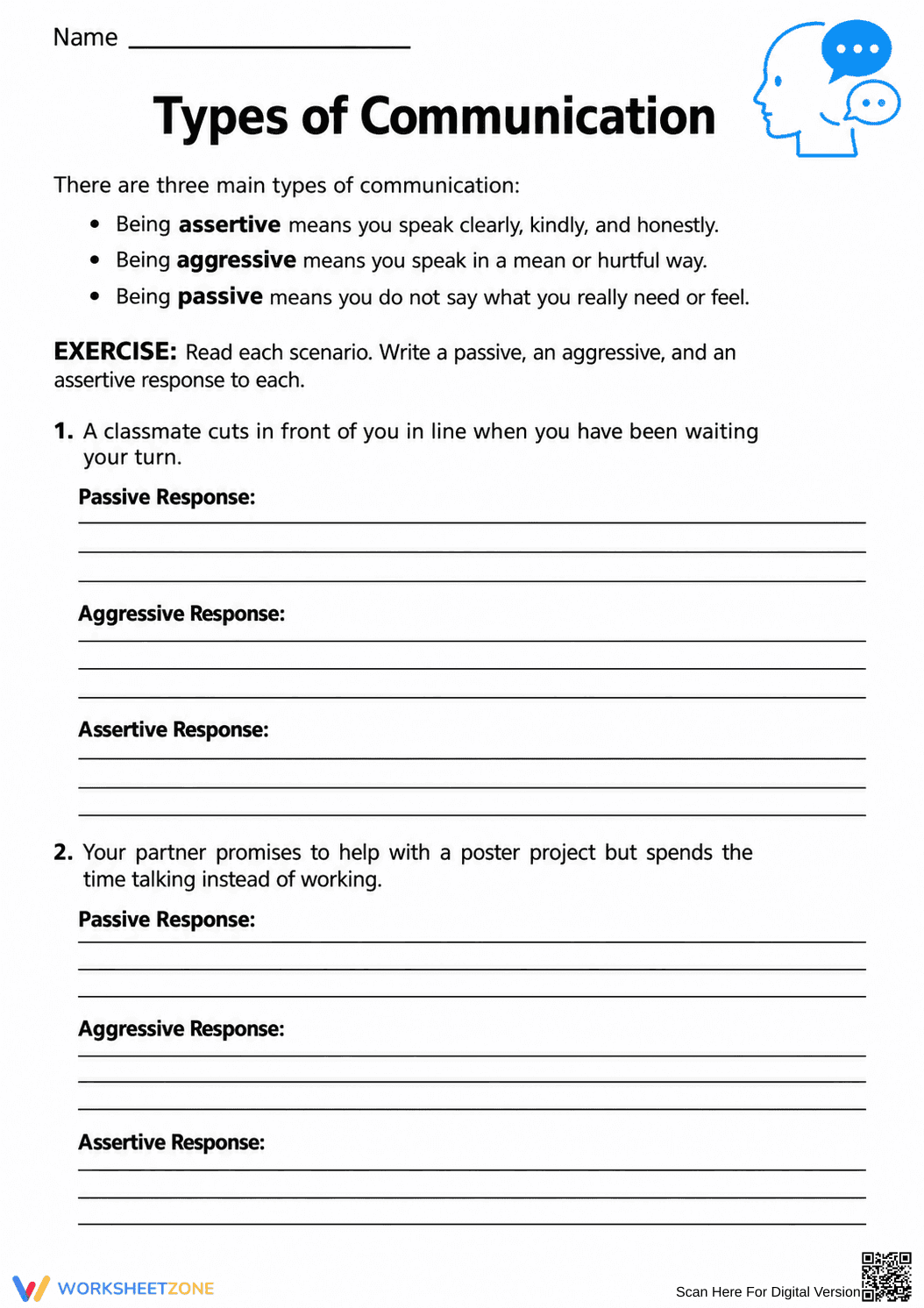

Grade 3 Communication Styles — Printable No-Prep Worksheet

Paste this activity's link or code into your existing LMS (Google Classroom, Canvas, Teams, Schoology, Moodle, etc.).
Students can open and work on the activity right away, with no student login required.
You'll still be able to track student progress and results from your teacher account.
This Grade 3 social-emotional learning worksheet equips students to identify and practice healthy communication styles. By analyzing real-world scenarios, learners differentiate between passive, aggressive, and assertive responses. This targeted practice helps students build emotional intelligence, resolve conflicts effectively, and express their needs clearly in everyday interactions.
At a Glance
- Grade: 3 · Subject: Social Skills
- Standard:
CCSS.ELA-LITERACY.SL.3.1— Express ideas clearly and build on others' communication- Skill Focus: Assertive, aggressive, and passive communication
- Format: 1 page · 6 writing tasks · Open-ended · PDF
- Best For: Independent practice and SEL lessons
- Time: 15–20 minutes
This single-page resource features a clear reference guide defining assertive, aggressive, and passive communication. Students encounter two relatable social scenarios, such as a classmate cutting in line. For each scenario, learners write out three distinct responses, demonstrating their understanding of how each style looks and sounds. The open-ended format encourages critical thinking.
Designed for immediate classroom implementation, this resource requires minimal teacher preparation:
- Print (1 minute): Simply print the single-page PDF for each student. No special materials or extensive background knowledge are required.
- Distribute (1 minute): Hand out the worksheets during morning meeting, an SEL block, or as a meaningful filler activity.
- Review (3 minutes): Briefly read the definitions at the top of the page together, then let students work independently.
With under two minutes of total prep time, this worksheet is an excellent addition to any emergency sub plan or quick social skills intervention.
This activity aligns with CCSS.ELA-LITERACY.SL.3.1, requiring students to engage effectively in collaborative discussions and express their own ideas clearly. By writing out specific responses to peer conflicts, students practice the foundational language skills necessary for productive social interactions. Both standard codes can be copied directly into lesson plans, IEP goals, or district curriculum mapping tools.
Introduce this worksheet during a social-emotional learning block after direct instruction on conflict resolution. Teachers can brainstorm potential responses as a class before students write independently. As a formative assessment observation tip, circulate and note whether students accurately distinguish between assertive and aggressive language in their responses. Expect completion within 15 to 20 minutes.
This resource is primarily designed for third-grade students, though it is highly effective for second through fifth graders working on peer relationship skills. It serves as an excellent tool for school counselors, special education teachers writing IEP progress notes for behavior goals, and general education teachers fostering a positive classroom community. Pair this worksheet with role-playing activities where students act out the assertive responses they wrote down.
Developing strong interpersonal skills in elementary school is a critical component of long-term academic and social success. This worksheet targets CCSS.ELA-LITERACY.SL.3.1, helping students express ideas clearly and build on others' communication through structured scenario analysis. According to a RAND AIRS 2024 report, explicit instruction in social-emotional competencies, such as distinguishing between passive, aggressive, and assertive communication, significantly reduces classroom behavioral incidents and improves overall student well-being. By requiring learners to draft specific responses to common peer conflicts, this resource bridges the gap between theoretical understanding and practical application. Students who regularly practice assertive communication are better equipped to advocate for their needs, establish healthy boundaries, and navigate complex social dynamics without resorting to aggression or withdrawal. This targeted practice lays the groundwork for a supportive, communicative classroom environment.


